
A 12-week gait retraining programme left knee and whole-body motion more regular and more stable than an abrupt switch of footstrike. The same gait retraining period, however, came with higher vertical loading rates than the first few minutes of the change.
Gait retraining over 12 weeks produced steadier running mechanics than an immediate change of footstrike, according to a study published in the Journal of Sports Science and Medicine on 1 September 2026.
The work was led by Kaicheng Wu and colleagues at the Key Laboratory of Exercise and Health Sciences of the Ministry of Education at Shanghai University of Sport, with co-authors at Central South University, Ningbo University and the Li Ning Sports Science Research Center. Weijie Fu was the corresponding author.
Thirty-three male recreational runners enrolled. The analysis compared three states: habitual rearfoot strikers during their first acute attempt at a non-rearfoot strike, the same runners after 12 weeks of structured retraining, and a separate group of runners who already landed on the forefoot or midfoot by habit.
Thirteen rearfoot strikers completed both assessments, alongside 14 habitual non-rearfoot strikers. The authors reported that 11 runners with observations in both conditions were needed for 80 percent power, so the analysed sample met that threshold with little margin.
At a Glance
- Published online in the Journal of Sports Science and Medicine on 1 September 2026, volume 25, pages 822 to 837.
- Thirty-three male recreational runners enrolled; 13 rearfoot strikers and 14 habitual non-rearfoot strikers were analysed.
- Mean age was about 34 years in both groups, with body mass near 70 kg.
- The gait retraining programme ran 12 weeks and used minimalist shoes with progressively increasing mileage.
- Foot-strike angle was 4.52 degrees higher after retraining than during the acute switch.
- Vertical instantaneous loading rate was 17.32 body weights per second higher after retraining, and average loading rate 14.93 higher.
- Main caveat: only male runners, a small analysed sample, and no follow-up after the programme ended.
How the Gait Retraining Study Was Run
Runners who habitually land heel-first were measured twice. The first measurement captured the acute state, in which they were asked to adopt a non-rearfoot strike with no preparation. The second came after the 12-week programme, which used minimalist footwear and raised minimalist-shoe mileage gradually rather than switching outright.
Attrition shaped the final sample. Two runners stopped because of triceps surae soreness, one was excluded for not following the protocol, and three never converted to a non-rearfoot strike at all. Nineteen rearfoot strikers started; 13 supplied usable paired data for the gait retraining comparison.
Why Footstrike Became a Gait Retraining Target
Heel-first landing produces a sharp early rise in vertical force, and that spike has long been linked in the literature to impact-related running injury. Moving the landing forward lowers the spike, which is why footstrike has been such a popular gait retraining target among recreational runners.
The catch is that the calf, Achilles tendon and foot take on more work once the heel stops arriving first. That trade-off is why researchers keep testing how a gait retraining transition should be paced, rather than whether the end position is theoretically preferable.
What the Acute Switch Looked Like
Asked to change footstrike on the spot, the runners overshot. Their landing was the most anterior of the three states measured, and their vertical loading rates were the lowest. On the surface that looks like the ideal outcome, since high loading rates have long been treated as a marker of impact stress.
The nonlinear measures told a different story. Knee joint motion in the sagittal plane was less regular and less locally stable in the acute state than in either of the other two, which is consistent with a movement pattern being improvised rather than owned.
How much higher the foot-strike angle was after 12 weeks of gait retraining than during the runners first acute attempt at a non-rearfoot strike.
Where Gait Retraining Shifted the Pattern
After the gait retraining programme, the knee moved more regularly and more stably than in the acute state. Sample entropy for sagittal knee motion fell by 0.02 and the largest Lyapunov exponent by 0.18, both statistically significant after adjustment. Vertical centre-of-mass motion was also more stable, by 0.14.
Lower values on both measures mean steadier, more repeatable movement. In other words, the benefit of gait retraining showed up less in the headline kinematics than in how consistently the runners executed the new pattern, stride after stride.
Why Loading Rates Rose Instead of Falling
This is the result most likely to be misread. Vertical instantaneous loading rate was 17.32 body weights per second higher after retraining than in the acute state, and vertical average loading rate 14.93 higher. Both differences were significant.
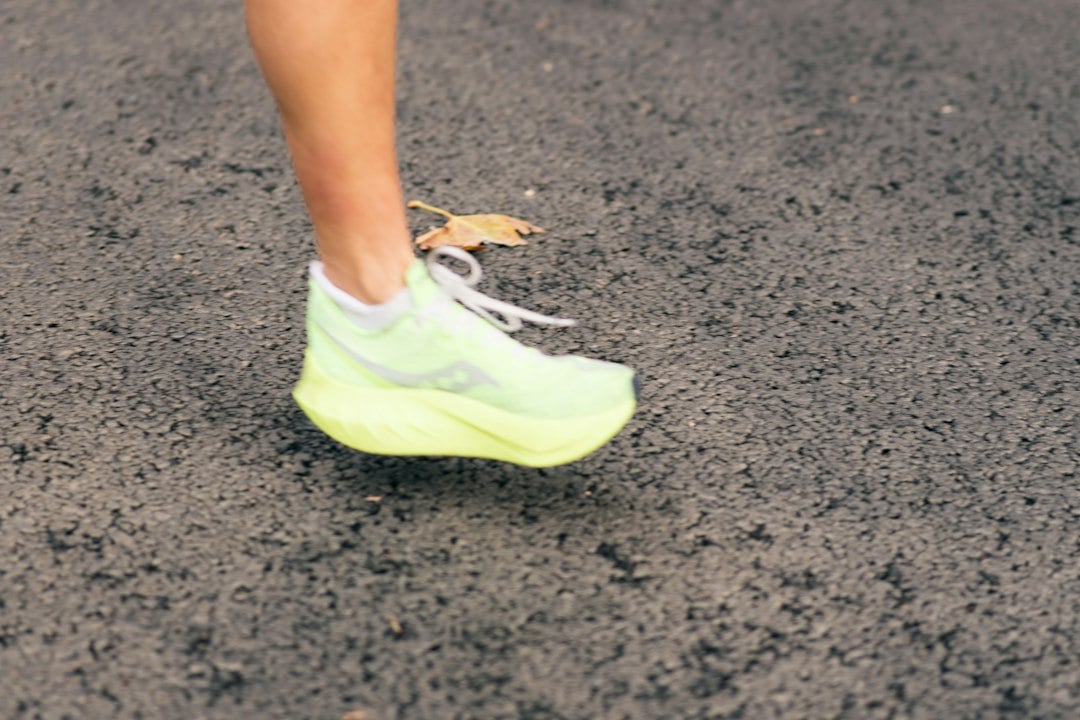
The likely explanation sits in the foot-strike angle. During the acute attempt the runners landed furthest forward on the foot, which lowers the initial impact peak. Over 12 weeks of gait retraining the landing drifted back towards a flatter position, closer to something sustainable, and loading rates climbed with it.
Regularity and Stability, Explained
Sample entropy asks how predictable a movement signal is from one cycle to the next. The largest Lyapunov exponent asks how quickly small deviations grow, which is a way of describing how tolerant a pattern is of perturbation. Neither is a conventional biomechanical variable.
Both were included because the usual measures, such as joint angles and peak forces, were largely similar across the three states. Without the nonlinear analysis, the gait retraining programme would have looked like it changed almost nothing.
How Close to a Lifelong Forefoot Striker
Not all the way. The habitual non-rearfoot strikers were more regular and more stable still: their sagittal knee sample entropy was 0.05 lower and their Lyapunov exponent 0.38 lower than the acute state, both larger gaps than retraining achieved. Their foot-strike angle sat 2.95 degrees above the acute condition.
Twelve weeks of gait retraining therefore moved the rearfoot strikers towards, but not into, the pattern of runners who had always landed that way. The authors conclude that a gradual programme of this kind may be an appropriate way to make the transition.
What 13 Runners Can and Cannot Settle
The sample is small and entirely male, and the study design compared states rather than randomising runners to competing programmes. It also included strengthening work alongside the footwear progression, so the gait retraining effect cannot be separated from the strength component.
Related FLM reporting gives useful context. A review found that hip and core exercise reduced navicular drop in flexible flatfoot, another study measured higher lung function in marathon runners than in untrained men, and work on neuromuscular fatigue and rowing kinematics showed how quickly technique shifts once fatigue sets in.
Environment matters too. FLM has reported that higher nitrogen dioxide was linked to slower marathon finish times, a reminder that mechanics are only one input into how a run actually goes.
Where This Research Goes Next
Three gaps stand out. The study measured mechanics rather than outcomes, so whether steadier movement lowers injury risk is untouched. It enrolled only men. And it stopped measuring on the day the programme ended, which leaves retention unknown.
A randomised comparison of paced gait retraining against an abrupt switch, followed long enough to count injuries, would settle far more than a state-to-state comparison can. Until that study exists, the careful reading of this gait retraining work is that gradual change produces a more consistent pattern, not that it demonstrably protects anyone.
What This Means for Runners
The practical reading is narrow but real. If a runner has a reason to change footstrike, doing it through gradual gait retraining appears to produce a more settled movement pattern than switching in a single session, even though the loading-rate numbers look worse on paper.
It does not follow that anyone should change footstrike. The study enrolled healthy recreational runners and measured mechanics, not injuries, pain or race times. General points worth holding on to include the following.
- Three of 19 runners never managed the switch at all, so conversion is not guaranteed.
- Two withdrew with calf soreness, which is the classic cost of loading the calf and Achilles differently.
- A single flattering variable, such as a low loading rate, does not establish that a pattern is sound.
Anyone carrying a current injury, or considering minimalist footwear after years in cushioned shoes, is better served by a clinician or coach who can watch them run than by a general rule.
The Fitness Living Takeaway
Twelve weeks of gradual gait retraining left 13 male runners with more regular, more locally stable knee and whole-body motion than an abrupt change of footstrike, while vertical loading rates rose rather than fell.
The sample was small, male only, and followed no further than the end of the programme, and injuries were never measured. What the study does usefully show is that the smoothest-looking impact numbers can come from the least settled movement, and that patience buys consistency. Whether that consistency reduces injury risk is still an open question.
Research & Sources
- Journal of Sports Science and Medicine: movement regularity and stability in retrained non-rearfoot-strike running
- Journal of Sports Science and Medicine: current issue, volume 25 issue 3
- Journal reference: Journal of Sports Science and Medicine, 25(3), 822 to 837, DOI 10.52082/jssm.2026.822.
- Images: Roman / Unsplash; Taylor Friehl / Unsplash
This article summarizes peer-reviewed research for general information and is not individualized medical or exercise advice.