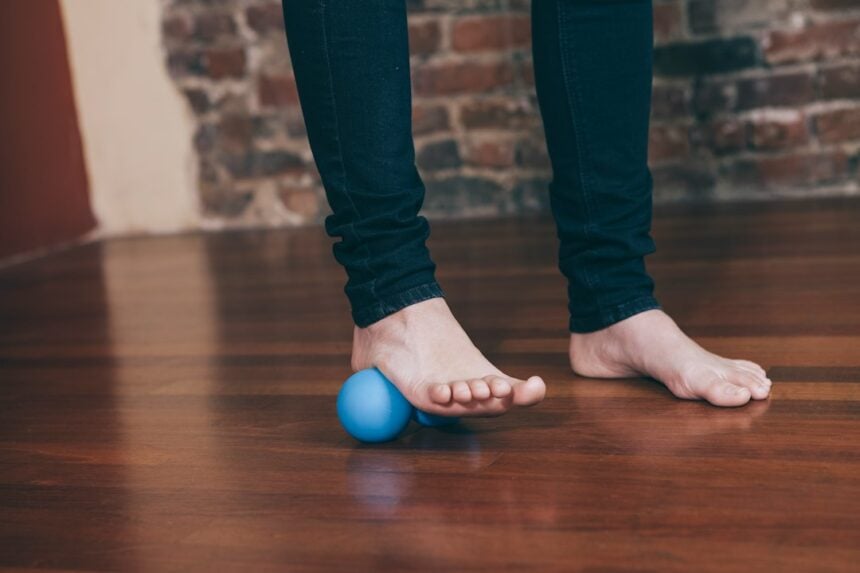
A new systematic review pooled 14 randomized trials to ask whether adding hip and core exercise to foot work changes the arch in flexible flatfoot. The answer was a small, low-certainty drop in navicular height and almost nothing else that held up.
Flexible flatfoot is one of the most common reasons an adult walks out of a clinic holding a sheet of foot exercises, and a review published on October 12, 2026 in Frontiers in Physiology tested whether those sheets should reach further up the leg. Researchers at Hebei University of Engineering and Guangxi Minzu University pooled randomized trials comparing exercise programmes that included proximal kinetic-chain components, meaning hip, gluteal or trunk work, against local foot and ankle exercise alone.
The review was registered with PROSPERO as CRD420261455079 and searched four databases through July 19, 2026. Fourteen randomized trials, reported across 15 publications, met the inclusion criteria, and 13 of them contributed data to at least one meta-analysis. Results were pooled with random-effects models, risk of bias was judged with RoB 2, and certainty was rated with GRADE.
The primary structural outcome was navicular drop, a tape-measure estimate of how far the inner arch collapses when a person stands. Across 11 trials and 410 participants, programmes that added proximal work reduced navicular drop by a mean of 2.34 mm, with a 95% confidence interval running from 3.30 mm to 1.37 mm.
That was the only outcome the authors were willing to treat as probable, and even then the certainty was rated low. Heterogeneity across those 11 trials reached an I-squared of 84.6%, meaning the trials disagreed with each other far more than chance alone would explain. Every other measure in the flexible flatfoot analysis crossed the line of no effect.
At a Glance
- Published October 12, 2026 in Frontiers in Physiology, Exercise Physiology section, volume 17; DOI 10.3389/fphys.2026.1959545.
- Fourteen randomized trials across 15 publications; 13 trials contributed to at least one pooled estimate.
- Navicular drop fell by 2.34 mm with added proximal work across 11 trials and 410 participants, 95% CI 3.30 to 1.37 mm.
- The Foot Posture Index shifted 1.67 points across 4 trials and 157 participants, 95% CI 3.36 to 0.01, an interval that includes no effect.
- Three directions of Y-Balance reach, each drawn from only two trials, all produced intervals spanning zero.
- Heterogeneity ran high throughout, from 84.6% for navicular drop to 96.5% for the exploratory Plantar Arch Index.
- Certainty was rated low, and only two of the 14 trials documented a flexibility test to confirm flexible flatfoot.
What Proximal Kinetic-Chain Work Means in a Flexible Flatfoot Programme
Flexible flatfoot rehabilitation has historically stayed below the ankle: short-foot exercises, toe curls, heel raises, arch doming. The trials gathered here tested a different premise, that the hip governs how the leg rotates over the foot, and therefore how the arch is loaded during standing and walking.
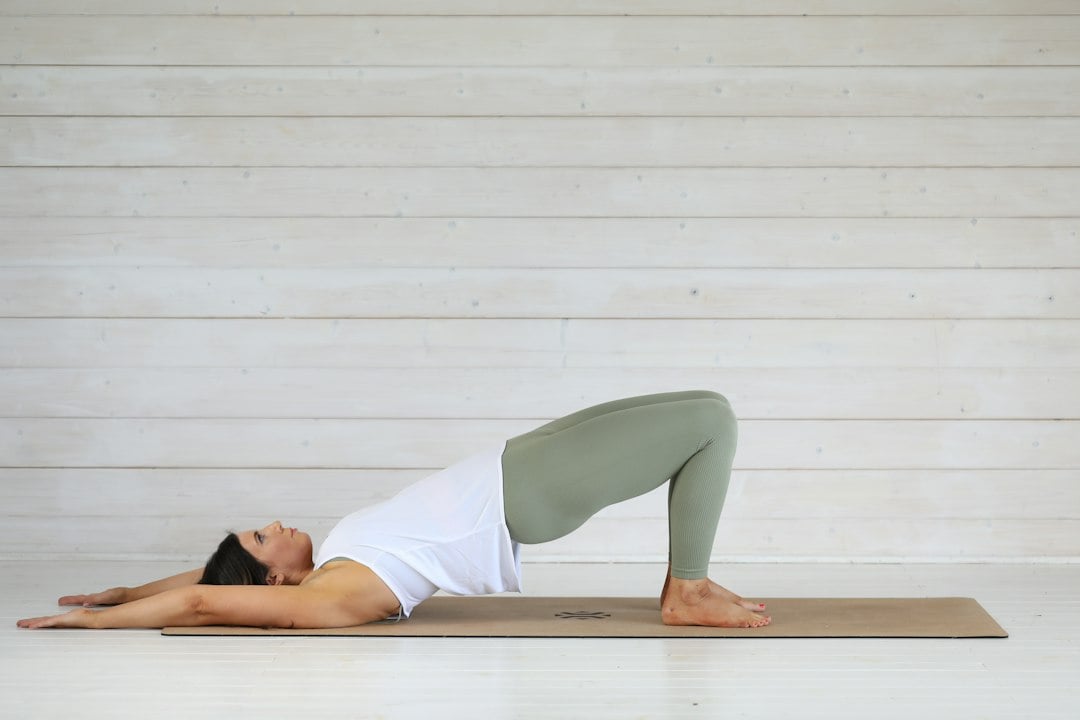
Programmes in the proximal arm layered hip abductor and external rotator work, gluteal strengthening or trunk control drills on top of foot exercise. Comparison arms kept the foot work alone or received basic care. Session counts, supervision and progression varied widely, and the review notes that many interventions bundled several components at once.
The 2.34 mm That Survived Every Sensitivity Check
A 2.34 mm reduction sounds trivial until it is set against the measure itself, where a standing arch commonly drops somewhere between 5 and 12 mm. The pooled effect is a fraction of that range. What gives it weight is consistency: it moved in the same direction in every restricted analysis the authors ran.
When the pool was limited to comparisons in which both arms were matched for exercise components, the effect narrowed to 1.88 mm across 5 trials and 172 participants, with a 95% confidence interval from 3.09 to 0.68 mm. Excluding unmatched multicomponent comparisons gave 1.99 mm across 9 trials and 333 participants, interval 2.95 to 1.04 mm.
Those are post hoc restrictions rather than planned subgroup tests, and the authors state plainly that no formal interaction test was performed. Consistency is reassuring; it is not confirmation. Heterogeneity stayed near 80% in both restricted pools.
The pooled reduction in standing navicular drop when hip and core work was added to foot exercise, across 11 randomized trials and 410 participants with flexible flatfoot.
Where the Flexible Flatfoot Numbers Stopped Being Convincing
The Foot Posture Index, a six-item visual scoring system used widely in clinics, shifted by 1.67 points in favour of the proximal programmes across 4 trials and 157 participants. Its 95% confidence interval ran from 3.36 to 0.01, which means the data are compatible with a meaningful change and with no change at all.
An exploratory Plantar Arch Index analysis drawn from two trials produced a mean difference of 0.134, an interval from 0.278 to 0.009, and an I-squared of 96.5%. Two trials cannot carry that much disagreement. The authors treat it as a prompt for further study rather than a finding.
Dynamic balance fared no better. Y-Balance reach gave a Hedges g of 0.43 in the anterior direction, 0.78 posteromedially and 0.66 posterolaterally, each from two trials, and every interval crossed zero. Functional, patient-reported, adherence and adverse-event outcomes were reported too rarely to pool at all.
Heterogeneity Was the Story, Not a Footnote
I-squared values of 84.6%, 89.1% and 96.5% are not background noise. They indicate that the pooled flexible flatfoot trials were effectively answering slightly different questions, with different populations, different dose, different supervision and different measurement technique.
Navicular drop is taken by hand, with a ruler and a marked bony landmark, and its reliability depends on the examiner. When pooled trials use different examiners, different foot positions and different definitions of a neutral foot, a 2.34 mm difference can be part technique and part physiology. This review cannot separate the two.
The Diagnosis Problem Sitting Under the Whole Review
Flexible flatfoot is defined by what the arch does when load comes off it: the arch reappears when the person sits, rises onto the toes or extends the great toe. A rigid flatfoot does not. That distinction decides whether exercise is even a reasonable treatment to attempt.
Only two of the 14 trials explicitly reported a flexibility test. The authors are direct about it, noting that diagnostic verification remained limited and that only two trials reported flexibility testing. Some participants in the pooled population may not have had flexible flatfoot at all.
Participants also skewed young, and some were asymptomatic, recruited because an arch looked low rather than because anything hurt. Follow-up ran 4 to 12 weeks. Nothing in this evidence speaks to an adult who has lived with a painful flexible flatfoot for twenty years.
What a Millimetre of Arch Height Means on a Clinic Floor
Structural measures are proxies. People care about pain, standing tolerance, shoe fit and whether they can walk a city block without their shins complaining. This flexible flatfoot review found that functional, patient-reported, adherence and adverse-event outcomes were recorded too rarely to analyse.
That gap matters more than the 2.34 mm. A flexible flatfoot programme could lift the arch slightly and change nothing a person notices, or change how someone feels without moving the navicular at all. These trials were not designed to tell those two outcomes apart.
Four additional reports could not be retrieved, which the authors flag as a possible source of availability bias. Combined with bundled interventions and incomplete reporting of dose, progression and supervision, that makes attributing the effect specifically to the proximal component difficult.
What This Means If You Have Been Handed Foot Exercises
Nothing here argues against foot exercise, and nothing promises that hip work will fix a low arch. It does suggest that a flexible flatfoot programme built entirely below the ankle may be leaving a plausible lever untouched. General, non-individualized points worth raising with a clinician:
- Ask whether your flatfoot has actually been confirmed as flexible, because that shapes every treatment decision that follows.
- Expect any arch change from exercise to be small and slow, measured across weeks rather than days.
- Judge progress by symptoms and function, not by how the arch looks in a mirror.
- Hip and trunk work is low risk for most healthy adults and carries benefits well beyond the foot.
- Treat hip and trunk strengthening as an addition to a flexible flatfoot routine rather than a replacement for foot work.
- Persistent foot pain, numbness or a sudden change in arch shape warrants assessment rather than a new exercise sheet.
Readers following how exercise evidence gets weighted elsewhere on this site will recognise the same tension in our coverage of lengthening exercise and hamstring return-to-play timelines, where the pooled effect was far larger but certainty still set the ceiling. Balance outcomes carry a similar caveat in the trial of slackline training for trunk endurance and sprint speed, where a measurable change arrived without a clear mechanism.
The distance between a measurable change and a change that matters also runs through reactive balance training that improved stepping without reducing falls and through a review of upper-limb bone health in 1,880 women rated very low certainty. Measured against those, flexible flatfoot research is still early.
The Fitness Living Takeaway
Adding hip, gluteal and trunk work to foot exercise reduced standing navicular drop by a pooled 2.34 mm across 11 randomized trials and 410 participants, with certainty rated low.
Every other outcome the reviewers examined, from the Foot Posture Index to three directions of dynamic balance reach, produced confidence intervals compatible with no effect. Heterogeneity was high, most trials never confirmed the flatfoot was flexible, and follow-up stopped at 12 weeks. Treat this as a reasonable direction for flexible flatfoot programmes rather than a settled prescription.
Research & Sources
- Frontiers in Physiology: Exercise programmes incorporating proximal kinetic-chain components in flexible flatfoot
- Study DOI
- Images: RAD Roller / Unsplash; Margaret Young / Unsplash
This article summarizes peer-reviewed research for general information and is not individualized medical or exercise advice.