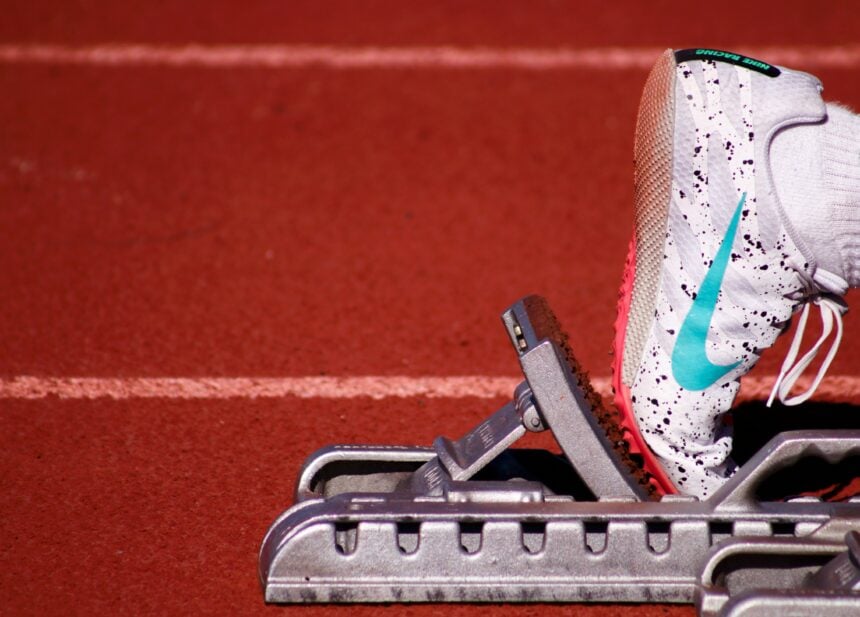
Eighteen novice runners sprinted 60 meters in sprint spikes and again in their own trainers, and the spikes were 1.7 percent faster. Modelled knee joint forces were about 10.8 percent of body weight higher in the same shoes.
Sprint Spikes made beginners measurably faster and loaded their knees harder in the same session, according to a within-subject study published on 12 November 2026 in the German Journal of Exercise and Sport Research. The trade-off appeared in a group of 18 novices who had little or no track experience before the test.
Most footwear research recruits trained sprinters, which is the gap the authors set out to fill. Meike Gerlach, Myriam Lauren de Graaf, Kim Joris Bostroem and Heiko Wagner ran the study, with Wagner based at the Center for Data Science and Complexity at the University of Muenster in Germany.
The sample was nine women, aged 20.8 years on average, and nine men, aged 21.1 years. Entry required at least two hours of exercise a week and little to no track and field background, so none of them had trained in spiked shoes. Each ran six maximal 60 meter sprints from a standing start, three in sprint spikes and three in their own running shoes, with the order alternated.
Times came from timing gates. Full-body motion was captured with an Xsens suit and fed into a musculoskeletal model that estimated joint contact forces at the hip, knee and ankle. Results were analysed with generalised linear mixed models, which keeps each runner as their own comparison.
At a Glance
- Published 12 November 2026 in the German Journal of Exercise and Sport Research, DOI 10.1007/s12662-026-01172-y.
- 18 novices, nine female and nine male, each running three 60 meter sprints in sprint spikes and three in their own trainers.
- Sprint times were 1.7 percent faster in spikes overall; 0.9 percent faster for women, 2.7 percent for men.
- Knee joint contact forces rose by 10.8 percent of body weight in spikes; 9.1 percent for women, 12.4 percent for men.
- Hip and ankle joint forces showed no significant difference between the two shoes.
- Joint forces were estimated by a musculoskeletal model, not measured directly.
- Main caveat: the authors note the small sample of 18 limits how far the findings generalise.
The Speed Gain Was Real but Uneven
Across the group, sprint times fell 1.7 percent in spikes. Split by sex, the gap widened: women improved 0.9 percent, with F equal to 9.74 and p equal to 0.002, while men improved 2.7 percent, with F equal to 49.91 and p below 0.001.
A 2.7 percent improvement over 60 meters is not trivial for someone who has never worn the shoes. It also means the men in this group converted the footwear into speed roughly three times as effectively as the women did, and the study does not explain why.
With nine runners per group, that split is a lead rather than a conclusion. Differences in top speed, mass or how readily a beginner tolerates a stiff plate could all shape how much sprint spikes give back, and none of those were isolated here.
Where the Extra Load Landed
Only one joint changed. Estimated knee joint contact forces rose by 10.8 percent of body weight in sprint spikes, with women at 9.1 percent and men at 12.4 percent. Both splits were statistically clear, with p equal to 0.004 for women and below 0.001 for men.
The hip and ankle did not follow. Hip forces returned p values of 0.670 for women and 0.904 for men, and the ankle 0.649 and 0.232. For a shoe that changes the foot and ankle so visibly, that pattern is the surprise: the load showed up a joint higher.
Joint contact force is the compression passing through the joint itself, muscle tension included, which is why it is reported as a multiple of body weight. An extra 10.8 percent of body weight through the knee of a 70 kilogram runner is roughly another 7.5 kilograms of compression, repeated every stride.
The rise in estimated knee joint contact force, expressed as a share of body weight, when novices ran in sprint spikes rather than their own trainers.
Why Spikes Change the Leg at All
A spike plate is stiff and the heel sits low, which holds the foot closer to a sprinting posture and limits how much the ankle can give. Less travel at the ankle has to go somewhere, and the knee is the next joint in line.
That reading fits earlier footwear work. A study of 31 runners found that shoe bending stiffness increased estimated Achilles tendon load, another case where a stiffer shoe moved force rather than removing it.
The grip matters as much as the plate. Sprint spikes bite into the track, so less of each push slips away, and the leg can apply force into a surface that holds. That is where the speed comes from, and it is also why the limb has to absorb more on the way back down.
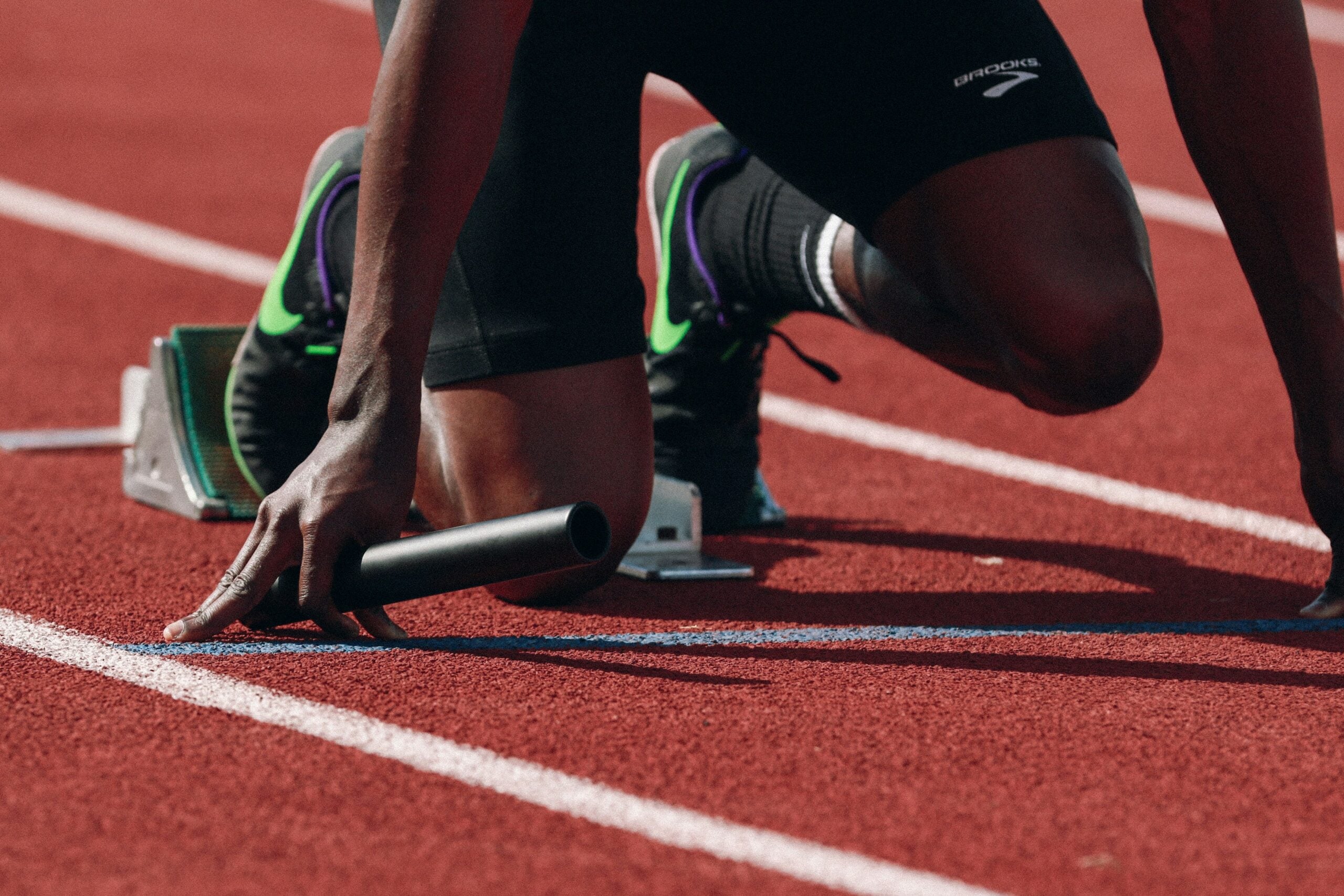
Why Testing Sprint Spikes in Novices Matters
Trained sprinters have spent years in spiked shoes, so their legs have already adapted to them. Testing sprint spikes in people who have never used them isolates the shoe’s immediate effect, before any adaptation can blur it.
That design choice is also the practical one. Beginners are exactly the group that buys a first pair of sprint spikes on a recommendation and uses them for a full session, and they are the group with the least information about what the shoes do to their joints.
How It Sits With Other Performance Margins
A 1.7 percent change is the size of effect that shows up all over sprint research. A trial of female athletes found caffeine made 30-meter sprints about 1.5 percent faster, which is the same order of magnitude from a completely different intervention.
The loading half has company too. Twelve weeks of gait retraining steadied running motion but raised loading rates, and work on 31 professional players showed that strength asymmetry did not track landing force asymmetry. Changes meant to help one variable regularly move another.
What the Sprint Spikes Question Still Needs
The obvious next study is longer. A single session can show that sprint spikes shift load to the knee, but only repeated exposure over weeks would show whether that load becomes an injury risk or something the knee adapts to.
A larger and mixed-ability sample would help as well, along with a standardised control shoe instead of whatever trainers participants owned. Direct force measurement, rather than a model estimate, would put the knee figure on firmer ground.
What Runners Can Take From This
If you are new to track and thinking about sprint spikes, this study supports the idea that they make you faster straight away, and it adds a reason not to go from nothing to a full spike session.
The authors put it plainly in the abstract: although spikes offer performance benefits, beginners should consider the increased knee loading associated with their use. Their own suggestion is progressive or occasional use. In practice that points to a few general habits:
- Introduce spikes for short, specific efforts rather than a whole session at first.
- Keep early spike volume low and leave recovery days around it.
- Treat new knee soreness after a spike session as feedback, not something to push past.
- Take any persistent knee pain to a clinician rather than changing your shoes and hoping.
Worth keeping in proportion: the knee figure is an increase on one session, not evidence that sprint spikes injure beginners. None of this is individualized advice, and a single-session study in 18 people is not a basis for anyone’s injury plan.
The Fitness Living Takeaway
In 18 novice runners, sprint spikes cut 60 meter times by 1.7 percent while raising estimated knee joint contact forces by about 10.8 percent of body weight, with hip and ankle loads unchanged.
The speed benefit was larger in men than women, and the loading figures are model estimates from one session, not measured forces over a season. The authors’ own conclusion is the cautious one: take the performance gain, and introduce the shoes gradually.
Research & Sources
- German Journal of Exercise and Sport Research: Comparing the influence of spikes and running shoes on sprint performance and lower extremity joint kinetics in novices
- Study DOI
- Images: Joshua Hoehne / Unsplash; Braden Collum / Unsplash
This article summarizes peer-reviewed research for general information and is not individualized medical or exercise advice.