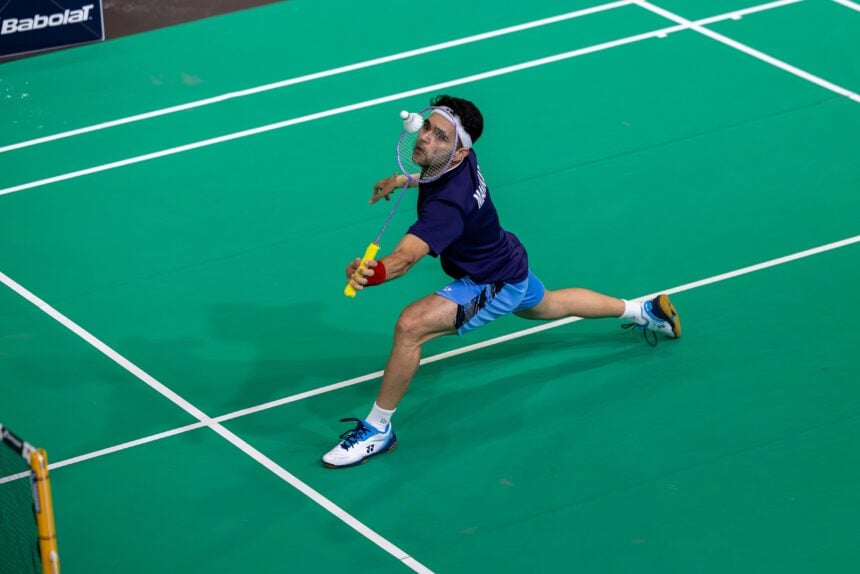
A three-arm trial in 84 Indian badminton players tested whether added skill work would raise smash velocity beyond conventional practice. Motor control exercise outperformed the control group on smash velocity, accuracy and balance, but it also carried extra training time.
Smash Velocity is the number badminton coaches chase hardest, and a randomized controlled trial published on November 20, 2026 in Sport Sciences for Health reports that six weeks of motor control exercise raised it further than conventional training alone.
The trial was run by Nitin Kumar Indora, Manoj Malik and Jaspreet Kaur of the Department of Physiotherapy at Guru Jambheshwar University of Science and Technology in Hisar, Haryana, India. It appears in volume 22 of the journal as article number 418.
Eighty-four players were recruited from five Indian academies: 47 male and 37 female, with a mean age of 20.46 years (SD 2.35). The design was an assessor-blinded, three-arm randomized controlled trial with concealed 1:1:1 allocation, placing 28 players in each group.
Two of the three groups received added work. Sensorimotor training and motor control exercise were each delivered for 30 sessions over six weeks alongside conventional training, while the control group did conventional training alone. Smash velocity was the primary outcome, measured by radar gun at baseline, six weeks and ten weeks.
At a Glance
- Published 20 November 2026 in Sport Sciences for Health, volume 22, article number 418.
- 84 badminton players (47 male, 37 female), mean age 20.46 years (SD 2.35), drawn from five Indian academies.
- Assessor-blinded, three-arm randomized controlled trial with concealed 1:1:1 allocation and 28 players per group.
- 30 sessions across six weeks of sensorimotor training or motor control exercise, added on top of conventional training.
- Motor control exercise beat control on smash velocity by a mean difference of 9.71 (98.33% CI 3.85 to 15.57, p < .001).
- Alongside smash velocity, accuracy rose 3.10 percentage points (98.33% CI 0.35 to 5.84, p = .021) and both balance composites improved.
- The added sessions gave both intervention groups about 29% more training time than the control group.
What Motor Control Exercise Did to Smash Velocity
Smash velocity was the trial’s primary endpoint, recorded with a radar gun. Measured against the control group, motor control exercise produced a mean difference of 9.71, with a 98.33% confidence interval running from 3.85 to 15.57 and a p value below .001.
The abstract reports those smash velocity figures without naming a unit, so the scale behind the 9.71 is not stated on the record. The direction of the effect and its statistical weight are clear; the practical size in kilometres per hour is not.
The wide confidence intervals are a function of the design. With three arms compared against each other, the authors used a 98.33% interval rather than the conventional 95%, which is a correction for multiple comparisons and widens every estimate in the paper.
Accuracy and Balance Moved With Smash Velocity
Smash accuracy, measured with the Forehand Smash Stroke Performance Test, rose 3.10 percentage points against control, with a 98.33% confidence interval of 0.35 to 5.84 and p = .021. That lower bound sits close to zero.
Dynamic balance, measured by the Y-Balance Test, improved on both sides: a mean difference of 12.06 on the left (98.33% CI 2.86 to 21.26, p = .006) and 12.95 on the right (98.33% CI 3.85 to 22.05, p = .002). Group by time interactions were significant for all four outcomes, all at p ≤ .010.
The balance result is the easiest to read directionally and the hardest to size. The abstract gives the left and right composite differences without a unit or a baseline value, so a 12-point gap cannot be translated into anything a coach could measure on court.
Extra training time carried by both intervention groups, because the added sessions were layered on top of conventional practice rather than replacing part of it.
The Extra Training Time Is the Catch
The authors are direct about this. Because sessions were added rather than substituted, the two intervention groups trained roughly 29% more than the control group they were measured against.
That makes the comparison a test of more training plus specific content against less training, not a clean test of the content on its own. The authors state plainly that the effects cannot be attributed specifically to the motor control exercise content, including its effect on smash velocity.
A cleaner design exists. Matching total training time across all three arms, so that the intervention groups give up part of conventional practice in exchange for the new work, would isolate the content and answer the question coaches actually face when the schedule is already full.
Why Sensorimotor Training Came Out Weaker
Sensorimotor training improved within its own group but showed smaller and less consistent between-group effects than motor control exercise. The authors describe its added benefit over conventional training as uncertain and call for adequately powered trials to settle it.
That comparison is the most informative part of the trial. Both intervention arms received the same 29% time bonus, so the gap between them in smash velocity is not explained by training volume alone, which points back toward the content of the sessions.
It is also the part most exposed to sample size. With 28 players per arm and intervals widened for multiple comparisons, a real but modest advantage for sensorimotor training could easily fail to separate from the control condition.
What the Ten-Week Measurement Point Was For
Outcomes were recorded three times: at baseline, at six weeks when the added sessions finished, and again at ten weeks. That final point is a retention check, four weeks after the intervention stopped.
The structure is the right one for a skill study, because a stroke measure can improve while players are being coached closely and then drift back once the extra attention ends. The abstract reports significant group by time interactions for all four outcomes without breaking out the ten-week contrast on its own.
So the retention question stays partly open in the published summary. What the trial establishes is that the pattern across the three time points differed by group; how much of the smash velocity advantage survived the four-week gap is not stated in the abstract.
How It Sits Alongside Other Racket-Sport Research
Skill outcomes in racket sports are sensitive to fatigue and to measurement choices. A tennis trial found that serve accuracy fell at 80% workload but held at 60%, a reminder that a stroke measure such as smash velocity can move for reasons unrelated to training content.
Balance work has a mixed record of its own. Slackline training cut 20-metre sprint time by 0.61 seconds in one small adult trial, while a nine-week basketball warm-up programme produced a sprint gain of 0.07 seconds, a result whose practical weight is open to argument.
The common thread is that added-time designs reward the arm that trains more. Unless a trial substitutes the new work for an equal slice of existing practice, the honest reading is that a larger package beat a smaller one, which is close to how these authors frame their own result.
What Coaches Can Take From This
The result supports adding structured motor control work to badminton practice when the time exists to raise smash velocity. It does not show that the same gains would appear if that work replaced part of existing practice instead.
A few general points follow for anyone weighing the trade-off, none of them specific to an individual player.
- The gain came on top of conventional training, so budget the extra sessions rather than swapping them in.
- Smash velocity, accuracy and balance all moved together, which argues for testing more than one outcome.
- Follow-up ended at ten weeks, so durability beyond that point is unknown.
- Findings in academy players around age 20 may not transfer to recreational or masters play.
The schedule itself deserves a note. Thirty sessions in six weeks works out to five a week layered onto normal academy practice, and sustaining that volume outside a supervised trial is a real constraint for a club coach.
The broader lesson is about how promising methods get tested. Velocity-based training matched traditional lifting in a 16-player football trial, another case where a well-reasoned method did not separate from the standard approach once it was measured directly.
The Fitness Living Takeaway
Motor control exercise added to conventional training improved smash velocity, smash accuracy and dynamic balance more than conventional training alone across 84 badminton players.
The intervention groups also trained about 29% more, so the trial cannot separate the content from the extra time. Sensorimotor training was the weaker of the two additions, and the authors call for adequately powered trials before its benefit is accepted. The abstract reports no measurement unit for smash velocity, which leaves the practical size of the gain unresolved.
Research & Sources
- Sport Sciences for Health: Sensorimotor training and motor control exercise in badminton players
- Study DOI
- Images: Azim Khan Ronnie / Unsplash; Irish83 / Unsplash
This article summarizes peer-reviewed research for general information and is not individualized medical or exercise advice.