Six weeks of supervised slackline training beat usual daily activity on trunk endurance, dynamic balance, sprint time and jump height in a 40-adult randomized trial. The effect sizes were large on all four outcomes, which is unusual for slackline training research.
Slackline training has spent a decade stuck in an argument about transfer. Balancing on a narrow band of webbing clearly makes people better at balancing on webbing, but researchers have struggled to show that the skill carries over to anything else. A randomized controlled trial published on 9 October 2026 in BMC Sports Science, Medicine and Rehabilitation reports that it did.
The trial was run by Busra Sahin at Bursa Uludag University and Banu Bayar at Mugla Sitki Kocman University, both in Turkey. Forty healthy university students, 20 women and 20 men with a mean age of 21.40 years, were analysed after six weeks of either supervised slackline training or their ordinary routine.
Recruitment ran from April to June 2024. Of 46 volunteers who completed baseline testing, 44 were randomized in sex-stratified blocks, 22 to each arm. Two intervention participants missed the adherence threshold, one control participant reported an injury and one skipped the final session, leaving 20 per group for the per-protocol analysis.
Every between-group difference favoured the intervention at six weeks, with all four p-values below 0.001 and partial eta squared values between 0.650 and 0.773. A value of 0.14 is conventionally read as a large effect, so these sit far above that threshold.
At a Glance
- Published 9 October 2026 in BMC Sports Science, Medicine and Rehabilitation, registered as NCT07050849 and accepted on 6 October 2026.
- 40 healthy adults analysed, evenly split by sex, mean age 21.40 years; 18 supervised sessions of 45 minutes across six weeks, three per week.
- Trunk muscle endurance composite: adjusted between-group difference of 27.19 seconds (95% CI 20.87 to 33.51), partial eta squared 0.679.
- Y Balance Test total: 14.92 points (95% CI 12.19 to 17.65), the largest effect in the study at partial eta squared 0.773.
- 20-metre sprint: -0.61 seconds (95% CI -0.75 to -0.48), partial eta squared 0.704; single-leg vertical jump: 4.06 cm (95% CI 3.05 to 5.06).
- Controls barely moved, with the slackline training group going from 54.46 to 82.40 seconds on trunk endurance while controls shifted from 52.29 to 53.14.
- Main caveat: no adjustment for multiple comparisons, a per-protocol rather than intention-to-treat analysis, and a control group that did no supervised exercise at all.
How the Slackline Training Protocol Was Built
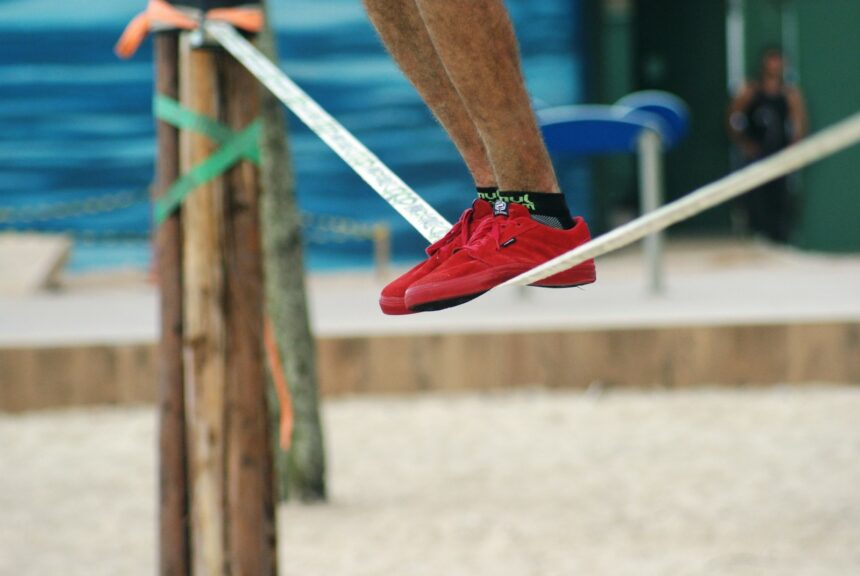
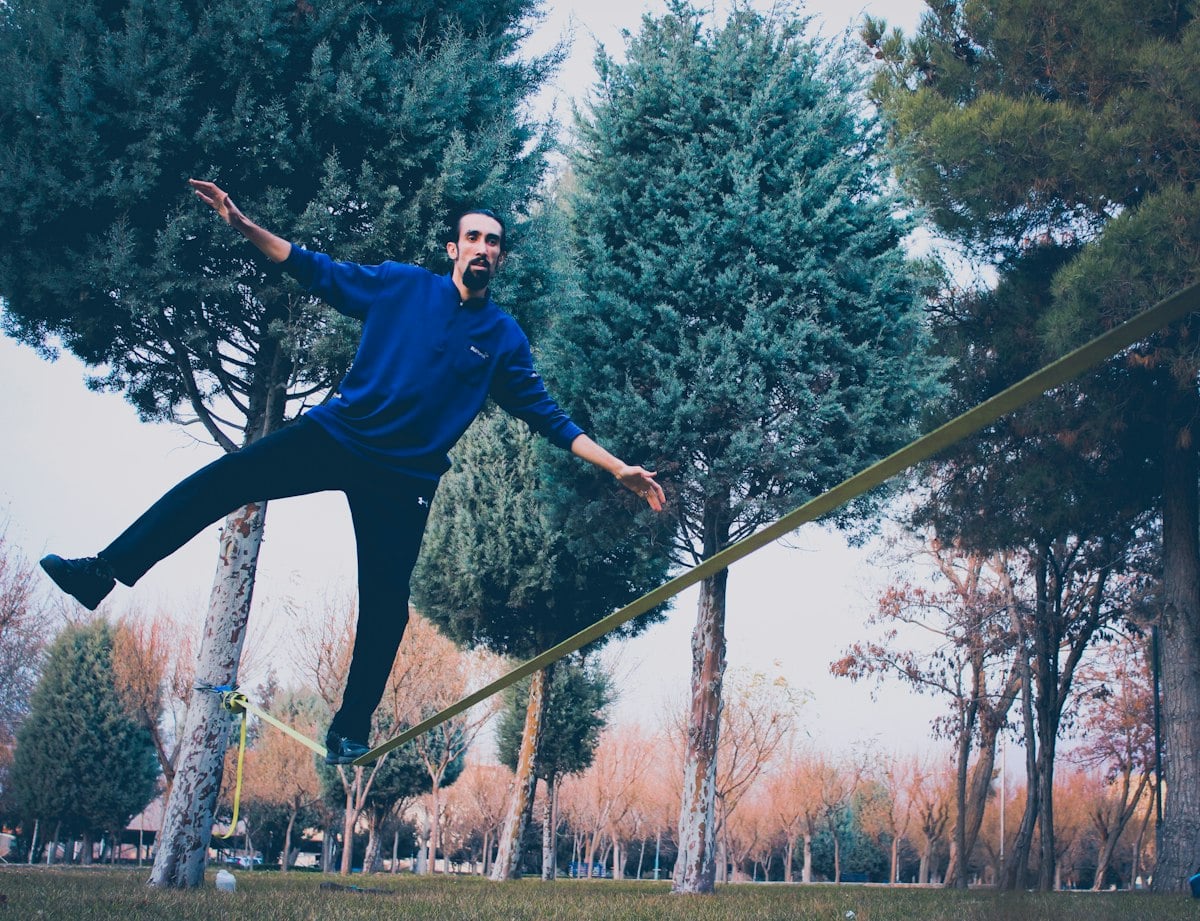
The researchers used a Gibbon travel set with 12.5 metres of 50-millimetre webbing, tensioned 50 centimetres above the ground and kept at the same height and tension for every session. That low setup was chosen deliberately, to allow enough clearance when the line loaded without the fall risk of a higher line.
Each 45-minute slackline training session worked through a standardised progression of 11 exercises, from physiotherapist-assisted standing up to unassisted long walks of four sets of five minutes. All sessions were supervised by the same licensed physiotherapist. Anyone missing three consecutive sessions, or more than two in total, was counted as non-adherent.
That level of control is what separates this trial from much of the slackline training literature, where protocols are often loosely described. Participants were told not to begin any new structured exercise, assessments were taken by an evaluator blinded to allocation, and the two groups started out matched on age, weight, height, body mass index and self-reported activity.
Trunk Endurance Rose Across All Four Tests
Trunk endurance was measured as the average hold time across four tests: trunk flexion, trunk extension, a side bridge on the dominant side and a prone bridge. The composite rose 27.19 seconds more in the slackline training group than in controls after adjustment for baseline scores and gender.
Component analyses pointed to the sagittal plane. Trunk flexion endurance showed the biggest gap at 44.06 seconds (95% CI 29.84 to 58.28), followed by extension at 34.23 seconds. The lateral and prone holds moved less, at 14.18 and 16.97 seconds, with correspondingly smaller effect sizes of 0.332 and 0.455.
The pattern fits the mechanism the authors propose for slackline training: a narrow, moving surface demands near-continuous reactive trunk activation, rather than loading one movement plane the way a dedicated core exercise would.
Dynamic Balance Produced the Largest Effect
Y Balance Test composite scores were normalised to each participant leg length across anterior, posteromedial and posterolateral reaches. The slackline training group went from 87.56 to 103.84 while controls moved from 88.85 to 89.78, an adjusted gap of 14.92 points and the study largest effect size.
That result speaks directly to the transfer question, because the Y Balance Test is nothing like standing on a line. Previous meta-analytic work has found favourable balance effects in healthy people, while other studies have concluded that gains stay stuck on the apparatus itself.
The adjusted between-group gap in 20-metre sprint time after six weeks of slackline training, a margin that would be meaningful in most field-sport settings if it holds up in larger and better-controlled trials.
Sprint and Jump Results Land in the Transfer Debate
Sprint times fell from 4.94 to 4.23 seconds in the slackline training group while controls went from 4.80 to 4.77. Single-leg vertical jump height rose from 19.00 to 23.15 centimetres against an unchanged 19.35 in controls, giving an adjusted difference of 4.06 centimetres.
Those are the outcomes the literature disagrees about most. Earlier trials in youth footballers and female basketball players have reported sprint, agility and jump improvements, while other work insists the adaptations are task-specific. This trial sides with transfer, and the authors suggest greater trunk activation and sensorimotor control may improve force transmission.
It is worth comparing with adjacent findings. A trial we covered found that suspension training added 4.8 cm to jump height in 71 untrained teenagers, and a nine-week programme reportedly cut sprint time by 0.07 seconds in 65 teenagers — a far smaller sprint margin than the one reported here.
Why Slackline Training Results Still Divide Researchers
Effect sizes this uniform invite scrutiny. The comparison here is against people who did nothing new, so the gap captures the whole package: 13.5 hours of supervised exercise, one-to-one physiotherapist attention, novelty and the practice effect of being tested twice.
The authors say so plainly, noting that the specific effects of slackline training cannot be fully separated from those of additional supervised exercise and other non-specific intervention effects. No single primary outcome was prespecified, and no correction was applied across the four comparisons, which inflates the chance that at least one result is a false positive.
A plausible reading is that this trial establishes that six weeks of structured slackline training beats nothing, with a large margin, and leaves open whether it beats any other six-week supervised programme. That is a narrower claim than the numbers first suggest, and it is the claim the design can support.
What Readers Can and Cannot Take From This
Nothing in the trial makes slackline training necessary. Everyone in it was a healthy university student aged 18 to 27, with licensed athletes, orthopaedic history, cardiovascular disease and vestibular disorders all excluded. Older adults, injured people and trained athletes were not studied, and the results should not be stretched to them.
What the trial does offer is evidence that slackline training, an unstable-surface activity people often treat as a park novelty, responds like real training when it is programmed, progressed and supervised. No intervention-related injuries, pain or discomfort were reported across the 18 sessions.
Balance work has a wider track record worth weighing. A randomized trial we covered found that reactive balance training improved stepping but did not reduce falls in older adults, and in young players eight weeks of plyometric training was linked to more match running.
For anyone curious enough to try it, the general and cautious version:
- The protocol that worked was supervised, progressive and frequent: 18 sessions of 45 minutes over six weeks.
- The line sat 50 centimetres off the ground, low enough to step off safely.
- Early sessions were assisted; unassisted walking came only in the final fortnight.
- Anyone with a balance, joint or cardiovascular condition should clear this with a clinician first.
The Fitness Living Takeaway
Six weeks of supervised slackline training produced large between-group gains in trunk endurance, dynamic balance, 20-metre sprint time and single-leg jump height in 40 healthy young adults.
The design was sound where it counts, with randomization, a blinded assessor and baseline-adjusted analysis. Its weakness is the comparator: the control group added no exercise, so the trial shows slackline training beats inactivity rather than beating an equivalent conventional programme. The authors call for comparisons against active interventions and for follow-up on how long the gains last.
Research & Sources
- BMC Sports Science, Medicine and Rehabilitation: Effects of slackline training on trunk muscle endurance, dynamic balance and physical performance
- Study DOI
- Images: Mauricio Santanna / Unsplash; Nasim Keshmiri / Unsplash
This article summarizes peer-reviewed research for general information and is not individualized medical or exercise advice.