A newly published randomized trial found that a low-cost reactive stepping program helped older adults take larger, faster recovery steps, but those gains did not translate into fewer unexpected laboratory falls or fewer falls over the following year.
Reactive balance training is designed around a simple idea: ordinary balance drills teach stability, while real falls often begin with something sudden—a trip, a slip or a loss of footing that demands a fast corrective step. A study published September 4 in Age and Ageing tested whether a practical six-week program could improve that reaction without relying on expensive perturbation treadmills or laboratory equipment.
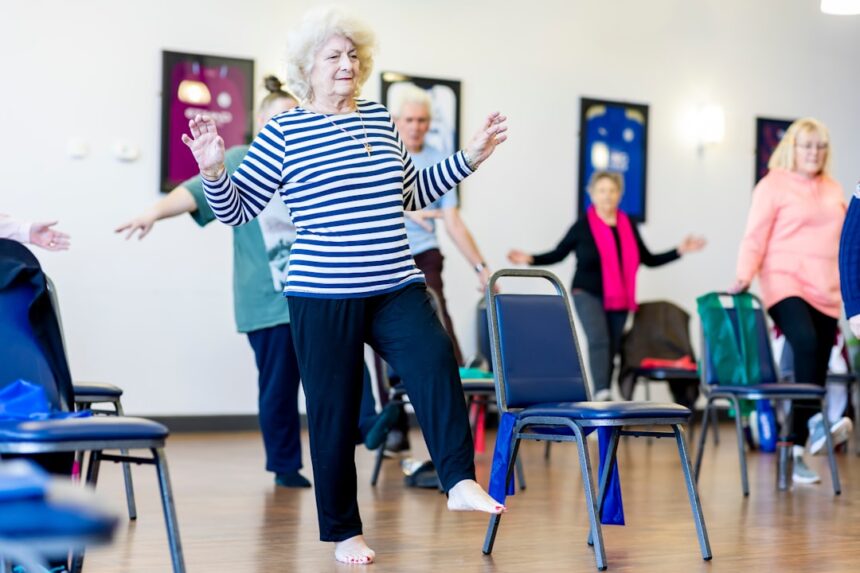
The assessor-blinded randomized controlled trial enrolled 88 community-dwelling adults age 65 and older, with a mean age of 72. Forty-three were assigned to ReacStep, a program combining tether-release reactive stepping and intentional slip practice once a week for six weeks. Both the ReacStep group and the 45-person control group also received an eight-week home strength program.
The result was mixed in an important way. Participants assigned to ReacStep improved maximum step length and choice stepping reaction time compared with controls. But the intervention did not significantly reduce falls during unexpected trip and slip tests in the laboratory, and it did not reduce daily-life falls during 12 months of follow-up.
At a Glance
- The peer-reviewed randomized trial was published September 4, 2026.
- Eighty-eight older adults were randomized; the average participant was 72 years old.
- ReacStep was delivered once weekly for six weeks, alongside home strength training that both groups received.
- The intervention improved maximum step length and choice stepping reaction time.
- It did not significantly reduce unexpected laboratory falls or daily-life falls over one year.
- Adherence to ReacStep sessions was high at 90%.
What the Reactive Balance Training Trial Actually Tested
ReacStep was built to make perturbation-based training more accessible. Instead of a moving treadmill or hidden platform, participants practiced recovery steps after being released from a tethered leaning position and practiced intentional slips in a supervised setting. The training emphasized rapid stepping in different directions and gradually increased the challenge as participants improved.
That matters because fall prevention has two different components. One is reducing the chance that a loss of balance happens in the first place through strength, mobility, vision, medication review and environmental safety. The other is recovering once balance has already been disrupted. ReacStep was aimed primarily at that second problem.
Both groups completed strength work, which makes the comparison more informative than simply measuring ReacStep against inactivity. The trial therefore asked whether adding specific reactive-balance practice produced benefits beyond a basic strength program.
Older adults were randomized to ReacStep plus home strength training or home strength training alone, with falls tracked for 12 months.
The Improvements Were Real—but Specific
After the intervention, the ReacStep group could take longer maximum recovery steps and completed a choice stepping reaction task faster than the control group. Those measures are relevant because a person who loses balance may need both sufficient step length and quick decision-making to get the base of support back under the body.
The study also reported high attendance, suggesting that participants generally tolerated the once-weekly format. That is useful from a real-world programming perspective: an intervention can be physiologically interesting but still fail outside the laboratory if people do not want to perform it consistently.
However, improved stepping measures are surrogate outcomes. They show that a component of balance performance changed; they do not automatically prove that the person will fall less often in everyday life.
Why the Program Did Not Reduce Falls
The most important finding is the one that could be easy to overlook: ReacStep did not significantly reduce the rate of falls during unexpected laboratory trips or slips, and it did not reduce real-world falls during the 12-month monitoring period.
The researchers argue that task specificity may help explain the gap. Practicing a recovery step from a standing tether release is not identical to catching a foot on an obstacle while walking. A real trip provides a sudden sensory cue through the foot and occurs during forward motion, while a standing release creates a different mechanical and sensory problem.
The same issue may apply to slip practice. When the direction and timing of a slip are visible or expected, a participant can prepare differently than when the foot unexpectedly slides during normal walking. Training can improve the practiced task without fully transferring to a less predictable one.
This is a useful lesson for fitness more broadly. Improvements in a drill are most valuable when they transfer to the activity or outcome that motivated the drill in the first place.
ReacStep was a supervised research intervention. Reactive stepping and intentional slip training are not appropriate do-it-yourself drills for someone at elevated fall risk. People with balance concerns should use professional guidance and an environment designed to prevent injury.
What This Means for Older Adults Who Exercise
The new trial should not be read as evidence that balance training is ineffective. Federal physical-activity guidance continues to recommend balance activity for older adults alongside aerobic and muscle-strengthening work. The National Institute on Aging and CDC both emphasize that balance practice is one part of a broader strategy for maintaining function and reducing fall risk.
Instead, the study refines the question. A specialized reactive-balance program may improve stepping capacity without being sufficient, by itself, to reduce unexpected falls. That suggests fall prevention may need more varied and ecologically realistic practice plus the basics that are already well established: strength, balance, appropriate footwear, vision care, medication review and safer environments.
Recent Fitness Living reporting on exercise and nutrition counseling in older adults also illustrates why simple, repeatable programs can matter even when individual outcomes vary. And our coverage of aerobic exercise after menopause shows that different training modes can influence different aspects of healthy aging.
What the Trial Cannot Tell Us
The study was relatively small and did not reach its planned sample size, which reduces power to detect modest differences in falls. Seventy-five participants completed the post-intervention assessment, and the daily-life fall outcome was based on a 12-month follow-up in a specific group of community-dwelling volunteers.
The participants were also healthy enough to walk independently and join a demanding perturbation program. The findings may not generalize to frailer adults, people who use mobility aids, or people with neurological conditions that affect balance.
Because both groups performed home strength training, the trial does not tell us whether ReacStep is better than doing nothing. It tells us whether adding ReacStep to strength training improved outcomes compared with strength training alone.
Finally, the negative fall result does not prove the program can never reduce falls. It means this six-week version, delivered in this population and tested with these outcomes, did not demonstrate that benefit.
A Practical Way to Use This Research
For older fitness enthusiasts, the safest practical takeaway is to keep balance training broad rather than chasing one specialized drill. Practice strength, controlled single-leg or tandem positions when appropriate, directional stepping, walking variation and tasks that challenge coordination within a safe environment.
If someone has already fallen, feels unsteady or is afraid of falling, individualized assessment is more useful than experimenting with reactive slip drills. A physical therapist or qualified clinician can identify whether strength, vestibular function, vision, medication effects, gait mechanics or another factor is contributing.
The study also reinforces a principle that applies at any age: train the capacity you want, but verify that the capacity transfers. Faster reaction time on a test is encouraging; staying upright during an unexpected trip is the harder standard.
The Fitness Living Takeaway
Six weeks of supervised reactive balance training helped older adults take larger and faster recovery steps, but it did not reduce unexpected laboratory falls or falls in daily life over one year.
That makes ReacStep an interesting training model, not a proven fall-prevention shortcut. The most defensible approach remains a broader program that combines strength, balance, mobility, environmental safety and individualized guidance when fall risk is elevated.
Research & Sources
- Age and Ageing: Effects of the ReacStep training program on balance recovery and fall risk factors in older people
- Permanent DOI for the randomized controlled trial
- British Geriatrics Society: ReacStep trial summary and registration
- CDC: What counts as physical activity for older adults
- Image: Centre for Ageing Better / Unsplash
This article reports on peer-reviewed exercise research for general information. It is not individualized medical, rehabilitation or fall-prevention advice.
The Fitness Living Weekly
New Fitness Living Spotlights, important fitness news, research and independent reporting, delivered directly to your inbox.
One considered edition each week.
Do You Lead a Fitness Business Worth Knowing?
Fitness Living Magazine features independent gym owners, fitness trainers, and Pilates studio owners strengthening their local communities.