A three-arm trial in 90 healthy young adults tested fibular repositioning taping against a sham strip and against nothing at all. On the outcome the researchers had nominated in advance, repositioning taping did not beat the sham.
Repositioning taping applied to the fibula produced no statistically significant advantage over sham taping on a single-leg balance test, in a randomized controlled trial published in BMC Sports Science, Medicine and Rehabilitation on November 18, 2026. Jump and sprint measures did move, but the authors label those results exploratory and hypothesis-generating.
The trial was run by Selim Mahmut Günay of Hatay Mustafa Kemal University, with Büşra Şahin, Çetin Sayaca and Özden Özkal Değirmenci of Bursa Uludağ University, in Turkey. It was received on August 21, 2026 and accepted on November 16, 2026, and is currently posted as an early-access accepted version.
Ninety healthy adults aged 18 to 30, sixty women and thirty men, were randomized one to one to one into three groups: fibular repositioning taping, sham taping, or no intervention. The primary outcome was the Y-Balance composite score. Secondary outcomes were a single-leg hop, a single-leg countermovement jump and a 10-metre sprint.
Everything was measured twice, at baseline and 30 minutes after the tape went on. The analysis used a mixed-design repeated-measures ANOVA on the group by time interaction, with Bonferroni-adjusted pairwise comparisons. The trial is registered as NCT07604090, registered retrospectively on April 29, 2026.
At a Glance
- Published November 18, 2026 in BMC Sports Science, Medicine and Rehabilitation; accepted November 16, 2026.
- Ninety healthy adults aged 18 to 30, randomized evenly to repositioning taping, sham taping or control.
- Primary outcome Y-Balance composite, with single-leg hop, single-leg countermovement jump and a 10-metre sprint as secondary measures, all retested 30 minutes later.
- Y-Balance, taping against sham: mean difference in change 2.80, 95 percent CI minus 0.88 to 6.48, p equals .199. Not significant.
- Single-leg countermovement jump interaction: F(2,87) equals 9.446, p below .001, partial eta squared .178, favouring the taped group.
- Ten-metre sprint interaction: F(2,87) equals 13.873, p below .001, partial eta squared .242, favouring the taped group.
- The main caveat is that the authors call the jump and sprint results exploratory, and the balance advantage over control vanished once baseline scores were adjusted for.
What Fibular Repositioning Taping Is Meant to Do
The technique targets the position of the fibula, the slender outer bone of the lower leg, rather than the ankle joint itself. The idea is that a small positional correction at the distal fibula changes the mechanical and sensory input the joint receives, and that the nervous system responds within minutes.
That mechanism predicts a balance benefit above all, which is why the Y-Balance composite was the nominated primary outcome. Setting the primary endpoint in advance is what makes this trial worth reading carefully: it tells you which result the design was built to answer, and which results arrived as byproducts.
The Primary Outcome Did Not Separate From Sham
On the Y-Balance test, repositioning taping was not distinguishable from sham taping. The mean difference in change scores was 2.80 points, with a 95 percent confidence interval running from minus 0.88 to 6.48 and a p value of .199. An interval that spans zero cannot support a claim of benefit.
The overall group by time interaction for Y-Balance did reach significance, at F(2,87) equals 4.542, p equals .013, partial eta squared .095. Against the no-intervention control, the taped group gained 4.49 points more, 95 percent CI 0.82 to 8.17, p equals .011.
That comparison is the weaker of the two. A difference against doing nothing can reflect the ritual of being taped as much as the tape, which is precisely what the sham arm existed to rule out, and the sham arm showed no such gap.
Why the ANCOVA Result Matters More Than the Change Scores
The researchers then reran the balance comparison as an analysis of covariance, adjusting for baseline scores. Under that model the taped group differed from neither comparison: p equals .155 against sham and p equals .251 against control. The advantage over doing nothing did not survive the adjustment.
This is the most informative line in the paper. Change-score analyses are vulnerable to baseline imbalance, and when a result holds in one model but not the other, the honest reading is that the balance effect of repositioning taping is unproven rather than established.
The primary outcome. Fibular repositioning taping did not differ significantly from sham taping on the Y-Balance composite score, the result the trial was designed to test.
Sprint and Jump Moved, and the Authors Call Them Exploratory
The secondary measures produced the larger statistics. The single-leg countermovement jump interaction came in at F(2,87) equals 9.446, p below .001, with a partial eta squared of .178, and the authors report greater gains in the taped group than in either sham or control.
The 10-metre sprint went further still: F(2,87) equals 13.873, p below .001, partial eta squared .242. That is the largest effect size in the trial, and it sits on the outcome furthest from the mechanism repositioning taping is supposed to work through.
The single-leg hop, by contrast, did not move. Its interaction was F(2,87) equals 2.210, p equals .116, partial eta squared .048. Three secondary outcomes, two significant and one not, is the pattern that statisticians treat with caution when no endpoint was prespecified.
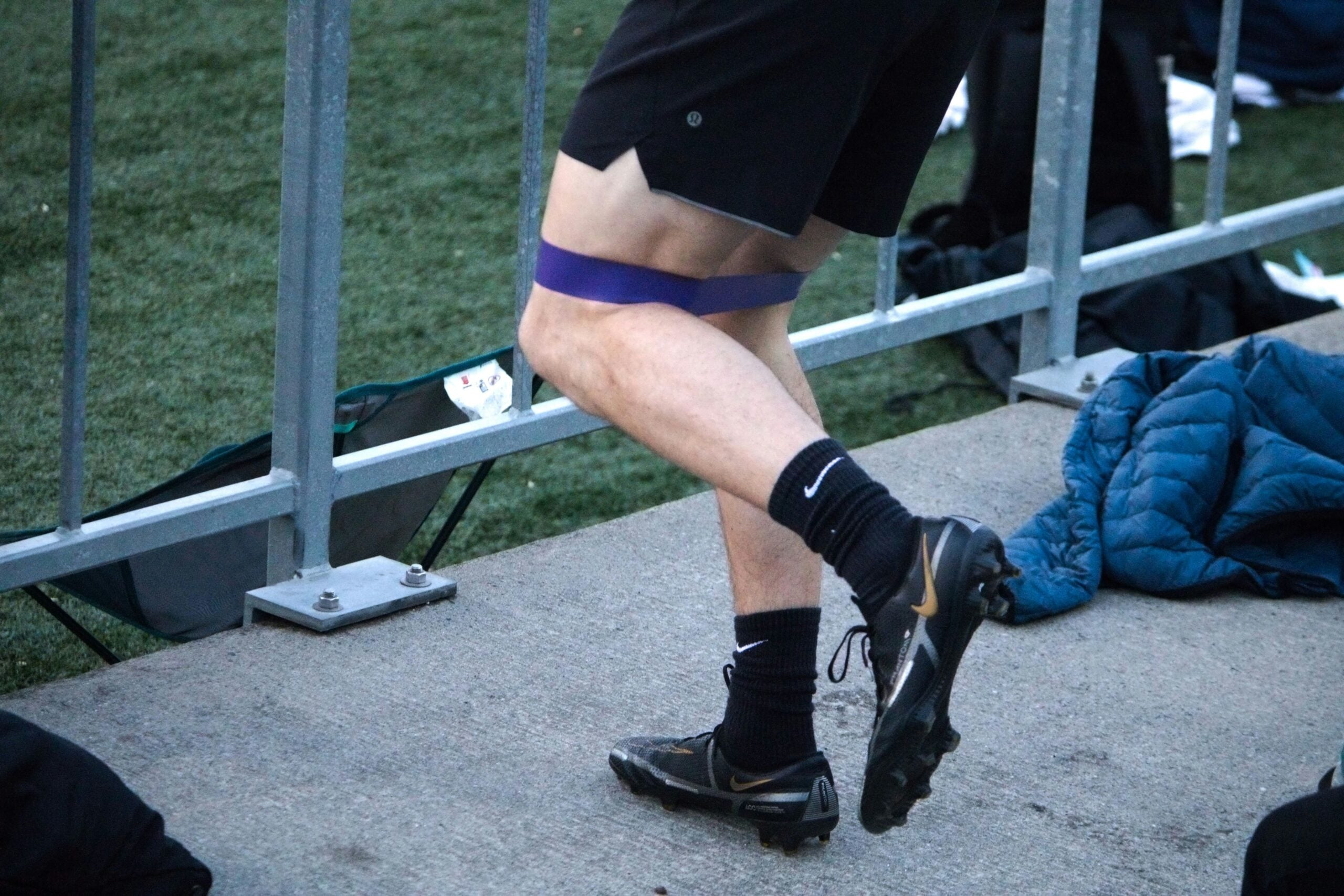
The authors state plainly that FRT did not differ significantly from sham taping in Y-Balance performance. They add that although greater improvement was observed with FRT than with no intervention in the change-score analysis, this difference was not statistically significant in the baseline-adjusted ANCOVA.
On the secondary measures they write that greater short-term improvements in single-leg countermovement jump and 10-metre sprint outcomes were observed with FRT than with sham and control under the standardized testing conditions of this study, and that these exploratory, hypothesis-generating secondary findings require confirmation in further studies. Beyond the wording of the authors, three design facts constrain the reading: participants were healthy adults aged 18 to 30, every measurement was taken within a single 30-minute window, and the trial was registered retrospectively.
What a 30-Minute Window Can and Cannot Show
This was an acute study by design. Nothing in it tells us what repositioning taping does over a training block, across a match, or once tape has been worn through a sweaty session and started to lift. Adhesion, skin response and habituation all take longer than half an hour to appear.
Nor does it speak to injured athletes. A sample of uninjured 18 to 30 year olds is the cleanest way to isolate an acute mechanical effect, and also the population least likely to need one. Whether repositioning taping helps someone with chronic ankle instability is a separate trial.
Where Repositioning Taping Fits Alongside Other Acute Interventions
Acute performance research has a recognizable shape: modest effects, small samples and results that shrink as methods tighten. Work on warm-up programs and their effect on sprint, agility and jump outcomes sits in the same genre, and so does the evidence on slackline training for trunk endurance, balance and sprint ability.
Measurement choice matters as much as the intervention. The countermovement jump is sensitive to fatigue and to the protocol used to collect it, a point covered in reporting on countermovement jump fatigue testing, and a 10-metre sprint carries real trial-to-trial noise.
What Repositioning Taping Means for Your Own Training
For a healthy recreational athlete, the practical answer is that nothing here justifies adding tape to a routine in search of balance. The trial tested that claim directly and did not find support for it once a sham comparison was in place.
The jump and sprint signals are interesting enough to warrant another trial, and weak enough that they should not change how anyone trains this week. A few general points follow.
- Repositioning taping is a clinician technique, not a self-applied performance hack. Application quality is likely to determine whether it does anything at all.
- If balance is the goal, trained balance work has better evidence behind it than tape, including the structured protocols covered in reactive balance training research.
- Tape is not a substitute for rehabilitation after an ankle injury, and this trial enrolled nobody with an injury.
- Anyone managing pain, instability or a previous sprain should work with a physiotherapist or physician rather than reading a performance trial as clinical guidance.
The Fitness Living Takeaway
Fibular repositioning taping failed to beat sham taping on the balance test this trial was built to measure, while producing large but exploratory gains in single-leg jump and 10-metre sprint among 90 healthy young adults.
The primary outcome is the one that counts, and it was null against sham. The balance advantage over no intervention disappeared under baseline adjustment, which further weakens it. The jump and sprint effects are the largest in the paper and the hardest to explain through the proposed mechanism, so repositioning taping is best read today as a technique with an open question attached rather than a demonstrated performance aid.
Research & Sources
- BMC Sports Science, Medicine and Rehabilitation: Acute effects of fibular repositioning taping on balance, jumping and sprint performance
- Study DOI
- Images: Felix yu / Unsplash; Danielle-Claude Bélanger / Unsplash
This article summarizes peer-reviewed research for general information and is not individualized medical or exercise advice.