A randomized trial gave 40 women in their seventies twelve weeks of elastic band training and measured far more than muscle. Strength, walking mechanics, muscle architecture, cardiac indices and even brain-to-muscle signalling all moved.
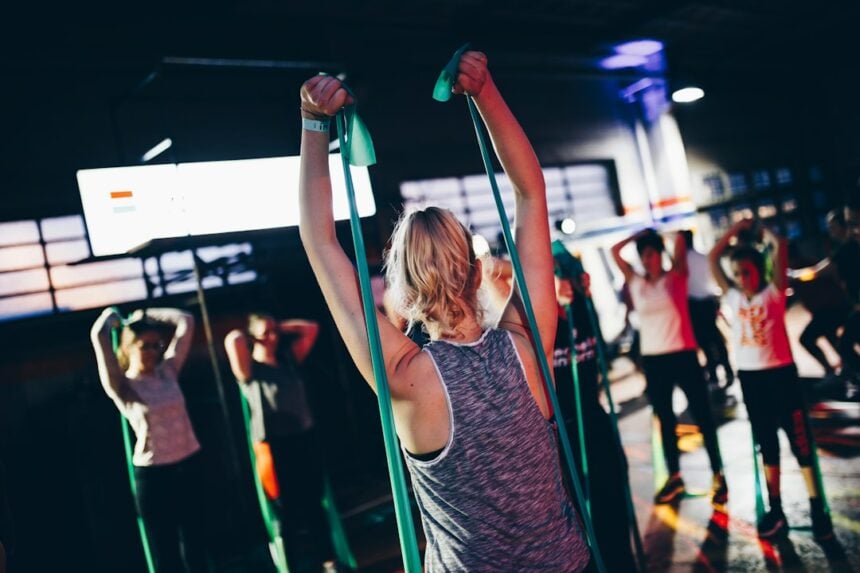
Elastic band training improved muscle strength, physical function and gait in older women screened as being at risk of sarcopenia, according to a randomized controlled trial published on October 22, 2026 in BMC Geriatrics. Forty participants with a mean age of 76.4 years were randomized to health education alone or to health education plus twelve weeks of elastic band training.
The trial was run by Yanhong Su of Liaoning Normal University in Dalian with colleagues at Dalian University of Technology and several other Chinese institutions. Participants had a mean age of 76.4 years with a standard deviation of 5.8, and all carried an Ishii score of 120 or above, a screening threshold used to flag sarcopenia risk.
The control group received health education only. The intervention group received the same health education plus the training block, which makes the twelve-week resistance programme the one thing separating the two arms. Muscle mass, muscle strength, physical function, gait parameters, skeletal muscle and cardiac morphology, and corticomuscular coherence were all assessed at baseline and again after twelve weeks.
The authors set up the question around what they call the heart-brain-muscle network, writing that the risk of sarcopenia is associated with dysregulation of that network and that the study investigated whether elastic band resistance training modulates these integrative pathways.
At a Glance
- Published October 22, 2026 in BMC Geriatrics; received January 21, 2026 and accepted October 7, 2026.
- Randomized controlled trial in 40 older women, mean age 76.4 years with a standard deviation of 5.8.
- All participants had an Ishii screening score of 120 or above, marking elevated sarcopenia risk.
- Twelve weeks of elastic band training plus health education, versus health education alone.
- Muscle strength and physical function improved at P below 0.05; the Ishii score fell at P below 0.01.
- Stride length rose and double-support time fell, both at P below 0.01.
- Main caveat: 40 participants, all women, twelve weeks, and the published abstract reports significance levels without effect sizes or confidence intervals.
Where Elastic Band Training Changed Function
The functional results are the most directly useful part of the paper. The authors report that the training group significantly improved muscle strength and physical function at a P value below 0.05, and reduced the Ishii score at a P value below 0.01. Because the Ishii score is the instrument that qualified participants for the trial in the first place, a drop in it means the elastic band training moved the screening measure that defined the problem.
That is a tidier result than it sounds. Plenty of resistance trials in older adults register a strength gain without shifting any composite risk score, because scores built from age, grip strength and calf circumference are slow to respond over a short block.
Gait Was the Clearest Everyday Signal
Two gait parameters moved in the direction associated with steadier walking. Stride length increased at a P value below 0.01, and double-support time, the fraction of the gait cycle with both feet on the ground, fell at the same threshold. Older adults who feel unsteady tend to shorten stride and lengthen double support, so both numbers shifting after elastic band training points the same way.
The paper describes this as improved gait stability. It is worth stressing that these are laboratory gait measures over twelve weeks, not falls. No fall outcomes are reported, and a trial of 40 people could not have detected a difference in them whatever elastic band training did to stride length.
The length of the elastic band training block that separated the two groups. Both arms received identical health education alongside it.
What the Ultrasound and Echocardiography Added
Imaging picked up structural change as well as functional change. Ultrasound showed significant increases in biceps brachii thickness, rectus femoris cross-sectional area and rectus femoris pennation angle, all at a P value below 0.05. Pennation angle describes the angle at which muscle fibres attach to the tendon, and a rise in it is a recognised architectural response to resistance work.
The cardiac measures are the more unusual inclusion for an elastic band training trial. Interventricular septal thickness rose at a P value below 0.05, while left ventricular ejection fraction and the E over A ratio, a marker of diastolic filling, both rose at a P value below 0.01. The authors are careful to call these changes in selected cardiac indices rather than a demonstrated cardiac benefit.

The Brain-Muscle Measurement That Sets This Trial Apart
Corticomuscular coherence estimates how tightly the electrical activity of the motor cortex is coupled to the electrical activity of a working muscle. Higher coherence in the beta band is generally read as steadier descending drive during sustained contraction, and it is rarely measured in community exercise trials at all, let alone in an elastic band training study.
After correction for multiple comparisons, the authors report that beta-band coherence areas for the vastus lateralis and the biceps femoris increased, with an adjusted P value below 0.05. Two thigh muscles out of the set tested reached that bar, and the correction matters: it is the step that stops a long list of outcomes from throwing up false positives.
How Much 40 Participants Can Settle About Elastic Band Training
Not a great deal, and the authors say so themselves. Their closing line is unusually candid for an abstract: these findings suggest parallel adaptations rather than directly demonstrating integrated regulation of the heart-brain-muscle network. In other words, several systems changed at once, which is not the same as showing that they changed together through one mechanism.
The practical limits stack up quickly. Forty participants split across two arms leaves twenty per group. Every participant was an older woman, so nothing here transfers automatically to men. Twelve weeks is a short horizon for cardiac remodelling. And the published abstract gives significance levels without effect sizes or confidence intervals, so the size of each elastic band training benefit cannot be judged from it.
Where This Fits With Other Older-Adult Training Research
Band and low-equipment work has a reasonable record in this age group, and elastic band training sits at the cheap end of it. A separate trial covered here found that resistance training raised respiratory muscle strength in 60 older adults, and another reported that one isometric exercise session a week held a 6.56 mmHg blood pressure drop without any gym equipment at all.
On the outcomes this trial touches, a pooled review found that exercise was linked to better upper-limb bone health across 1,880 women, and a running study showed how slowly gait mechanics respond to twelve weeks of deliberate retraining. Aerobic volume carries its own separate benefits; a cohort analysis published this week linked higher weekly activity to lower pancreatitis risk in 82,408 adults.
What Elastic Band Training Does and Does Not Mean for Readers
The honest summary is that this trial supports something already widely recommended rather than revealing anything new to do. Progressive resistance work two or three times a week is standard guidance for older adults, and elastic band training is one acceptable way to deliver it. This paper does not publish its session-by-session protocol in the abstract, so there is no programme here to copy.
General, non-individualized points that follow from the design:
- Every participant was screened as being at elevated sarcopenia risk, so the starting point was low function, where gains come fastest.
- Both groups received health education, so the comparison isolates the training itself rather than attention or advice.
- The gait results are laboratory measures over twelve weeks, not evidence about falls.
- The cardiac findings are described by the authors as changes in selected indices and should not be read as a treatment for any heart condition.
Anyone in their seventies starting resistance work, particularly with a known cardiac or musculoskeletal condition, should get individual clearance and ideally early supervision rather than working from a trial summary.
The Fitness Living Takeaway
Twelve weeks of elastic band training improved strength, physical function, stride length and double-support time in 40 older women screened at risk of sarcopenia.
The trial measured an unusually wide set of outcomes, from muscle architecture to brain-to-muscle coupling, and corrected for multiple comparisons on the coherence results. It is still 40 women over twelve weeks, reported without effect sizes, and the authors themselves call the pattern parallel adaptation rather than proof of one shared mechanism.
Research & Sources
- BMC Geriatrics: Elastic band resistance training in older women at risk of sarcopenia
- Study DOI
- Images: Geert Pieters / Unsplash; Kira Severinova / Unsplash
This article summarizes peer-reviewed research for general information and is not individualized medical or exercise advice.