A 14-week school trial in Istanbul tested whether the kind of exercise children do matters for working memory, not just how hard they breathe. Both programmes helped, but the coordination group gained more working memory points than the aerobic group did.
Working memory improved more in children who spent 14 weeks on cognitively demanding coordination drills than in children who did matched aerobic exercise, according to a three-arm randomized controlled trial published on 18 September 2026 in BMC Sports Science, Medicine and Rehabilitation.
The trial enrolled 78 children aged 10 to 12 at a single state primary school in Istanbul, Turkiye, during the 2025 to 2026 academic year. Forty-one were girls and 37 were boys, and the median age was 11.0 years. The researchers used 1:1:1 stratified block randomisation to place 26 children in each of three arms: a cognitively engaging gross-motor coordination programme, an aerobic programme, and a control group that continued the usual curriculum.
Both exercise programmes ran for 40 minutes, three times a week, for 14 weeks, which came to 42 sessions in all. They were delivered at school on top of regular physical education. The authors matched the two programmes for frequency, duration and rated perceived exertion, so effort was not the variable separating them.
On the group-by-time interaction for working memory, the trial reported F(2, 75) = 12.47, p less than 0.001, and a partial eta squared of 0.25. Both exercise arms improved more than the control arm. The coordination arm posted a median gain of 5.2 digit span points against 3.1 points in the aerobic arm.
At a Glance
- Published 18 September 2026 in BMC Sports Science, Medicine and Rehabilitation, volume 18, article number 440.
- 78 children aged 10 to 12, median age 11.0, from one state primary school in Istanbul, Turkiye; 26 per arm.
- 40-minute sessions, three times a week, for 14 weeks, totalling 42 sessions added to regular physical education.
- Working memory group-by-time interaction: F(2, 75) = 12.47, p less than 0.001, partial eta squared 0.25, 95% CI 0.09 to 0.39.
- Coordination versus aerobic on working memory: median 5.2 points against 3.1 points, adjusted p = 0.045, r = 0.31.
- Selective attention improved in both exercise arms but did not differ between them, adjusted p = 0.320.
- Main caveat: one school, one age band, a retrospectively registered trial, and a between-programme gap the authors call modest.
Two Programmes, One Deliberate Difference
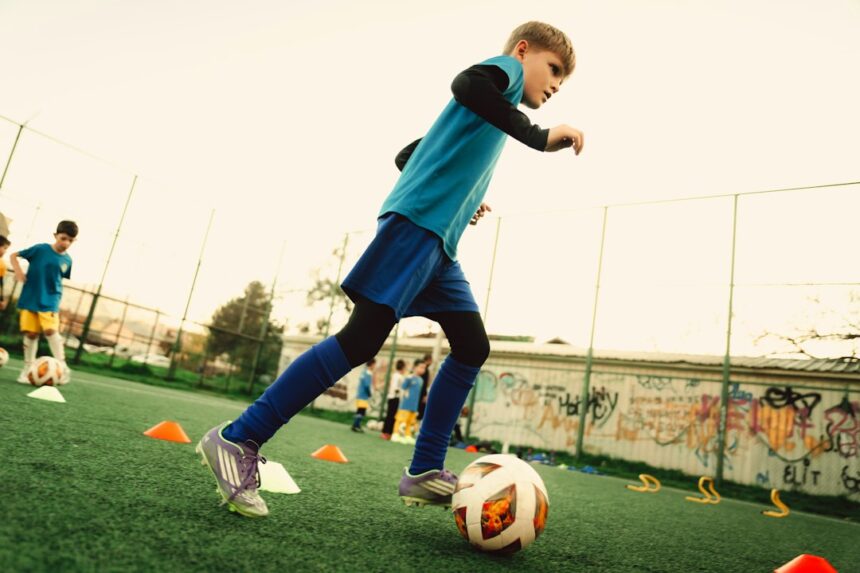
The two exercise arms were built to look alike on paper. Both ran 40 minutes, three times a week, for 14 weeks, and both were pitched at the same rated perceived exertion. What differed was the thinking load. The coordination arm added perceptual demands, decision-making, motor planning and inhibitory control. The aerobic arm kept the movement pattern simpler and steadier.
That design choice is the argument of the paper. If working memory gains tracked only with how hard children breathed, the two arms should have moved together. They did not, and that gap is what the authors are pointing at.
How the Working Memory Scores Were Collected
Working memory was measured with a paper-and-pencil digit span task given before and after the 14 weeks. Selective attention was measured with the d2 test, and the team analysed the total number of items processed. Because the outcome distributions were not normal, the analysis used aligned rank transform ANOVA rather than a standard parametric model.
Both instruments are brief and classroom-friendly rather than laboratory batteries. That keeps the trial practical, and it also limits how finely the working memory result can be read.
Where Coordination Training Pulled Ahead
On the group-by-time interaction, working memory produced F(2, 75) = 12.47 at p less than 0.001, with a partial eta squared of 0.25 and a 95% confidence interval running from 0.09 to 0.39. Both exercise arms beat the control arm on both outcomes, with Bonferroni-adjusted p values at or below 0.018.
The head-to-head comparison is the newer part. On working memory, the coordination arm recorded a median change of 5.2 points, interquartile range 4.6 to 5.9, against 3.1 points in the aerobic arm, interquartile range 2.2 to 3.9. The adjusted p value was 0.045 and the between-group effect size was r = 0.31, with a 95% bias-corrected interval of 0.06 to 0.52. The median difference came to 2.1 points, 95% bias-corrected interval 1.44 to 2.76.
That is a narrow margin resting on a lower bound close to zero. It sits alongside earlier cross-sectional work linking physical fitness to arithmetic fluency in 1,166 adolescents, but a randomized comparison of two matched programmes asks a sharper question than an observational snapshot can.
The median working memory advantage for coordination training over matched aerobic exercise on the digit span task.
Why Selective Attention Did Not Separate the Groups
Selective attention told a different story. The interaction against the control group was clear, at F(2, 75) = 8.23, p less than 0.001, partial eta squared 0.18, 95% CI 0.04 to 0.32. The two exercise arms, however, did not differ from each other. The adjusted p value was 0.320 and the effect size was r = 0.16, with a 95% bias-corrected interval of minus 0.10 to 0.40 that crosses zero.
Median d2 change was 29.0 items in the coordination arm and 30.5 in the aerobic arm. The authors also report that the two change scores were only weakly related, with a Spearman rho of 0.12 and no statistical significance, which suggests the working memory and attention movements were not one underlying improvement wearing two labels.

What a 78-Child Trial Can and Cannot Settle
The sample is small for a three-arm comparison. The authors own power analysis called for 60 children, 20 per arm, and the team enrolled 78 instead, 26 per arm. That helps, but the decisive working memory contrast still rests on 52 children across two arms.
The setting is narrow as well: one state primary school in a single city, one academic year, one age band of 10 to 12. Nothing in the design speaks to younger children, to adolescents, or to schools with different physical education provision. Research on body fat and motor fitness in 306 Croatian children is a reminder of how much baseline profiles vary between school populations.
What the Working Memory Result Means for Families and Schools
Read at the level the data support, the trial says something modest and useful. In this group, both kinds of structured exercise beat no extra exercise, and the version that made children think while they moved produced a slightly larger working memory gain. It does not show that coordination drills are a treatment, and it measured no effect on grades or classroom behaviour because it did not look.
- Treat both options as worthwhile. The control arm, which simply continued the usual curriculum, improved least on both measures.
- Where a choice exists, activities with changing rules, targets and decisions carry the demands this trial associates with working memory.
- Keep the dose ordinary. Forty minutes, three times a week, added to normal physical education was enough to register here.
- Do not expect transfer to school performance from this trial, which did not measure it.
None of this is individualised advice. Any child with a medical condition or a current injury should start from guidance from their own clinician rather than from a trial average. Adults looking at their own routines will find the broader picture in work on physical activity and memory across 136,503 older adults and in a small trial on 10 minutes of slow running and executive function.
The Fitness Living Takeaway
In 78 Istanbul schoolchildren, 14 weeks of cognitively demanding coordination training improved working memory about 2.1 digit span points more than matched aerobic exercise did.
Both exercise arms clearly outperformed a no-extra-exercise control on working memory and selective attention, so the practical headline is still that structured activity helped. The coordination advantage was specific to working memory, did not appear for attention, and rested on a narrow margin in one school. It is a lead worth following, not a settled result.
Research & Sources
- BMC Sports Science, Medicine and Rehabilitation: Comparing cognitively engaging gross-motor coordination training and aerobic exercise on working memory and selective attention in school-age children
- Study DOI
- BMC Sports Science, Medicine and Rehabilitation: recent articles
- Images: Ile Ristov / Unsplash; Zoshua Colah / Unsplash
This article summarizes peer-reviewed research for general information and is not individualized medical or exercise advice.