
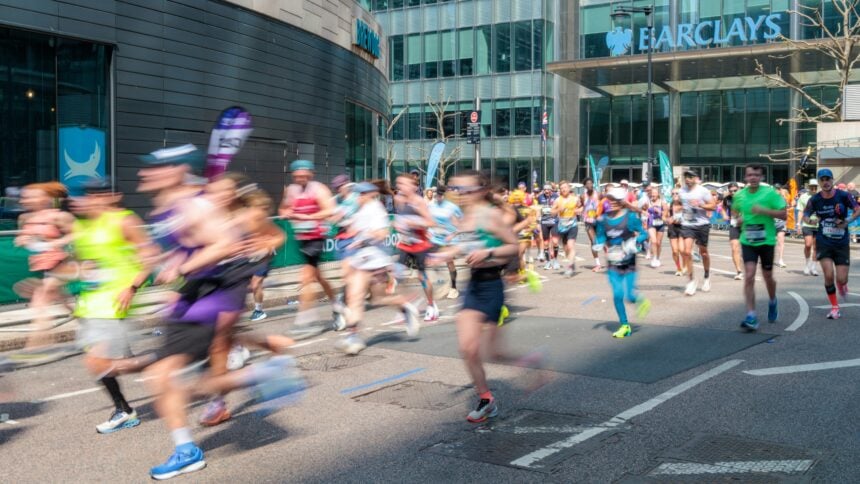
A Polish comparison of 31 recreational marathon runners and 82 men from the general population found markedly higher lung function in the runners, on both forced vital capacity and one-second volume. The airflow ratio that flags obstruction was identical between groups, which shapes how the lung function gap should be read.
Lung function is the one piece of endurance physiology most runners never measure. A cross-sectional study published in Frontiers in Physiology on September 25, 2026 measured it in amateur marathoners and in men drawn from the wider population, and the gap between them was large.
The work came from a group spanning the Medical University of Gdansk, the Gdansk University of Physical Education and Sport, the University of Warmia and Mazury in Olsztyn, and the Jozef Pilsudski University of Physical Education in Warsaw. The comparison group was assembled to represent the male population of the Pomerania region.
Thirty-one amateur male marathon runners and 82 men in the control group, all aged 35 to 66, completed basic spirometry: forced vital capacity, forced expiratory volume in one second, and the Tiffeneau index that divides one by the other. The analysis also collected body mass index, waist circumference, waist-to-hip ratio, smoking status and any history of obstructive lung disease.
Mean forced vital capacity was 5.24 litres in the runners against 4.58 litres in controls. Mean one-second volume was 4.14 litres against 3.55 litres. Both differences held at p below 0.001, in absolute terms and as percentages of predicted values.
At a Glance
- Published September 25, 2026 in Frontiers in Physiology, volume 17.
- 31 amateur male marathon runners compared with 82 men representative of the male population of Pomerania, Poland.
- All participants aged 35 to 66; the design was cross-sectional, not a training intervention.
- Forced vital capacity averaged 5.24 plus or minus 0.68 litres in runners and 4.58 plus or minus 0.95 litres in controls.
- One-second volume averaged 4.14 plus or minus 0.55 litres against 3.55 plus or minus 0.88 litres, p below 0.001.
- The Tiffeneau index, smoking status and prevalence of obstructive lung disease did not differ significantly between groups.
- Runners were leaner, but body measures were not significantly associated with lung function outcomes.
How the Two Groups Were Assembled
The runners were not elite. They were recreational athletes who had trained regularly for years, had finished multiple marathons, and were still physically active in the period immediately before testing. That matters for interpretation: this is a portrait of sustained amateur endurance training, not of professional sport.
The comparison group is the less common half of the design. Rather than recruiting a convenience sample of non-runners, the team used a group built to represent men across the Pomerania region, which makes the contrast one between marathoners and a realistic slice of the male population rather than against an unusually sedentary control.
What These Lung Function Measures Actually Capture
Spirometry reduces lung function to a small number of quantities. Forced vital capacity is the total volume a person can push out after filling the lungs completely. Forced expiratory volume in one second is how much of that total leaves in the first second. The Tiffeneau index is simply the second number divided by the first.
The pairing is what gives the test its diagnostic power. A low ratio alongside a low capacity points toward obstruction, where air struggles to leave. Two high volumes with an ordinary ratio describe a different situation entirely: more air moving, in the usual proportions. Knowing which pattern a lung function result belongs to matters more than the raw litres.
What the Spirometry Numbers Showed
The forced vital capacity gap came to roughly 0.66 litres, about 14 percent above the control mean. The one-second volume gap was about 0.59 litres, close to 17 percent. Both remained significant when expressed as percentages of predicted values, which adjusts for height, age and sex.
That last point is what stops the result from being a story about body size. Percent-predicted values already account for the physical characteristics that normally drive lung function, and the runners still sat clearly above the comparison group after that correction.
The difference in mean forced vital capacity between the marathon runners and the comparison group, a gap of roughly 14 percent.
Why the Airflow Ratio Did Not Budge
The Tiffeneau index, one-second volume divided by forced vital capacity, showed no significant difference between the groups. Neither did smoking status or the prevalence of obstructive lung disease. The runners were not simply a healthier-airway population.
Read together, those two results say something specific. Both components of lung function were elevated in roughly the same proportion, so the runners were not moving air faster relative to their capacity; they had more capacity to move. An unchanged ratio alongside higher absolute volumes is the signature of scale rather than of improved airflow mechanics.
What a Cross-Sectional Design Cannot Separate
Every participant was measured once. Nobody was followed from untrained to trained, and nobody was randomised into running. The study can therefore report that higher lung function accompanied years of endurance training; it cannot say which came first.
Selection is the obvious rival explanation. People who take up marathon running and stay with it for years are not a random draw from the population, and generous baseline lung function is exactly the sort of trait that makes distance running feel more rewarding early on. The authors themselves call for longitudinal work for this reason.
The runners were also significantly leaner and showed a lower prevalence of abdominal obesity, so body composition remains a plausible confounder. The paper reports that statistical analysis found no significant associations between body mass index, waist circumference, waist-to-hip ratio, smoking status, pack-years and the spirometric outcomes, which makes those variables unlikely to have substantially influenced the results.

Where Lung Function Sits in Endurance Performance
For most healthy athletes, the lungs are not the ceiling. Oxygen delivery is usually limited by the heart and the muscle rather than by the airway, which is why breathing-focused interventions produce mixed results. Fitness Living Magazine has covered a review finding that inspiratory muscle training changed heart rate variability signals while the evidence stayed very uncertain.
The bigger levers sit elsewhere. A 62-study review reported that live-high, train-low hypoxic training raised maximal oxygen uptake in athletes, and a separate methodological paper set out a framework for standardising maximal oxygen uptake across five different exercise tests. What the air itself carries also matters: higher nitrogen dioxide was linked to slower marathon finish times in earlier work.
Today Fitness Living Magazine also reports that a weekend warrior activity schedule was linked to lower ulcerative colitis risk in 95,197 adults, another case where sustained aerobic activity tracks with a health measure without a trial to prove causation.
What Runners Can Take From a 113-Man Comparison
The practical reading is modest. Nobody should start marathon training to improve lung function, and nobody should treat a spirometry result as a performance metric. Breathing capacity is rarely what separates a recreational runner from a goal time, and a lung function number will not tell anyone how to train next week.
Where the result does have value is as reassurance and as a prompt. Years of high-volume aerobic training in this sample were not accompanied by any excess of obstructive airway problems, which is the opposite of what some endurance runners worry about. A few general points, none of them individual medical advice:
- An unchanged airflow ratio alongside higher volumes points to scale in lung function, not altered airway mechanics.
- Percent-predicted values already adjust for height, age and sex, so they are the more meaningful comparison.
- Persistent breathlessness, wheeze or a cough that outlasts a hard training block warrants a clinician, not a training tweak.
- Lung function testing is diagnostic, not a training target; aerobic progress is better tracked through pace, heart rate and perceived effort.
The Fitness Living Takeaway
Recreational male marathon runners recorded forced vital capacity of 5.24 litres against 4.58 litres in 82 men from the general population, with one-second volume of 4.14 against 3.55 litres, both at p below 0.001.
Because everyone was measured once, the study shows that higher lung function accompanies years of endurance training without showing that training produced it. The unchanged Tiffeneau index is the most informative detail: both volumes were elevated together, and the runners carried no extra burden of obstructive airway disease. A larger longitudinal study, including women, is the obvious next step.
Research & Sources
- Frontiers in Physiology: Effects of endurance training on spirometric parameters in male long-distance runners
- Study DOI
- Images: Henry Ren / Unsplash; Tong Su / Unsplash
This article summarizes peer-reviewed research for general information and is not individualized medical or exercise advice.