A new research framework could help scientists compare cardiorespiratory fitness measured on treadmills, bikes, steps and walking courses without pretending that every exercise test produces the same kind of data.
A VO2 max fitness test framework published September 1 in npj Exercise Medicine and Health estimated cardiorespiratory fitness across five common exercise modes. In a development and evaluation sample of 911 adults, its estimates showed strong agreement with directly measured VO₂ max. Researchers then applied the model to more than 11,000 adults and found that its fitness estimates tracked cardiometabolic risk more closely than conventional equations.
The study addresses a quiet but important measurement problem. A treadmill test, cycle test, step test and self-paced walk can all be used to estimate fitness, but the formulas behind those estimates often assume steady exercise and average movement efficiency. Those assumptions can break down when intensity rises continuously or when one person uses more energy than another to perform the same mechanical work.
At a Glance
- The framework was developed and evaluated with exercise-test data from 911 adults.
- It covered treadmill walking and running, cycle ergometry, stepping and overground walking.
- Estimated VO₂ max correlated strongly with direct laboratory measurement (r = 0.80) in the held-out test data.
- The average estimation bias was 1.5 milliliters of oxygen per kilogram per minute.
- Applied to 11,307 Fenland Study adults, the new estimates showed stronger statistical relationships with glucose, fasting insulin and HDL cholesterol than conventional methods.
How the VO2 Max Fitness Test Framework Worked
VO₂ max describes the highest rate at which the body can take in and use oxygen during intense exercise. Direct measurement normally requires a progressive test to exhaustion while a mask and metabolic cart analyze inhaled and exhaled gases. That is valuable, but expensive equipment, trained staff and maximal effort make it difficult to use at population scale.
Submaximal tests offer a more practical alternative. The problem is that common estimation formulas often draw a straight line from heart rate at lower workloads to a presumed maximum. During a ramped test, however, heart rate lags behind a workload that is still increasing. That lag can make fitness look higher than it really is.
The new framework dynamically modeled that delayed heart-rate response. It also individualized the estimated energy cost of movement using factors including age, sex, height and weight, instead of treating every participant as mechanically identical.
Adults contributed treadmill, cycling, step-test and walking data to develop and evaluate the cross-test fitness framework.
How Accurate Were the Estimates?
In independent data held back from model development, the relationship between estimated and directly measured VO₂ max was strong, with a Pearson correlation of 0.80 and concordance correlation of 0.76. The average overestimation was 1.5 ml/kg/min, though individual error still varied.
When the researchers restricted the model to heart-rate data below 85% of age-predicted maximum, correlation remained 0.76 and average bias rose modestly to 2.0 ml/kg/min. Removing height and weight reduced performance further, with correlation falling to 0.69. That suggests individual calibration added meaningful information.
Why Comparing Different Tests Matters
Large health studies rarely use one universal fitness protocol. One cohort may rely on cycling because it is easy to standardize. Another may use a treadmill. A community program may use stepping or a timed walk because the equipment is inexpensive and the test is accessible.
If the estimates are not truly comparable, researchers can understate or distort the relationship between fitness and health. A method that translates varied tests into a more consistent physiological estimate could make older datasets more useful and multi-center studies easier to compare.
That is especially relevant after recent evidence that consumer fitness numbers can look more precise than they are. In our report on smartwatch calorie-burn accuracy, device estimates varied meaningfully from laboratory energy measurement. Both stories point to the same principle: the method behind a fitness number matters as much as the number itself.
What the Fenland Results Showed
The researchers applied their framework to exercise data from 11,307 adults in the UK Fenland Study. Higher framework-estimated fitness was associated with lower two-hour glucose, lower fasting insulin and higher HDL cholesterol. Those relationships were statistically stronger than relationships produced by two conventional estimation approaches.
The result supports the model’s usefulness as a research tool. It does not prove that changing a person’s estimated VO₂ max by a certain amount will cause a specific change in blood glucose or cholesterol. This phase of the study compared measurement methods inside an observational cohort; it was not an exercise intervention.
A stronger association with metabolic markers does not automatically make an estimate correct for every individual. Direct gas analysis remains the reference method, and the framework still requires independent validation across populations not managed by the research team.
Is This Coming to a Smartwatch?
Not yet. The authors describe consumer-wearable use as a theoretical future direction, but everyday movement is intermittent and consumer heart-rate sensors are less precise than research equipment. The immediate application is field-based and population research, where structured test data can be collected more reliably.
That distinction matters. The study should not be read as approval for a new home VO₂ max number or as evidence that every fitness tracker can now measure laboratory-grade cardiorespiratory fitness. It is a modeling framework for researchers and controlled testing environments.
What the Study Could Not Establish
The development data were primarily from adults and excluded children and adolescents. The sample also leaned toward people with higher fitness and included more men than women. Cycling cadence and step height were not varied as widely as would be ideal, and the formal evaluations largely used cohorts overseen by the authors.
The model showed small overestimation in some adults under 30 and in people with BMI values roughly between 25 and 33. The authors say validation is still needed in independent international datasets, clinical populations, people at the extremes of fitness and people with severe obesity.
Why This Story Matters Now
Fitness testing is moving beyond specialized laboratories. Health systems, community programs, researchers and consumer devices increasingly use heart rate and short exercise protocols to estimate aerobic capacity. Without careful standardization, a number labeled “VO₂ max” can mean different things depending on how it was produced.
This study offers a path toward more comparable estimates without requiring every participant to complete the same maximal test. That could improve research on how fitness relates to disease risk and help future programs monitor change more consistently.
The Fitness Living Takeaway
A new framework estimated VO₂ max across treadmill, cycling, step and walking tests with strong agreement to direct measurement. Its most promising use is not replacing laboratory testing for athletes. It is giving researchers a more consistent way to compare cardiorespiratory fitness across varied field tests. Independent validation will determine how broadly the method can be trusted.
Research & Sources
- npj Exercise Medicine and Health: A framework for estimating cardiorespiratory fitness from diverse exercise tests
- Permanent DOI for the peer-reviewed study
- U.S. Department of Health and Human Services: Physical Activity Guidelines for Americans
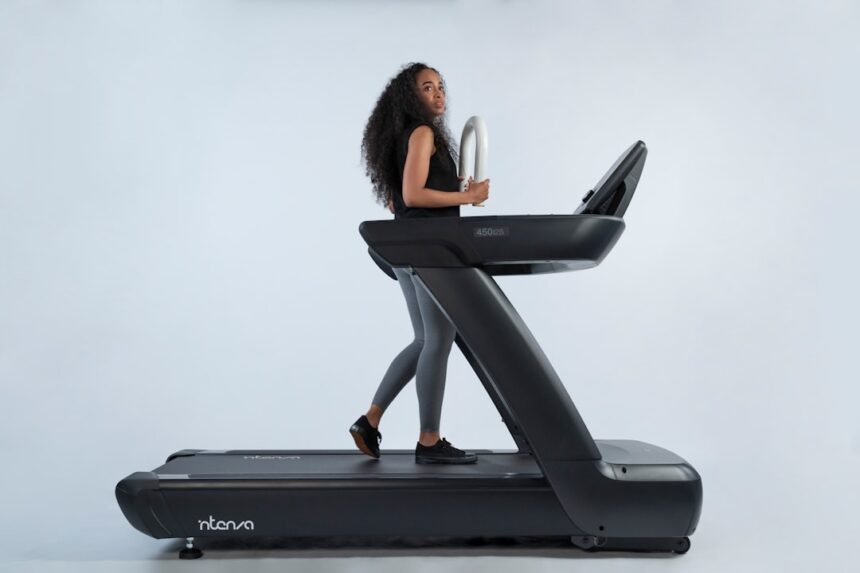
- Image: Intenza Fitness / Unsplash
This article reports on peer-reviewed fitness research for general information. It is not a personal fitness assessment or medical advice.
The Fitness Living Weekly
New Fitness Living Spotlights, important fitness news, research and independent reporting, delivered directly to your inbox.
One considered edition each week.
Do You Lead a Fitness Business Worth Knowing?
Fitness Living Magazine features independent gym owners, fitness trainers, and Pilates studio owners strengthening their local communities.