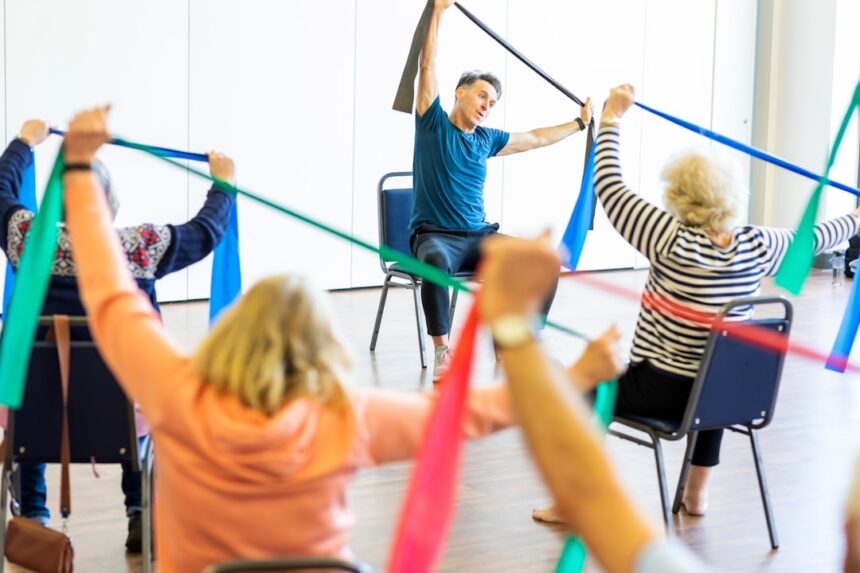
A newly published scoping review found that short, repeatable bouts of exercise may help older adults improve strength, balance and mobility while lowering the practical barrier created by longer workout sessions.
Exercise snacking for older adults is built around brief bouts of purposeful movement performed several times across the day rather than one longer workout. A review published September 9 in BMC Geriatrics examined whether this time-efficient approach could support physical function and frailty prevention in later life.
The review included 16 studies, 94% of which were published in 2022 or later. Seven were pilot randomized controlled trials. Across the literature, the authors reported generally favorable findings for muscle strength, balance and mobility, along with encouraging adherence and willingness to participate.
That does not make exercise snacking a proven prescription for preventing frailty. The evidence base is still young, study designs and protocols vary, and the reviewers explicitly called for larger multicenter trials, longer follow-up and better individualized programming.
At a Glance
- The scoping review was published September 9, 2026, in BMC Geriatrics.
- Sixteen studies met the inclusion criteria; seven were pilot randomized controlled trials.
- Most of the research was very recent, with 94% of included studies published in 2022 or later.
- Short exercise bouts were associated with improvements in physical-function measures including strength, balance and mobility.
- The review also described generally good safety and adherence, but protocols differed substantially.
- Long-term effects on frailty, falls, independence and clinical outcomes remain uncertain.
What Counts as Exercise Snacking?
Exercise snacks are not necessarily high-intensity intervals. In older-adult research, the term can include short sets of sit-to-stands, calf raises, balance drills, stair climbing or other simple movements repeated during the day. The defining feature is that the work is broken into brief, manageable bouts.
That matters because the biggest barrier to exercise is often not whether a program can work under ideal conditions, but whether someone can keep doing it. A five-minute movement break can be easier to place after breakfast or before lunch than a 45-minute session requiring travel, equipment and a large uninterrupted block of time.
studies were included in the new review. That is enough to identify a promising pattern, but not enough to establish one standardized dose, intensity or exercise menu for frailty prevention.
Why the Findings Are Encouraging
The review concluded that exercise snacking may support several components that become especially important with age: lower-body strength, balance, walking ability and general mobility. Those outcomes are practical because they relate to everyday tasks such as rising from a chair, climbing stairs and moving confidently through the home or community.
The authors also found signs of higher willingness to participate and better long-term adherence than traditional programs in some included studies. That may be the central appeal of the format. A physiologically modest program that people actually repeat can be more useful than a theoretically optimal program they abandon.
Fitness Living recently covered a randomized trial in which reactive balance training improved stepping performance in older adults without clearly reducing falls. The new exercise-snacking review reinforces the same caution: better performance on physical-function tests does not automatically prove fewer falls, disability or frailty over the long term.
The Evidence Is Not Yet a Universal Prescription
A scoping review maps an emerging field; it does not pool effects the way a formal meta-analysis can. The included studies used different exercises, schedules, populations and outcome measures, which makes it difficult to identify a single best protocol.
The literature is also dominated by small and pilot studies. Only seven of the 16 included studies were pilot randomized trials, and the authors specifically called for large multicenter clinical trials, stratification by frailty severity and long-term follow-up.
Metabolic and cognitive findings were less consistent than the physical-function outcomes. The reviewers reported positive signals, but improvements in some metabolic markers varied between studies. That is a reason to avoid treating exercise snacks as a replacement for established physical-activity recommendations.
Older adults with recent falls, severe balance impairment, unstable cardiovascular disease, significant joint pain or other medical limitations may need individualized guidance before adding repeated exercise bouts. A short session can still be challenging if the movement itself is inappropriate.
What Fitness Enthusiasts and Families Can Take From It
For a generally healthy older adult, the most practical interpretation is to view brief movement bouts as a way to accumulate more useful activity, not as a loophole that makes strength or aerobic training unnecessary.
A simple approach might involve linking a few movements to routines that already happen every day: several controlled sit-to-stands after breakfast, a short walk after lunch, or a few balance and calf-raise sets later in the day. The exact prescription should reflect current ability and safety.
Short sessions may also complement longer training. Fitness Living previously reported that 10 minutes of very light running improved mood and executive-function measures in a small trial. Together, these studies support a broader idea: useful physical activity does not always have to arrive in one large block.
The Fitness Living Takeaway
A new review of 16 studies found promising evidence that exercise snacking can improve strength, balance and mobility in older adults while offering a low-barrier format that may support adherence.
The evidence is still early. The review does not establish a universal dose or prove that short exercise bouts prevent frailty, falls or disability. Larger and longer randomized trials are the next step.
Research & Sources
- BMC Geriatrics: Exercise snacking as a strategy for frailty prevention and intervention
- Study DOI
- World Health Organization: Physical activity
- Image: Centre for Ageing Better / Unsplash
This article summarizes peer-reviewed research for general information and is not individualized medical, rehabilitation or fall-prevention advice.