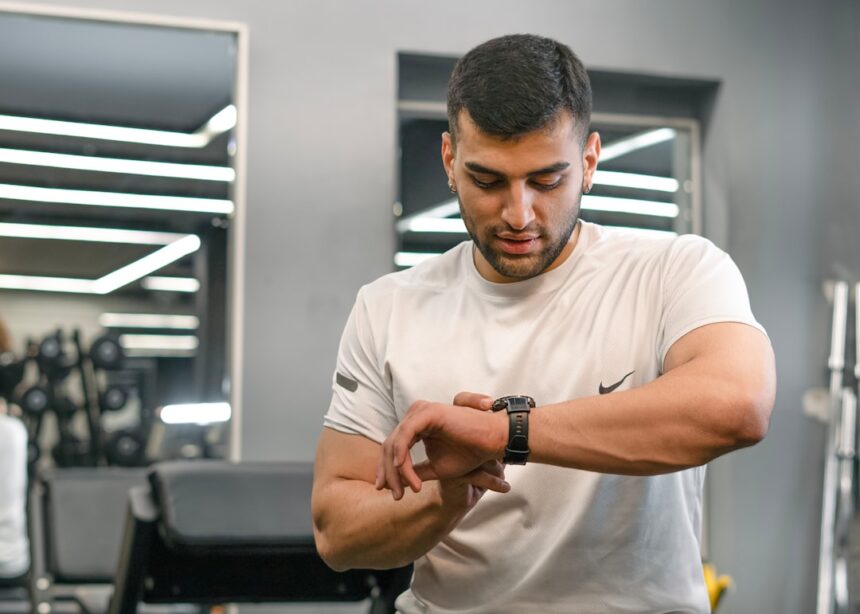
A new Florida International University report highlights an uncomfortable truth for anyone who adjusts food intake around a workout: smartwatch calorie-burn numbers can be useful for motivation, but they should not be treated as precise measurements of energy expenditure.
Smartwatch calorie burn accuracy was typically off by about 15% to 25% in an independent evaluation of four popular devices during cycling exercise, according to researchers at Florida International University. The errors were not uniform, and the estimates tended to become less accurate as participants’ body-fat percentage increased.
The study, published in PLOS One, compared Apple Watch Series 8, Fitbit Sense 2, Samsung Galaxy Watch 5 and Garmin Forerunner 955 readings with a COSMED K5 portable metabolic analyzer. Fifty-eight adults completed a controlled recumbent-cycling workout that alternated between moderate and vigorous intensity while the laboratory system measured oxygen consumption and carbon-dioxide production to estimate true energy expenditure.
At a Glance
- 58 adults completed a controlled cycling workout while wearing one of four popular smartwatches.
- Typical calorie-estimate errors were about 15% to 25%, with some devices performing worse.
- Apple produced the most accurate estimates in this specific test; Garmin and Samsung overestimated the most.
- Fitbit produced enough implausible or missing readings that much of its data had to be excluded from the main analysis.
- Higher body-fat percentage was associated with larger calorie-estimation error.
How the Smartwatch Calorie Burn Accuracy Test Worked
Energy expenditure is difficult to measure from the wrist. A smartwatch can monitor movement and heart rate, then combine those signals with personal information such as age, sex, height and weight. But it does not directly measure the oxygen and carbon dioxide used to calculate energy expenditure in a laboratory.
That is why the FIU team used indirect calorimetry as the reference. Participants rode a recumbent bike while wearing a metabolic analyzer and one of the tested watches. The workout moved between moderate and vigorous stages so researchers could compare the devices across changing exercise intensity.
Typical smartwatch calorie-estimate errors landed in this range during the cycling protocol, although average error for the poorest-performing devices climbed higher.
Those percentages can become meaningful when someone treats a watch as an accounting system. A displayed 500-calorie workout could be tens or even more than 100 calories away from the laboratory estimate. Repeated over a week, that gap can distort the idea of how much food was “earned” by exercise.
Why Body Fat May Change the Error
The researchers found that smartwatch calorie burn accuracy tended to worsen as body-fat percentage increased. The study does not establish exactly why. Consumer algorithms are proprietary, and researchers do not know which populations were used to develop each device’s equations.
That uncertainty matters because people using a wearable specifically for weight management may be especially likely to rely on calorie estimates. If the algorithm is less accurate for some body types, a single universal number can create false confidence.
What the Study Does Not Mean
The result does not mean smartwatches are useless. It also does not prove that every device is always wrong by 15% to 25%. This was one controlled cycling protocol using specific watch models and software versions. Accuracy can differ by activity, device generation, intensity and individual characteristics.
The study also cannot tell us how well these watches estimate energy expenditure during strength training, running, group classes or free-living activity across an entire day. The FIU team is now studying traditional resistance-training workouts, where short bursts of work and recovery may challenge algorithms in a different way.
Trying to “correct” a watch by sharply cutting food intake can create a second problem. Training still requires enough energy and nutrients to support recovery, muscle retention and performance. The safer lesson is to reduce precision, not reduce fuel indiscriminately.
Which Smartwatch Metrics Are More Useful?
For fitness enthusiasts, the most useful wearable data often comes from trends rather than single-point calorie estimates. Heart rate, workout duration, pace, distance and time spent in heart-rate zones can help show whether training load is changing over time.
A watch can also be valuable for habit formation. Seeing weekly training frequency, step counts or consistent workout duration can reinforce behavior even if the calorie estimate is imperfect. The key is to compare yourself with your own prior data instead of treating the device as a metabolic laboratory.
This is similar to how environmental data should be interpreted in our recent report on air pollution and marathon performance: one number is more useful when placed in context than when treated as a verdict.
How to Use Calorie Estimates for Weight Management
If body-composition change is the goal, weekly trends in body weight, waist measurements, training performance, hunger and recovery are usually more informative than trying to match every meal to a watch’s estimate. Day-to-day body weight fluctuates, but the direction across several weeks can show whether total intake and activity are roughly aligned with the goal.
Someone maintaining weight despite a watch that repeatedly reports a large calorie deficit has learned something important: the device’s energy math, the food-tracking math, or both are not precise enough to explain real-world balance. That is not failure. It is a reason to adjust based on observed trends rather than theoretical totals.
The Device Ranking Needs Caution
Apple performed best in this test, while Garmin and Samsung overestimated the most. But the study used Apple Watch Series 8, Fitbit Sense 2, Galaxy Watch 5 and Forerunner 955. Newer models, updated algorithms and different activities could produce different rankings.
Fitbit was especially difficult to judge because some readings were implausibly low or missing. Researchers excluded much of those data rather than pretending faulty measurements represented normal performance.
Why This Story Matters Now
Wearables increasingly influence training and nutrition decisions. People use them to decide whether to add cardio, eat more, recover, push harder or stop a session early. The more authority a device has in someone’s routine, the more important it becomes to know which numbers are direct measurements and which are estimates.
Smartwatch calorie burn accuracy belongs in the second category. The technology can still support consistency and self-awareness. It simply should not be asked to deliver a level of metabolic precision that the current hardware and algorithms cannot guarantee.
The Fitness Living Takeaway
Smartwatch calorie-burn estimates were typically off by about 15% to 25% in this FIU cycling study, and error tended to increase with body-fat percentage. Treat the number as a rough guide. For training, lean more heavily on repeatable metrics such as heart rate, pace, duration and personal trends. For weight management, use changes over several weeks rather than eating back every calorie a watch reports.
Research & Sources
- PLOS One: Body fat, skin tone, and the accuracy of smartwatch caloric expenditure estimates
- Florida International University research summary, September 1, 2026
- PubMed record for the smartwatch energy-expenditure study
- Image: Mina Rad
This article reports on peer-reviewed fitness research for general information. It is not individualized nutrition or medical advice.
The Fitness Living Weekly
New Fitness Living Spotlights, important fitness news, research and independent reporting, delivered directly to your inbox.
One considered edition each week.
Do You Lead a Fitness Business Worth Knowing?
Fitness Living Magazine features independent gym owners, fitness trainers, and Pilates studio owners strengthening their local communities.