
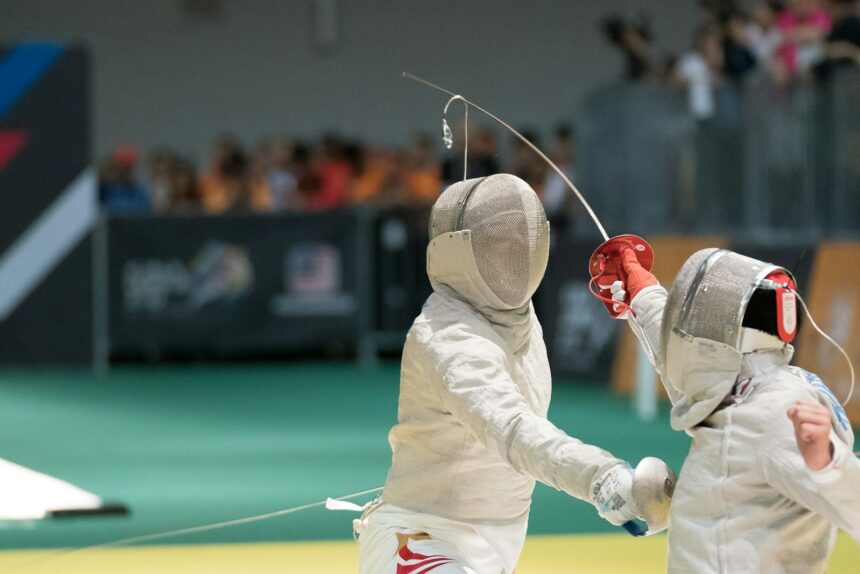
A full season of weekly monitoring in professional sabre fencers found that cumulative training load, rather than any single punishing week, tracked with overuse injury risk. The same pattern appeared across two-week, three-week and four-week training load windows.
Training Load accounting is one of the oldest arguments in sport science, and a new prospective cohort study has taken it into an unusual setting. Writing in BMC Sports Science, Medicine and Rehabilitation on November 24, 2026, researchers followed a single professional sabre fencing team through one complete competitive season to see whether the work already banked over preceding weeks predicted who would report an overuse problem.
Within the limits of a very small cohort, accumulation mattered and isolated weeks did not. Fencers sitting in the highest four-week cumulative training load category carried 2.76 times the odds of reporting a substantial overuse problem compared with those in the lowest category.
The squad was small by any standard: 14 professional sabre fencers, monitored across 497 athlete-weeks. Internal training load came from session rating of perceived exertion, the session-RPE method that pairs session duration with how hard the athlete judged the effort to be. It is cheap, needs no hardware and remains the most widely used internal measure in team settings.
Overuse problems were captured weekly with the Oslo Sports Trauma Research Centre Overuse Injury Questionnaire, abbreviated OSTRC-O2. That instrument matters here because it grades problems including pain and reduced participation, rather than counting only injuries severe enough to stop an athlete training. Across the season the squad logged 129 injury-weeks.
The analysis, from Wang and colleagues including Wong and Liao, used generalized estimating equations, divided each training load metric into tertiles drawn from the sample itself, and separated athletes by whether they had reported a substantial problem the previous week.
At a Glance
- Published November 24, 2026 in BMC Sports Science, Medicine and Rehabilitation as an exploratory prospective cohort study.
- 14 professional sabre fencers from one team, monitored across a full competitive season for a total of 497 athlete-weeks.
- Internal training load was measured by session rating of perceived exertion; overuse problems were graded with the OSTRC-O2 questionnaire.
- 129 injury-weeks were recorded over the course of the season.
- Highest versus lowest cumulative training load gave an odds ratio of 2.11 at two weeks, 2.36 at three weeks and 2.76 at four weeks, all significant at p below 0.01.
- Acute single-week training load showed no statistically significant association with injury risk.
- Associations were unadjusted and the cohort was very small, so the authors present the work as exploratory rather than prescriptive.
Why Cumulative Training Load Behaved Differently From One Hard Week
The contrast is the most useful part of the paper. A single demanding week, taken on its own, carried no detectable signal. Stack two, three or four weeks of training load together and the odds climbed in an orderly way, from 2.11 to 2.36 to 2.76.
That ordering is what makes the result worth a second look rather than noise. If the association were purely an artefact of a small sample, there would be no particular reason for the effect to grow as the window lengthened.
It also fits a common coaching intuition. Tissue tolerance is shaped by weeks of accumulated work, not by any one Tuesday.
What Session-RPE Actually Captures
Session-RPE multiplies minutes by perceived effort, producing one number per session. It folds physical and psychological strain into a single figure, which is both its strength and its weakness.
A fencer feeling flat after travel may rate an ordinary session highly. The method does not separate the mechanical loading of repeated lunges from general fatigue, so a rising training load score can reflect several different things at once.
That ambiguity is worth holding onto when reading any training load study built on perceived effort. It measures strain as the athlete experiences it, which is useful, but it is not a direct measure of tissue stress.
Athlete-weeks of training load and symptom data collected across one full competitive season from a squad of just 14 fencers.
The Acute-to-Chronic Ratio Did Not Hold Up
The study also tested acute-to-chronic workload ratios, the metric that dominated load monitoring for most of the last decade. Moderate versus low ratios produced odds ratios of 0.50 for an uncoupled one-week to four-week rolling average and 0.51 for a coupled exponentially weighted moving average.
The second reached nominal significance at p equal to 0.044, but neither survived adjustment for the small sample. On this evidence the ratio added nothing that raw cumulative training load did not already supply.
Why the Previous Week Changed the Picture
Stratifying by the previous week mattered. The cumulative training load associations appeared among fencers who had not reported a substantial problem in the preceding week. Among those who had, tertile analyses showed no detectable relationship at all.
Formal interaction tests between workload metrics and previous-week status were not significant, with all p values above 0.05, so the difference should be read cautiously. The authors note a plausible explanation: athletes already managing symptoms probably modified their own sessions, blurring any link between planned work and reported problems.
How the Result Sits Alongside Other Load Research
Load monitoring research has spent years hunting for a single ratio that flags risk, and the acute-to-chronic measure was the leading candidate. Larger reviews in team sports have steadily walked back that promise, finding the ratio sensitive to how it is calculated and poorly suited to decisions about individuals.
What survives is less tidy but more durable: rapid increases in work, sustained over several weeks, tend to precede problems. This study points the same way without claiming a cutoff, and it does so in a sport that almost never appears in the load literature at all.
What 14 Athletes Can and Cannot Settle
This is an exploratory study and the authors say so plainly. Fourteen fencers generate wide uncertainty, and the odds ratios reported here are better treated as a direction than as a measurement.
The associations were also unadjusted, meaning no statistical control for age, training history, prior injury or competition schedule. With several training load metrics and several time windows tested, the chance of a spurious finding rises accordingly.
What It Means If You Train Hard
Nothing here hands anyone a number to train to. What it does support is a habit: read the past month, not yesterday.
Most recreational athletes already track something, whether a watch metric or a simple session count. The practical shift is to read that record as a rolling total rather than a daily verdict.
- Compare the past three or four weeks of training load against the month before, rather than judging any single session.
- Treat a rising four-week total as a reason to plan an easier week, not as a cause for alarm.
- Log niggles weekly; graded symptom tracking caught problems here that a training-stopping definition would have missed.
- Remember that perceived effort climbs with poor sleep and stress, so a spike may not be mechanical at all.
There is also a reporting lesson buried in the method. The questionnaire used here asks athletes every week whether pain or reduced participation is affecting them, which surfaces trouble long before anything stops training altogether. Keeping a weekly note of niggles is unglamorous, but it is the part of this study design most easily copied by someone training alone.
Fencing is an unusual sport, but the loading logic is not exotic. Similar questions have been put to ball sports: FLM has covered research on muscle damage after a competitive football match and on how quickly footballers recover between fixtures, both of which bear on how much training load an athlete can absorb in a congested week.
Symptom-grading questionnaires of the kind used here have also reshaped how overuse is counted in youth sport, as in work on shoulder symptoms among elite youth handball players. And where accumulated load does translate into mechanical risk, movement quality matters too, a theme in research on landing asymmetry in soccer players.
For everyone training below the professional tier, the World Health Organization still frames the baseline in simpler terms, recommending at least 150 minutes of moderate-intensity physical activity per week, a level roughly a third of the adult world misses.
The Fitness Living Takeaway
In a season-long cohort of 14 professional sabre fencers, cumulative training load over two to four weeks was linked to higher odds of a substantial overuse problem, while single-week load showed nothing.
The orderly rise from 2.11 to 2.76 as the window lengthened is the detail worth keeping, because it points at accumulation rather than any one session. But 14 athletes, unadjusted models and multiple metrics tested mean this is a hypothesis, not a rule. It argues for watching monthly totals rather than setting a cutoff.
Research & Sources
- BMC Sports Science, Medicine and Rehabilitation: Internal training load and overuse injuries in professional sabre fencers
- Study DOI: 10.1186/s13102-026-02271-x
- World Health Organization: Physical activity fact sheet
- Images: Eugene Lim / Unsplash; CHUTTERSNAP / Unsplash
This article summarizes peer-reviewed research for general information and is not individualized medical or exercise advice.