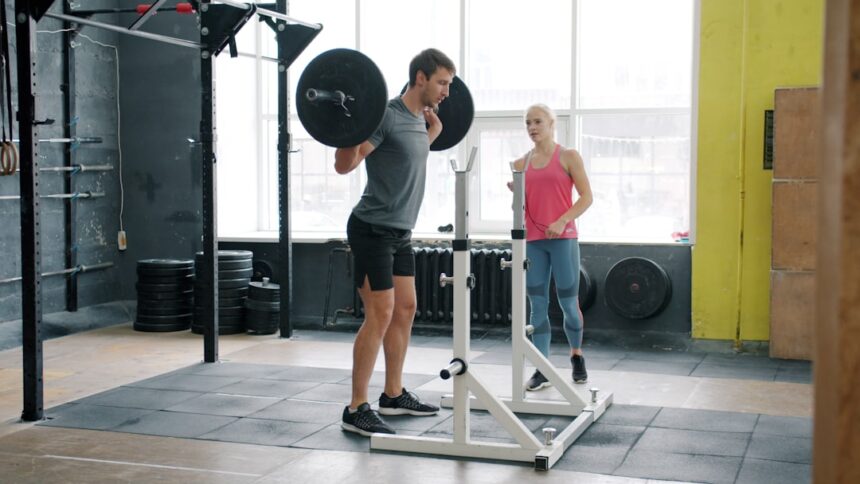
Top-half squats and bench presses let 10 untrained men handle substantially heavier 10-repetition-maximum loads while producing lower post-workout lactate and a smaller cortisol response than full-range lifting. The study measured only one exercise session and does not show that abbreviated reps build more muscle.
Partial range of motion training changes more than the distance a bar travels. By avoiding the mechanically difficult bottom portion of a squat or bench press, lifters can often use more weight. A study published September 12 in the European Journal of Applied Physiology tested how that tradeoff changed acute metabolic and hormonal responses in 10 young men with no regular resistance-training experience.
Each participant completed three conditions one week apart: full-range squats and bench presses, top-half partial versions of those lifts, and passive rest. The exercise sessions used three sets at each condition’s own 10RM on a Smith machine.
The partial-range condition allowed much heavier loads, but full-range training produced more blood lactate and a larger cortisol response. Testosterone rose immediately after both lifting conditions, and growth hormone increased over time after both, with no clear evidence that the partial-range condition produced a superior anabolic response.
At a Glance
- The study was published September 12, 2026, in the European Journal of Applied Physiology.
- Ten untrained men, average age 24.1, completed all three crossover conditions.
- Top-half partial squats used a 10RM of about 110 kg versus 66.7 kg for full-range squats.
- Top-half bench presses used about 63.9 kg versus 47.8 kg for full-range presses.
- Post-exercise lactate was higher after full-range training: about 12.0 versus 9.4 mmol/L.
- The study measured acute hormones and metabolic stress, not long-term strength or hypertrophy.
Top-Half Reps Changed the Load and Stress Profile
The largest practical difference appeared before the blood samples were analyzed: the shortened range let participants lift substantially more weight. Partial-range squat 10RM averaged 110.0 ± 17.2 kg, compared with 66.7 ± 8.2 kg through the full range. Bench-press 10RM averaged 63.9 ± 7.7 kg for partial reps and 47.8 ± 7.1 kg for full reps.
That does not mean the partial session did more total work. The researchers did not directly measure total mechanical work, and the shorter bar path changes the amount of distance moved on every repetition.
Blood lactate increased after both training conditions, but it rose more after full-range exercise: 11.97 ± 1.96 mmol/L compared with 9.37 ± 2.18 mmol/L after partial training. Heart rate and perceived exertion during the sets were broadly similar, although heart rate remained about eight beats per minute higher 15 minutes after full-range work.
completed the crossover experiment. That design helps compare the same people under different conditions, but the very small, all-male, untrained sample sharply limits how far the findings can be generalized.
The Hormone Results Need Careful Interpretation
Total testosterone increased immediately after both full- and partial-range sessions. Fifteen minutes later it had returned toward baseline after full-range training but remained significantly above baseline after partial training. Growth hormone rose over time in both lifting conditions, without a significant difference between them.
Cortisol increased significantly at 15 minutes only after the full-range session and was higher than passive rest at that time point. The testosterone-to-cortisol ratio, however, showed no significant condition, time or interaction effect.
Those details matter because acute hormone spikes are sometimes presented as a shortcut to predicting muscle growth. This experiment cannot do that. It did not measure changes in muscle size, strength adaptation, protein synthesis across a training program or performance over weeks and months.
This Was Shortened Partial Training, Not Lengthened Partials
The partial repetitions were performed in the biomechanically easier top half of each lift. In the squat, participants did not descend to the full parallel position; in the bench press, the bar traveled through roughly half the full distance near lockout.
That distinction is important because current range-of-motion research often separates shortened partials from lengthened partials performed near the stretched position of a muscle. The present findings apply only to the contracted or top-half version tested here.
Recent FLM coverage of quadriceps stiffness across different joint positions also shows why the exact position of a muscle can materially change what is being measured. A label such as “partial rep” is not specific enough without describing which part of the movement is trained.
What Full-Range Research Still Says
The authors note that previous systematic reviews generally favor full range of motion for hypertrophy, particularly in the lower body, even though partial reps can allow heavier loads and may be useful for specific purposes. That broader evidence should not be displaced by a single acute hormone study.
The new paper is better viewed as a physiology experiment: when work was shifted to the stronger half of the squat and bench press and the 10RM load increased accordingly, the immediate metabolic and endocrine pattern changed.
That complements, rather than replaces, studies focused on actual training adaptation. Fitness Living recently reported an isometric training trial that measured six-week changes in force and a deadlift study evaluating velocity-based 1RM estimation. Those designs answer different questions from an acute blood-sampling experiment.
What Lifters Can Actually Use
Top-half partials can be a legitimate way to expose a lifter to heavier absolute loads or train a specific portion of a lift. This study supports that mechanical observation and suggests the acute metabolic cost may differ from full-range work.
It does not justify replacing full-range training for general strength or muscle development. For most recreational lifters, range of motion is better chosen around the exercise goal, joint tolerance, technique and the muscle lengths being emphasized than around a transient testosterone or cortisol reading.
If partial reps are used, they can be treated as a specific programming tool rather than a universal upgrade. More meaningful guidance will require longer randomized training studies comparing shortened partials, lengthened partials and full range under better-matched work and volume.
The Fitness Living Takeaway
Top-half partial squats and bench presses let 10 untrained men use much heavier 10RM loads while producing lower lactate and less of a cortisol rise than full-range lifting in one laboratory session.
The interesting finding is the different acute stress profile—not proof of superior muscle growth. Full-range training remains well supported, while partial reps are best understood as a targeted tool whose long-term value depends on where in the range they are performed and how they fit the program.
Research & Sources
- European Journal of Applied Physiology: Resistance training performed under a partial range of motion elicits favorable hormonal responses in untrained young men
- Study DOI
- Image: Vitaly Gariev / Unsplash
This article summarizes exercise physiology research for general information and is not individualized strength-training or medical advice.