A Stanford-led analysis of mouthguard sensor data reports that straight-line head acceleration predicted concussion risk better than the rotational motion researchers have blamed for decades. The new concussion risk curve puts the 50 percent mark far lower than the threshold built into much of the helmet testing world.
Concussion Risk has been modeled around rotational acceleration since the 1940s. A study published in Annals of Biomedical Engineering on November 9, 2026 argues that the field has been tracking the wrong variable, and it uses instrumented mouthguard data from real competition to make the case.
The work came out of Stanford Medicine, with Jessica Towns, a graduate student in bioengineering, as lead author and David Camarillo, an associate professor of bioengineering, as senior author. Collaborators included SoftShox, Monash University, Deakin University, Duke University and Alfred Health.
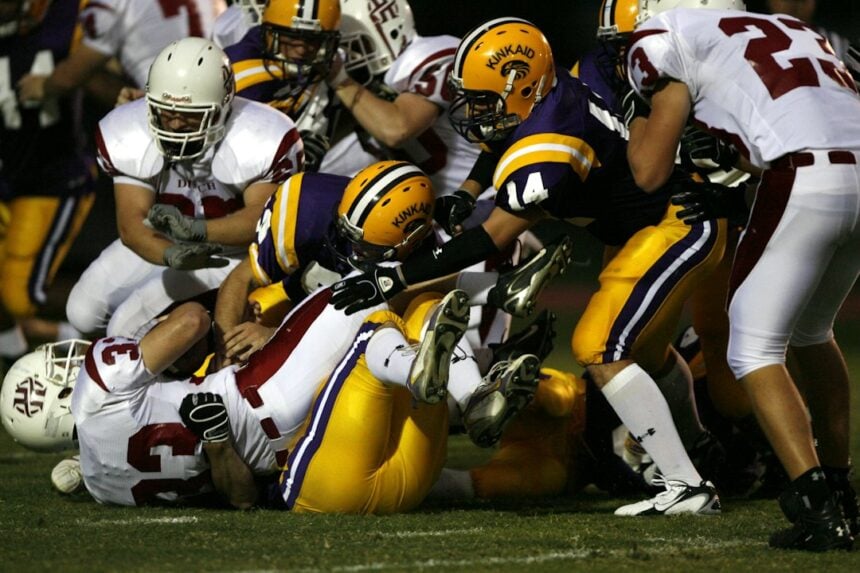
The dataset is the unusual part. Motion-sensing mouthguards worn by 203 male and female athletes across seven sports, among them football, lacrosse and mixed martial arts, captured 3,851 head impacts: 47 that led to a diagnosed concussion and 3,804 that did not.
In the resulting model, peak linear acceleration was the single most predictive factor. Adding peak rotational acceleration did not improve the model. For a field that has treated rotation as the primary mechanism of injury for 85 years, that is a substantial reordering.
At a Glance
- Published November 9, 2026 in Annals of Biomedical Engineering, from Stanford Medicine.
- 203 male and female athletes across seven sports wore instrumented mouthguards during real competition.
- 3,851 recorded impacts in total: 47 concussive and 3,804 non-injurious.
- Linear acceleration classified impacts better than rotational acceleration, with an area under the precision-recall curve of 0.65 against 0.35.
- Rotational acceleration was not an independent predictor once linear acceleration was in the model, with an odds ratio of 1.3, 95 percent CI 0.81 to 1.9.
- A 100 g linear impact carried a 50 percent concussion risk; 150 g exceeded 99 percent. The average football impact is about 25 g.
- Main caveat: only 47 concussions, so the concussion risk curve needs independent confirmation.
What the Concussion Risk Model Was Built From
Most head-injury thresholds in circulation were derived from helmet-mounted sensors, crash-test dummies or cadaver work. Mouthguards sit on the upper teeth, coupled to the skull rather than to padding, so they record what the head actually did instead of what the helmet shell did.
Impacts were videotaped, and concussion was determined either by on-site medical staff or by later review. That gives the concussion risk labels a clinical basis rather than relying on sensor thresholds alone, which has been a weakness of earlier datasets.
The comparison itself is straightforward: for each impact, how well did peak linear acceleration separate the injured cases from the uninjured ones, and how much did peak rotational acceleration add on top of that?
Why Straight-Line Motion Outperformed Rotation
On the published classification metrics, linear acceleration reached an area under the precision-recall curve of 0.65 and an F1 score of 0.50. Rotational acceleration managed 0.35 and 0.31 on the same measures, a clear gap rather than a marginal one.
When both were entered together, linear acceleration carried an odds ratio of 2.3 with a 95 percent confidence interval of 1.5 to 3.6, while rotational acceleration fell to 1.3 with an interval of 0.81 to 1.9 that crosses one. Rotation, in other words, stopped being an independent contributor to concussion risk.
One rotational measure did survive. Peak rotational velocity, as distinct from rotational acceleration, added a modest amount of predictive value when combined with linear acceleration, which suggests the rotational story is being refined rather than discarded.
The distinction is not academic. Linear acceleration describes the head being driven along a straight path, while rotational acceleration describes how fast its spin rate changes. Protective equipment, practice rules and tackling technique all target those two things differently, so which one drives concussion risk determines where the effort should go.
The linear acceleration at which the new model places concussion risk at 50 percent. An often-cited earlier threshold, derived from helmet-mounted sensors, sat at 192 g.
The New Concussion Risk Curve, in Numbers
The practical output of the paper is a risk function. At 100 g of linear acceleration, half of the athletes taking that blow would be expected to sustain a concussion. As the senior author put it, if 100 people were each hit at 100 g, half of them would get a concussion.
At 150 g the curve is close to vertical: predicted concussion risk exceeds 99 percent. For context, the average head impact in football measures roughly 25 g, which is well down the shallow part of the curve.
The gap with the older 192 g figure is the headline consequence. Thresholds used to qualify helmets for sale have generally been much higher than 100 g, which means equipment can pass while allowing impacts the new concussion risk model treats as coin-flip dangerous.
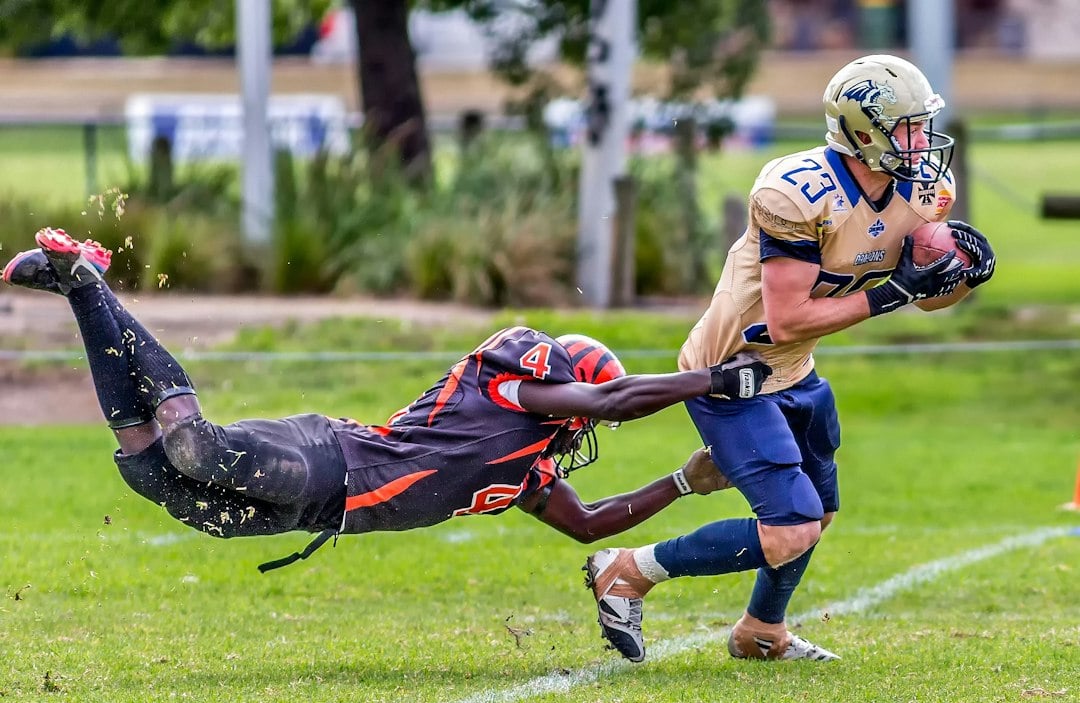
What It Could Mean for Padding and Helmet Design
The team also ran laboratory tests on football helmet padding filled with liquid rather than foam. At the highest impact level tested, predicted concussion risk fell from 73.3 percent with standard helmets to 55.7 percent with the liquid-filled pads.
Across the tested range, the reported reduction in predicted concussion risk reached up to 52 percent, and the mechanism was consistent with the main finding: the pads worked mainly by cutting linear acceleration rather than by damping rotation.
That result needs reading with the conflict of interest in view. Camarillo co-founded SoftShox, the company that licensed the Stanford technology and makes the liquid-filled pads, which the release discloses plainly.
Where the Concussion Risk Estimate Is Still Soft
Forty-seven concussions is a large number to collect with instrumented mouthguards and a small number on which to rebuild an injury standard. The authors say the finding needs confirmation across broader athlete cohorts before it should reshape safety guidelines.
There is also a sampling question. The impacts captured may have carried larger linear components than rotational ones, which would flatter linear acceleration. Rotational acceleration may still matter more in longer-duration mechanisms such as whiplash, where the head keeps turning well after contact.
A preliminary analysis of concussive impacts in athletes under the age of 14 indicated lower injury thresholds in children, but that part of the work is explicitly described as preliminary. The biological route by which linear forces damage brain tissue also remains under investigation.
Independent replication is the obvious next step, and it is now easier than it was. Instrumented mouthguards have spread through elite and college sport over the past decade, which means other groups hold datasets capable of testing whether this concussion risk curve holds in their own athletes.
What Athletes, Coaches and Parents Can Reasonably Take From It
No individual should recalculate their own concussion risk from a published curve. What the paper supports is a shift in how exposure is thought about: the severity of straight-line head acceleration, not just whether a hit looked like it twisted the neck.
- Contact exposure in training is modifiable in a way that game contact is not, which is where most sports have found room to cut total impacts.
- Equipment certification labels describe passing a test standard, not a personal concussion risk figure.
- Suspected concussion still needs removal from play and assessment by a qualified clinician, whatever the sensor numbers say.
- Youth thresholds may be lower than adult ones, and the evidence there is still preliminary rather than settled.
Impact exposure differs sharply by discipline, something our analysis of a reaction timing index across 312 combat sport athletes illustrated from the striking-sport side. Population injury data tells a complementary story: our review of 12 years of US exercise-related injury surveillance shows how rarely most activity produces serious harm.
For the youth end of the question, our coverage of a decade of youth sport participation data and of severe injuries among 192 elite cyclists both bear on how exposure and risk are traded against the clear benefits of competing.
The Fitness Living Takeaway
Across 3,851 monitored impacts, peak linear acceleration predicted concussion better than rotational acceleration, placing 50 percent concussion risk at 100 g rather than the long-cited 192 g.
The dataset is the strongest of its kind, drawn from mouthguards in live competition across seven sports. It still rests on 47 diagnosed concussions, the sampled impacts may have favored linear motion, and the senior author has a commercial interest in the padding technology tested alongside the model.
Research & Sources
- Stanford Medicine: Concussion study upends understanding of what makes head impacts dangerous
- Annals of Biomedical Engineering, study DOI: 10.1007/s10439-026-04437-7
- Preprint: Limitations of Rotational Acceleration for Predicting Concussion
- Bioengineer: Linear head motion outperforms rotational acceleration in predicting concussion risk
- Images: Keith Johnston / Unsplash; John Torcasio / Unsplash
This article summarizes peer-reviewed research for general information and is not individualized medical or exercise advice.