
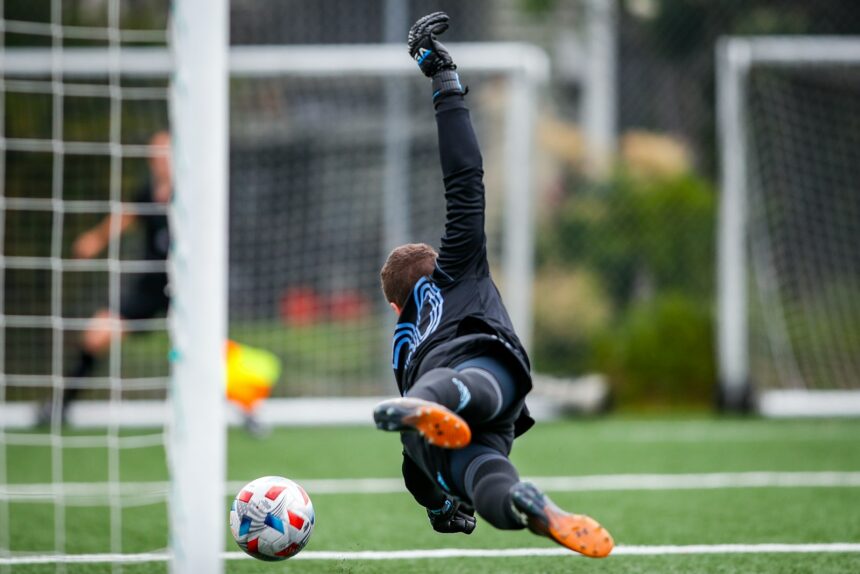
An eight-week trial added neuro-athletic training to the normal week of 20 competitive goalkeepers and measured what changed. Balance, jump flight time, grip strength and change-of-direction speed all moved, but neuro-athletic training left one jump measure untouched.
Neuro-Athletic Training is one of those terms that arrives in a gym before the evidence does. A randomized controlled trial published in BMC Sports Science, Medicine and Rehabilitation on November 24, 2026 put an eight-week progressive version of it in front of competitive soccer goalkeepers, and reported gains on four of five movement measures.
The trial was small and deliberately narrow. Twenty competitive male goalkeepers from the Turkish Regional Amateur League and the TFF Third League were randomly allocated to an experimental group of ten, who added neuro-athletic training to their usual soccer sessions, or a control group of ten, who simply carried on training as normal.
The design was assessor- and analyst-blinded and parallel-group, which matters for outcomes like agility timing where an unblinded tester can nudge results. The primary outcome was the dominant-limb Y-Balance composite score. Secondary outcomes covered countermovement jump flight time and height, handgrip strength and T-agility completion time.
The headline number sits in the agility test. The between-group difference in change was 0.283 seconds in favour of the group doing neuro-athletic training, on a test where a lower time is the better result.
At a Glance
- Published November 24, 2026 in BMC Sports Science, Medicine and Rehabilitation as an assessor- and analyst-blinded randomized controlled trial.
- 20 competitive male soccer goalkeepers from the Turkish Regional Amateur League and TFF Third League, split ten and ten.
- Eight weeks of progressive neuro-athletic training added to normal soccer training, against normal training alone.
- Y-Balance composite score: significant group-by-time interaction at p equal to 0.022, partial eta squared 0.259, Hedges g 1.07, with a 2.74 percent within-group improvement.
- Countermovement jump flight time: p equal to 0.015, partial eta squared 0.288, Hedges g 1.16. T-agility time: p equal to 0.005, partial eta squared 0.360.
- Handgrip strength also showed a significant interaction at p equal to 0.027, partial eta squared 0.243.
- Jump height did not move: p equal to 0.669, partial eta squared 0.010.
What Neuro-Athletic Training Actually Involves
The label covers work aimed at the nervous system rather than the muscle. In practice that means drills loading vision, balance and the vestibular system, often alongside breathing and reaction tasks, on the premise that movement quality is limited by how well the brain reads the body and its surroundings.
For a goalkeeper the logic is intuitive. The job is a sequence of reactions in cluttered visual conditions, and the first movement decides whether the dive arrives in time.
Whether neuro-athletic training delivers on that premise is a separate question from whether the premise is appealing, which is why a blinded trial is worth reading closely.
How the Trial Was Run
Both groups kept their regular soccer schedule across the eight weeks. Only the experimental group added the neuro-athletic training programme, and that programme progressed over the period rather than staying fixed.
Outcomes were measured before and after. The analysis looked for group-by-time interactions, the appropriate test for whether one group changed more than the other, and reported partial eta squared alongside Hedges g as effect size measures.
No confidence intervals were reported, which limits how precisely the size of each effect can be pinned down.
The between-group difference in change on the T-agility test, favouring the goalkeepers who added neuro-athletic training.
Where Neuro-Athletic Training Moved the Needle
Four outcomes showed significant interactions. Balance was the primary target and it responded: the Y-Balance composite improved with a partial eta squared of 0.259 and a Hedges g of 1.07, alongside a within-group gain of 2.74 percent.
Change-of-direction speed produced the largest effect size of the set, with a partial eta squared of 0.360 on T-agility completion time. Jump flight time followed closely, at 0.288.
Handgrip strength also shifted, which is harder to explain mechanistically and may reflect general training exposure rather than anything specific to neuro-athletic training.
The Measure That Did Not Budge
Jump height stayed flat. The interaction came in at p equal to 0.669 with a partial eta squared of 0.010 and a Hedges g of 0.19, which is as close to nothing as these trials produce.
That split is informative rather than disappointing. Flight time improved while height did not, and those two measures are related but not identical, since flight time is sensitive to take-off and landing mechanics as well as to raw propulsion.
A programme aimed at coordination plausibly changes how a jump is organised without changing how much force the legs can produce.
Why the Control Group Limits What This Shows
The authors are direct about the central weakness. The control group received no time-matched active intervention, so it trained less in total than the experimental group did.
That means the trial compares normal training plus extra work against normal training alone. It cannot separate the specific contribution of neuro-athletic training from the simple fact of doing more.
The authors state the finding should be read as evidence for the effect of adding this programme to regular training, and call for further trials using time-matched active control conditions.
How It Compares With Other Perceptual Training Work
Trials that target perception and coordination rather than muscle have a mixed record. Some report transfer to sport-specific tasks; others find gains that stay inside the drill itself and never surface in competition.
This trial sits in the more encouraging half, because its outcomes were standard field tests rather than the drills the athletes had practised. That reduces, though it does not eliminate, the risk that neuro-athletic training simply taught the test.
The absence of any match-performance outcome remains the real gap. Balance scores and agility times are proxies, and the step from a faster T-agility run to a save actually made is still an assumption.
What 20 Goalkeepers Can and Cannot Settle
Ten per group is a small trial, and the effect sizes reported here are correspondingly fragile. Large Hedges g values are common in small samples and tend to shrink when studies are repeated at scale.
The population is also specific: competitive male goalkeepers in two Turkish leagues, led by work from Okan Demir of Gümüşhane University in Türkiye. Whether the same programme helps outfield players, women, youth players or recreational athletes is untested here.
What the trial does establish is that eight weeks of this work produced measurable change on blinded tests, which is more than many training fads can claim.
What It Means for Athletes Outside the Goal
The honest reading is that neuro-athletic training looks promising for balance and change-of-direction qualities, on thin evidence, and that some of the benefit may simply be extra structured practice.
For most readers the practical implications are modest but real.
- Balance and reaction drills are cheap, low-risk additions to a week and need no equipment.
- Expect coordination gains rather than strength gains; jump height did not improve here.
- Eight weeks was enough to register change, so judge any similar programme over a block, not a fortnight.
- If time is limited, adding work on top of a full schedule raises total load, which carries its own cost.
That last point connects directly to our other report today on cumulative training load and overuse injury risk in professional fencers, which found accumulated weeks of work, not single sessions, tracking with problems. Adding a neuro-athletic training block is still adding work.
Readers following this ground may also want our coverage of virtual reality training and soccer cognition, which tests a related idea from a different direction, and of taping effects on balance and sprinting. For the strength side of the picture, our review of the reactive strength index and resistance training covers what does shift force production.
For anyone not chasing a performance edge, the World Health Organization baseline remains the sensible floor: at least 150 minutes of moderate-intensity physical activity per week, which roughly 31 percent of the adult world fails to reach.
The Fitness Living Takeaway
Eight weeks of progressive neuro-athletic training added to normal soccer training improved balance, jump flight time, grip strength and agility in 20 competitive goalkeepers, but left jump height unchanged.
The agility result, a 0.283 second between-group difference, is the most concrete finding, and the blinded assessment strengthens it. But the control group did no matched extra work, so part of the gain may be volume rather than method. Twenty athletes in two leagues is a starting point, not a verdict.
Research & Sources
- BMC Sports Science, Medicine and Rehabilitation: 8-week progressive neuro-athletic training and goalkeeper movement performance
- Study DOI: 10.1186/s13102-026-02200-y
- World Health Organization: Physical activity fact sheet
- Images: My Profit Tutor / Unsplash; Matheus Protzen / Unsplash
This article summarizes peer-reviewed research for general information and is not individualized medical or exercise advice.