A systematic review pooled six randomized trials of virtual reality training in soccer players and found no significant effect on cognitive performance. The pooled estimate was small, its confidence interval crossed zero, and no moderator explained the spread between trials.
Virtual Reality Training did not significantly improve cognitive performance in soccer players, according to a systematic review and meta-analysis published in BMC Sports Science, Medicine and Rehabilitation on November 17, 2026. Six randomized controlled trials covering 188 players produced a pooled effect of 0.36 that could not be separated from no effect at all.
The review was carried out by Haojian Cai of the School of Physical Education at South China University of Technology in Guangzhou. It followed PRISMA 2020 reporting standards and was registered in PROSPERO as CRD420261414222. The paper was received on June 9, 2026 and accepted on November 12, 2026.
Four databases were searched to March 20, 2026: Web of Science, PubMed, SPORTDiscus and PsycINFO. Eligible studies were randomized controlled trials testing virtual reality training against a comparator, with cognitive outcomes in soccer players. Four domains were targeted: attention, decision-making, response time and inhibitory control.
Six trials met the criteria, contributing nine separate effect sizes from 188 players. Because several trials reported more than one outcome, the author pooled results with a three-level random-effects model using robust variance estimation, and reported effects as Hedges’ g. Methodological quality scored between 5 and 7 on the PEDro scale.
At a Glance
- Published November 17, 2026 in BMC Sports Science, Medicine and Rehabilitation as a systematic review and meta-analysis.
- Six randomized controlled trials, 188 soccer players, nine effect sizes; four databases searched to March 20, 2026.
- Pooled effect of virtual reality training on cognitive performance: Hedges’ g of 0.36, 95 percent confidence interval -0.15 to 0.87, p = 0.13.
- Attention, decision-making and inhibitory control each returned small, non-significant effects between 0.21 and 0.26.
- The three domains did not differ from one another, so no cognitive skill stood out as more responsive.
- No moderator tested showed a significant between-group difference.
- PEDro scores ranged from 5 to 7, and the record is an early-access version registered under PROSPERO CRD420261414222.
Why Virtual Reality Training Returned a Non-Significant Result
The headline number is not zero. A Hedges’ g of 0.36 describes a small-to-moderate advantage, and if it held up across larger samples it would interest most coaching staffs. The problem is the interval around it. At 95 percent confidence the true effect sits somewhere between -0.15 and 0.87, which includes a slight disadvantage.
With a p value of 0.13, the result does not clear the conventional threshold for significance. The honest summary is that six trials and 188 players were not enough to tell a real benefit from statistical noise, and the author states that current evidence does not show a significant effect.
The pooled Hedges’ g for virtual reality training on cognitive performance, with a 95 percent confidence interval from -0.15 to 0.87 and a p value of 0.13.
What Counts as Virtual Reality Training in These Trials
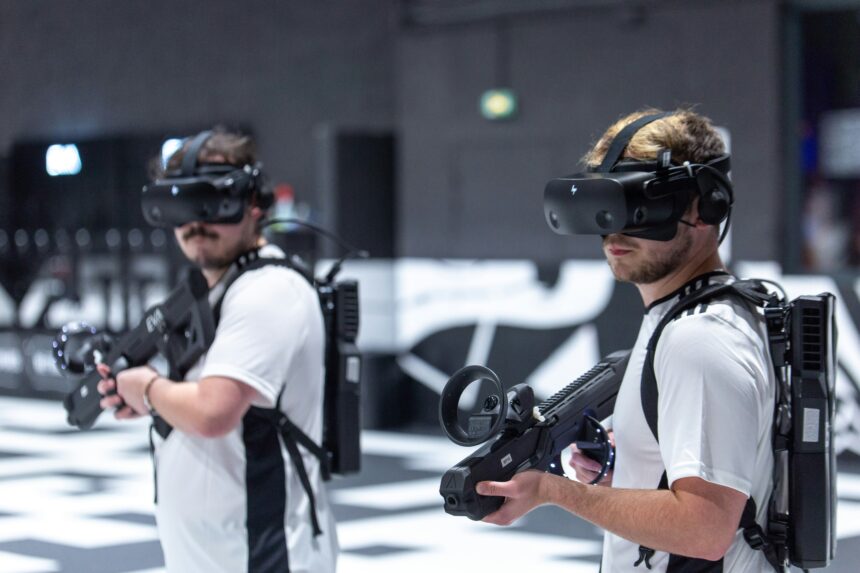
One detail the published abstract does not settle is what the six protocols actually involved, or what the control groups did instead. Virtual reality training in soccer usually means head-mounted displays running decision tasks built from match footage or simulated passing scenarios, with players reading developing play and responding under time pressure.
Without protocol detail in the record, the pooled figure spans programmes that may have differed in headset, task design, session length and total exposure. That variability is part of why one estimate for virtual reality training is hard to interpret, and why the author calls for trials that specify optimal designs rather than testing whichever system a laboratory happens to own.
One Hundred Eighty-Eight Players Across Six Trials
Sample size is the constraint sitting under every other finding. An average of about 31 players per trial is typical for applied sport science and far too small to detect modest cognitive change with confidence. Nine effect sizes drawn from six trials also means some studies contributed more than once, which the three-level model was chosen to handle.
That modelling choice is a strength. Treating multiple outcomes from one trial as independent would have overstated precision, and robust variance estimation guards against it. Better statistics cannot manufacture evidence that the trials did not collect.
Three Cognitive Domains, Three Small Effects
Broken down by domain, the pattern stayed flat. Attention, decision-making and inhibitory control each produced small effects between 0.21 and 0.26, none of them significant. The author reports that these domains did not differ from one another, so the data give no basis for claiming that virtual reality training sharpens decision-making in particular.
Response time was listed among the targeted outcomes in the methods, but no pooled result for it appears in the published record. Readers hoping to learn whether headset work speeds up reactions will have to wait for the full version of record.
The flatness across domains is itself informative. If virtual reality training worked chiefly by rehearsing game-specific decisions, decision-making should have moved further than inhibitory control. It did not, which points either to a general practice effect or to no real effect at all.
No Moderator Explained the Differences
Meta-analyses usually look for conditions that separate the trials where an intervention worked from those where it did not. Here none of the moderators tested showed a significant between-group difference. That removes the usual escape route of arguing that the intervention works but only for certain players, certain protocols or certain durations.
It also leaves the practical question open. If dose, format and population do not explain the spread, the field does not yet know what a well-designed virtual reality training protocol should contain.
Nine effect sizes is a small base for moderator analysis in any case. Tests of that kind need many more estimates before they detect differences reliably, so the absence of a significant moderator is better read as uninformative than as evidence that virtual reality training behaves the same way everywhere.
What a Measurable Training Effect Looks Like by Comparison
The contrast with physical outcomes is instructive. A randomized trial of 24 elite taekwondo athletes published in Frontiers in Sports and Active Living in October 2026 compared plyometric with traditional resistance training and found kick speed rose by 0.44 metres per second in the plyometric group against 0.07 in the resistance group, a between-group difference of 0.37 with a confidence interval from 0.25 to 0.49.
That interval never touches zero. Physical qualities such as jump height and kick speed are measured with instruments that resolve small changes reliably. Cognitive performance is measured with tasks that vary by learning effect, motivation and fatigue, which is one reason effects in this area are harder to pin down.
How Coaches Should Read Virtual Reality Training Claims
A non-significant pooled result is not proof that headsets do nothing. It means the evidence available cannot support marketing claims about sharper attention or faster decisions on the pitch. For a club weighing a purchase, that distinction is the whole decision.
Reasonable general guidance while the evidence matures:
- Treat cognitive claims attached to virtual reality training products as untested rather than disproven, and ask vendors for randomized data in players, not laboratory volunteers.
- Do not displace proven physical or technical work to make room for screen-based drills.
- If a club trials a system, measure something that matters on the pitch and keep a comparison group training as usual.
- Remember that the transfer question, whether laboratory gains reach competition, has not been answered in this literature.
Where It Sits in Our Coverage
Fitness Living Magazine has tracked adjacent questions. A review examined how exercise relates to esports performance, and a trial tested coordination training against working memory in children. On the physical side, we reported on plyometric training and match running in under-20 soccer.
Published the same day, a separate review found exercise associated with lower depressive symptoms across 18 youth trials while rating its own certainty as low, another reminder that mental and cognitive outcomes remain the hardest part of exercise science to measure.
The Fitness Living Takeaway
Across six randomized trials and 188 soccer players, virtual reality training produced a pooled cognitive effect of 0.36 that was not statistically significant, with a confidence interval running from -0.15 to 0.87.
Attention, decision-making and inhibitory control all moved slightly and none significantly, and no moderator explained the differences between trials. The sensible position is that virtual reality training for cognition in soccer is unproven, not refuted, and that the transfer question is still untested.
Research & Sources
- BMC Sports Science, Medicine and Rehabilitation: Effects of virtual reality training on cognitive performance in soccer players
- Frontiers in Sports and Active Living: Plyometric versus traditional resistance training in elite taekwondo athletes
- Images: Thibault Dandre / Unsplash; Hc Digital / Unsplash
This article summarizes peer-reviewed research for general information and is not individualized medical or exercise advice.