Laboratory trials have repeatedly found that swearing before a short, maximal effort lifts grip strength and power output by single-digit percentages. A new peer-reviewed perspective argues the case for promoting swearing as a performance aid has outrun the evidence supporting it.
Performance aid claims around swearing were audited in a perspective article published on October 30, 2026 in Frontiers in Sports and Active Living.
The paper comes from Nicholas B. Washmuth of the Department of Psychology at the University of Alabama in Huntsville, Lia Jiannine of the Department of Health and Human Performance at Nova Southeastern University in Fort Lauderdale, and Christopher G. Ballmann of the Department of Human Studies at the University of Alabama at Birmingham. It appears in the journal’s Elite Sports and Performance Enhancement section.
Rather than running a new trial, the authors assess whether the existing literature justifies telling athletes and gym-goers to use the technique. They apply Rogers’ Diffusion of Innovations framework, which weighs an intervention on advantages such as cost, ease of trial and compatibility with its setting. Their verdict on swearing as a performance aid is blunt: broad promotion is premature.
The starting observation is that swearing has recently emerged as a promising strategy for improving performance on short, intense physical tasks. Those gains are real in the lab. What the authors question is the leap from a controlled grip-strength test to a performance aid any coach should hand out.
At a Glance
- Published October 30, 2026 in Frontiers in Sports and Active Living as a Perspective article; received July 7, 2026 and accepted October 18, 2026.
- Scope: a critical appraisal of existing swearing trials, not new primary data.
- Reported gains: an 8 percent rise in grip strength and a 4.5 percent rise in anaerobic power in Stephens and colleagues’ work, with effect sizes of 0.72 and 0.62.
- A separate trial by Jiannine and Antonio reported grip strength up 9 percent, push-ups to fatigue up 15 percent, wall-sit time up 22 percent and plank time up 12 percent.
- In 11 resistance-trained men, swearing improved explosive bench press velocity with an effect size of 1.11, while repetitions to failure did not improve.
- Aerobic endurance showed no effect compared with a neutral word, though mood was enhanced.
- Main caveat: the authors state that real-world external validity has not yet been established.
Where the Performance Aid Evidence Is Strongest
The cleanest results come from brief, maximal tasks. In the work the authors lean on most, swearing resulted in a 4.5 percent increase in power during the Wingate anaerobic test and an 8 percent increase in grip strength, with 29 participants in the cycling test and 52 in the grip test.
Effect sizes of 0.62 and 0.72 put those shifts in moderate territory. A replication reported the same 8 percent grip-strength improvement, and a chair push-up test found holding time roughly 10 percent longer while swearing. For a performance aid that costs nothing, that pattern is why the idea attracted attention.
The second trial pushes further. Jiannine and Antonio reported grip strength up 9 percent and push-ups to fatigue up 15 percent, alongside a 22 percent gain in wall-sit time and 12 percent in plank hold. Those are isometric and muscular-endurance tasks rather than one-rep maximums, which widens the range of efforts where a performance aid signal has turned up.
The grip-strength increase reported with swearing in Stephens and colleagues’ trial, with an effect size of 0.72 across 52 participants.
The Tasks Where Swearing Did Nothing
A performance aid that works everywhere would be unusual, and this one does not. Ballmann and colleagues found that swearing did not influence aerobic endurance compared with a neutral word, although mood was enhanced. That null result matters for anyone hoping the technique carries into a long run or a cycling session.
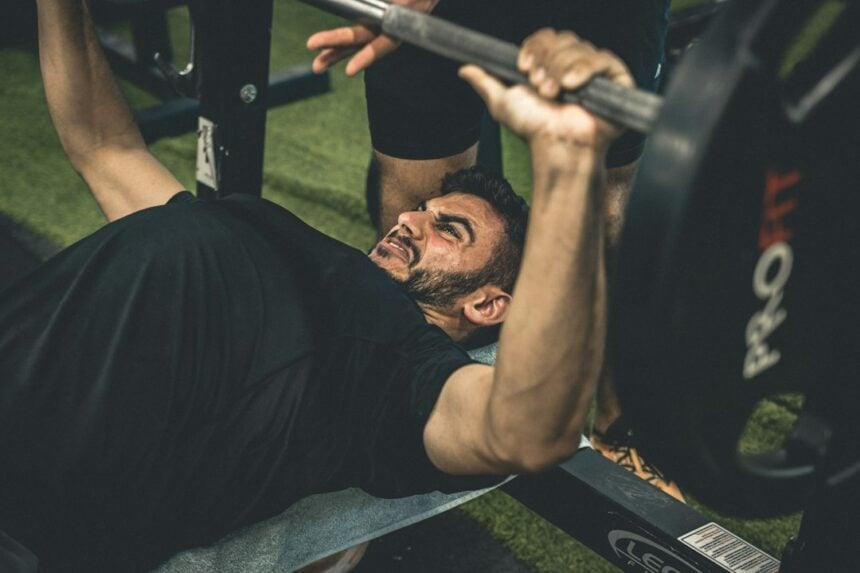
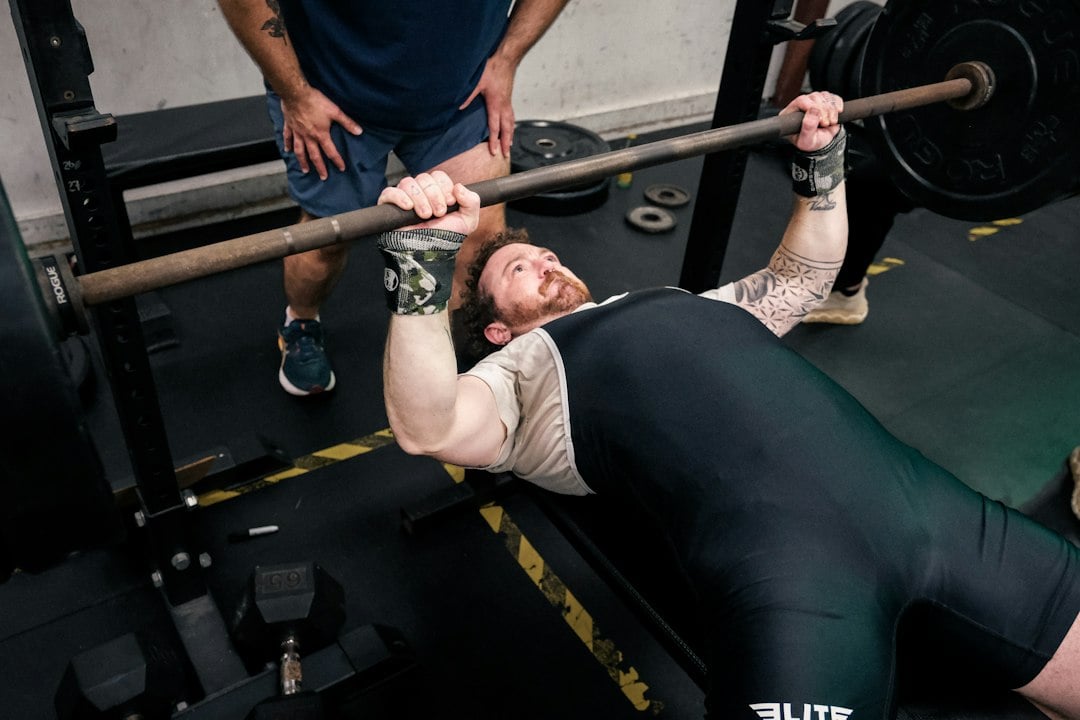
The bench press trial draws a similar line from the other direction. In 11 resistance-trained males, swearing improved explosive bench press velocity with an effect size of 1.11 and a p-value of 0.004, yet repetitions to failure were not improved. Speed on a single effort responded; volume did not. A performance aid that moves one and not the other is a narrow tool.
Read together, the picture is narrow rather than general. The performance aid effect appears tied to brief bursts of maximal output, and the evidence for anything longer is either absent or negative.
Why the Mechanism Still Is Not Settled
If swearing works, something has to explain it. The leading candidate has been disinhibition, the idea that the act loosens self-monitoring and allows a harder effort. A 2026 mediation analysis tested that directly and found state disinhibition explained a modest 14 percent of the variance, reported as an R-squared of 0.14.
Fourteen percent leaves most of the effect unaccounted for. Pain tolerance, arousal, attention and simple expectancy have all been proposed as the route by which a performance aid of this kind could work, and none has been isolated. A performance aid without a known mechanism is harder to apply deliberately, because there is no clear rule for when it should help.
One Research Network, Mostly College Students
The authors are unusually direct about the shape of the evidence base. They note that the available research has originated from a relatively small research network, and that the work has primarily relied on convenience sampling of college students in laboratory conditions.
That combination is familiar in sport science and it limits generalization in two ways. Undergraduate volunteers performing a grip test are not competitive athletes under meet conditions, and a small cluster of labs sharing methods can reproduce their own assumptions as easily as a true effect.
The authors also flag the relatively small samples, controlled laboratory settings, and variability in performance tasks as reasons the practical significance of these effects for athletes and exercisers remains uncertain. Eleven lifters and 52 grip-test participants are not a base for recommending a performance aid to the public.
What the Diffusion Framework Adds to a Performance Aid Debate
Rogers’ model is normally used to explain why some innovations spread and others stall. Applying it to a performance aid is the paper’s structural move, and it reframes the question from does this work to should this be recommended yet.
On two criteria swearing scores well. It costs nothing, and anyone can test it privately in a single session, which the framework treats as a strong trialability advantage. On observability and compatibility it fares worse, because the gain is invisible without instruments and the behavior clashes with many training environments.
Where the Social Context Complicates Things
Swearing is not a neutral intervention like a warm-up set. The paper notes that roughly 70 percent of adults report hearing others swear in public, while 9 percent of college students report never hearing a professor swear, a gap that illustrates how sharply norms shift between settings.
A related finding sharpens the point. Earlier work by Ballmann and colleagues found that censored-lyric music decreased bench press performance relative to explicit music, which suggests that the surrounding language environment, not just a single word, can move output. Any performance aid built on language has to contend with where it is being used.
For a coach working with minors, in a school facility or in a broadcast setting, the compatibility test in the diffusion framework fails regardless of effect size. That is a large share of the places people actually train.
What the Performance Aid Finding Means in a Real Gym
Nothing in this paper tells anyone to change a training plan. It is an argument about evidence standards, and the practical reading is modest rather than prescriptive.
- The measured gains sit in short, maximal tasks such as grip tests, a single explosive press and brief isometric holds, not in endurance work or total training volume.
- Effect sizes come from fewer than 60 people per test, so an individual trying it should expect wide variation and no guarantee of any benefit.
- Setting decides whether the technique is usable at all, and a facility, team or age group with language norms rules it out before physiology enters the discussion.
- None of this substitutes for the training variables that are well established, including progressive loading, adequate rest and consistent attendance.
The ergogenic parallel worth reading is our coverage of caffeine and sprint performance in a small female athlete trial, where a similarly modest percentage gain came with similar sample-size caveats. For acute strategies that prime a later effort, see our report on resistance priming, velocity loss and jump performance.
Because the bench press result here turns on movement speed rather than load, our write-up of velocity thresholds in the deadlift one-rep max explains why velocity has become a standard measurement. And for the broader question of what preparation does to short-burst output, our summary of a basketball warm-up program tested on sprint, agility and jump is a useful comparison.
The Fitness Living Takeaway
Controlled trials have found swearing lifts grip strength by 8 to 9 percent and anaerobic power by about 4.5 percent on short maximal tasks, but a new perspective concludes that promoting it as a performance aid is premature.
The effects are confined to brief bursts, absent in aerobic endurance, and explained only 14 percent by the leading mechanism. They rest on small convenience samples from a narrow research network, with no established real-world validity. The authors argue the idea deserves more investigation rather than wider promotion, and the social settings where most people train add a constraint no effect size can resolve.
Research & Sources
- Frontiers in Sports and Active Living: Swearing as a performance aid, promising evidence, premature promotion
- Study DOI
- Images: Shoham Avisrur / Unsplash; Aiden Craver / Unsplash
This article summarizes peer-reviewed research for general information and is not individualized medical or exercise advice.