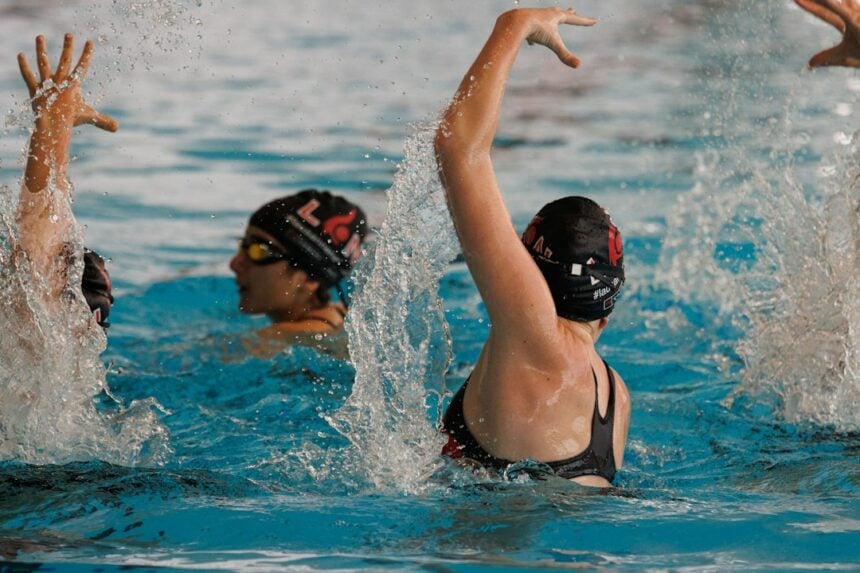
A two-season surveillance project in Spanish clubs counted 70 injuries among artistic swimmers and found the rate climbing steadily with each age category. Senior artistic swimmers lost more than three times as many days per training hour as the youngest group.
Artistic Swimmers have rarely been tracked the way footballers and runners are. A longitudinal prospective study published on October 24, 2026 in BMC Sports Science, Medicine and Rehabilitation closes part of that gap, reporting injury incidence and injury burden across four age categories in a single national setting.
The work was led by Ane Begone Rincon and Alfonso Trinidad of Universidad Europea de Madrid, with the Aqualab Research Group, alongside Alejandro Lopez-Valenciano of Universidad Cardenal Herrera-CEU in Castellon de la Plana, with the Physical Exercise and Performance Research Group.
Injuries were monitored and recorded in clubs over two seasons spanning 2023 to 2025. Four clubs were followed across both seasons and two clubs across the 2024 to 2025 season only. The dataset covers 390 unique swimmers, of whom 121 were followed across both seasons, producing 511 athlete-seasons of observation.
Across that exposure, 70 injuries were recorded in 65 artistic swimmers. The headline pattern is not the total but its distribution: both the rate of injury and the days lost per injury rose with every step up the age ladder.
At a Glance
- Published October 24, 2026 in BMC Sports Science, Medicine and Rehabilitation, DOI 10.1186/s13102-026-02202-w.
- 390 artistic swimmers across six Spanish clubs, 511 athlete-seasons, two competitive seasons from 2023 to 2025.
- 70 injuries recorded in 65 artistic swimmers; 80.0 percent arose from non-contact mechanisms.
- Incidence by category: 0.23 per 1,000 hours in U12 (95% CI 0.15 to 0.34), 0.42 in U16 (0.27 to 0.61), 0.70 in U19 (0.37 to 1.20) and 1.18 in Senior and Master (0.47 to 2.44).
- Injury burden by category: 8.49, 8.00, 18.00 and 29.61 days lost per 1,000 hours respectively.
- Lower limbs accounted for 45.7 percent of injuries, with the knee the most affected site.
- Main caveat: the oldest groups are small, with 33 swimmers in U19 and 40 in Senior and Master, and their confidence intervals are correspondingly wide.
How Six Spanish Clubs Tracked 390 Artistic Swimmers
Age categories followed the competitive structure of the sport. U12 covered artistic swimmers under 12 and held the largest group at 215. U16 covered ages 12 to 14 with 102 artistic swimmers. U19 covered 15 to 18 with 33. The Senior and Master category covered 19 and over with 40.
That shape matters for how the results should be read. The pyramid is wide at the bottom and narrow at the top, which is normal for a youth-heavy sport but means the most eye-catching numbers rest on the fewest athletes. Incidence among senior artistic swimmers is estimated from a group of 40.
Injury Rates Among Artistic Swimmers Climbed With Every Age Category
Expressed per 1,000 hours of exposure, the youngest artistic swimmers recorded 0.23 injuries, with a 95% confidence interval of 0.15 to 0.34. U16 recorded 0.42, with an interval of 0.27 to 0.61. U19 recorded 0.70, with an interval of 0.37 to 1.20. Senior and Master recorded 1.18, with an interval of 0.47 to 2.44.
The point estimates rise cleanly, roughly five-fold from the youngest to the oldest category. The intervals tell a more cautious story. The U19 and senior ranges are wide and overlap each other substantially, so the ordering at the top of the ladder is less firmly established than the gap between the youngest and oldest artistic swimmers.
Compared with contact sports, these are low absolute numbers. An incidence under 1.2 per 1,000 hours sits well below what injury surveillance typically reports in football or rugby, which is consistent with a non-contact aquatic discipline. Low rates do not make the problem trivial for artistic swimmers, though, because the sport trains in long sessions and hours accumulate quickly.
Days Lost Rose Faster Than Injury Counts
Injury burden combines how often injuries happen with how long they keep an athlete out, and it separates the categories more sharply than incidence alone. U12 recorded 8.49 days lost per 1,000 hours and U16 recorded 8.00, essentially the same despite U16 having nearly double the incidence.
Above that, the figures jump. U19 recorded 18.00 days lost per 1,000 hours and the Senior and Master group recorded 29.61. Older artistic swimmers were not only hurt more often; each injury cost more training time. The gap between the two burden figures is wider than the gap in incidence, which is the clearest signal in the dataset.
The authors identify knee sprains and shoulder fractures as carrying the highest burden. That combination is instructive, because one is a high-frequency joint problem and the other is a low-frequency but severe event, and burden metrics capture both in a way that raw injury counts do not.
Days lost per 1,000 hours of exposure in the Senior and Master category, against 8.49 in the youngest group.
Where Artistic Swimmers Got Hurt
Non-contact mechanisms accounted for 80.0 percent of the 70 injuries. In a sport judged on held positions, repeated eggbeater kicking and forceful lifts, that proportion is unsurprising, but it is worth stating because it narrows the prevention question considerably for artistic swimmers and the staff around them.
Lower limbs were the most affected region at 45.7 percent of injuries, and within that region the knee was the most frequent site. The emphasis on the knee aligns with earlier FLM coverage of what athletes know about knee ligament injury prevention, which found awareness lagging well behind risk.
The Diagnosis Mix Shifted With Age
The type of injury changed as swimmers got older. Muscle and tendon injuries were the most frequent diagnosis in U12, at 37.5 percent. In the Senior and Master group, joint and ligament injuries took the top spot at 42.9 percent. U16 and U19 sat between the two, with both diagnosis types equally frequent at 23.1 percent and 30.8 percent respectively.
That drift from soft-tissue problems in children toward joint and ligament problems in adults is a familiar pattern in sports where athletes accumulate years of repetitive loading. It also suggests that a single prevention protocol applied across all artistic swimmers would be aimed at the wrong tissue for at least one end of the age range.
Readers who follow return-to-play research may find the parallels in pooled hamstring rehabilitation evidence useful, since soft-tissue and joint injuries diverge sharply in how long they keep an athlete out.
What a 70-Injury Dataset Can and Cannot Settle
Seventy injuries spread across four age categories leaves small cells. The senior estimate carries a confidence interval running from 0.47 to 2.44 injuries per 1,000 hours, a range wide enough to contain both a modest and a substantial risk elevation. Precision, not direction, is the weak point, and a larger pool of senior artistic swimmers would be needed to narrow it.
The study is also confined to one country and one club structure. Training volumes, coaching conventions and pool access differ internationally, and all of those feed into exposure hours. Whether the age gradient seen in these artistic swimmers holds elsewhere is an open question.
Nothing in the design identifies a cause. Prospective surveillance records what happened and when, not why. Higher senior burden could reflect accumulated tissue load, heavier training, more demanding routines, slower healing, or simply a greater willingness among adults to report and sit out an injury.
What Coaches and Parents of Artistic Swimmers Can Use
The practical reading is modest and general. This is one descriptive study, it prescribes no protocol, and it cannot tell individual artistic swimmers what their own risk is. What it does offer is a map of where attention is most likely to pay off within this sport.
Several points follow directly from the reported figures rather than from inference:
- Non-contact mechanisms dominated at 80.0 percent, so prevention work targets movement quality and load management rather than collision avoidance.
- The knee was the most affected single site, and knee sprains carried among the highest burden.
- Diagnosis patterns differ by age, so the same preparation routine is unlikely to suit a 10-year-old and a 25-year-old equally.
- Days lost rose steeply above U19, which makes senior training load a reasonable place to look first.
- Any athlete with pain, instability or a prior injury should be assessed individually before changing training.
- None of this replaces a qualified coach or clinician who has watched the artistic swimmers in question train.
For wider context on how injury counts translate into population-level numbers, the earlier FLM report on 12 years of exercise-related injuries in United States emergency departments and the trial coverage of a structured warm-up program and its performance effects both offer useful comparison points.
The Fitness Living Takeaway
Across 511 athlete-seasons in six Spanish clubs, injury incidence among artistic swimmers rose from 0.23 per 1,000 hours in the under-12 group to 1.18 in the senior group, while days lost rose from 8.49 to 29.61.
The gradient is consistent across both measures, and the dominance of non-contact knee and lower-limb problems gives prevention work a clear target. The caution is sample size: the oldest categories hold 33 and 40 artistic swimmers, and their confidence intervals are wide enough that the exact size of the gap remains unsettled. Direction is the finding here, not magnitude.
Research & Sources
- BMC Sports Science, Medicine and Rehabilitation: Epidemiology of injuries and injury burden in artistic swimmers
- Study DOI
- Images: Nathanael Desmeules / Unsplash; Marcos Lira / Unsplash
This article summarizes peer-reviewed research for general information and is not individualized medical or exercise advice.