
A randomized crossover tested whether resistance priming with back squats sharpens jumping later the same day or the next. The answer depended entirely on when the athletes were retested, and resistance priming produced nothing at the early time points.
Resistance Priming is the practice of performing a short, deliberately incomplete bout of heavy work hours before competing, on the theory that the nervous system stays potentiated once the fatigue has cleared. A crossover trial published on September 23, 2026 in BMC Sports Science, Medicine and Rehabilitation put two versions of that idea on a clock.
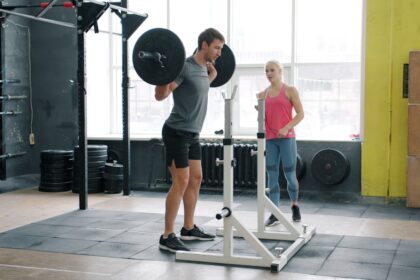
Researchers at Southwest Medical University in Luzhou, Sichuan, China, recruited 24 male athletes and had every one of them complete all three experimental conditions. Two were resistance priming sessions built around back squats. The third was passive rest.
The 20% condition performed three sets of moderate-load back squats terminated at a 20% velocity loss. The 30% condition performed three sets terminated at a 30% velocity loss. Countermovement jump performance was evaluated before the session and again at 6 hours, 24 hours and 30 hours afterward.
No meaningful between-condition differences were observed at 6 to 24 hours. At 30 hours, within-group comparisons showed improvements in jump height under both priming conditions: 5.5% with an effect size of 0.59 for the 20% threshold, and 2.8% with an effect size of 0.38 for the 30% threshold.
At a Glance
- Published September 23, 2026 in BMC Sports Science, Medicine and Rehabilitation.
- Twenty-four male athletes completed all three conditions in a randomized crossover design.
- Both resistance priming conditions used three sets of moderate-load back squats; the control was passive rest.
- Countermovement jump height was measured before priming and at 6, 24 and 30 hours after it.
- No meaningful between-condition differences appeared at 6 to 24 hours.
- At 30 hours, within-group jump height rose 5.5% (d = 0.59) after the 20% threshold and 2.8% (d = 0.38) after the 30% threshold.
- For the primary outcome, the condition-by-time interaction did not reach statistical significance at P = 0.088.
What a Velocity-Loss Threshold Controls
Velocity-based training ends a set when bar speed drops by a set percentage below the fastest repetition, rather than at a fixed repetition count. A 20% threshold stops the set early; 30% allows more repetitions and more fatigue. Using speed as the stopping rule keeps the dose comparable across athletes who differ in how quickly they tire.
The same logic underpins other velocity work in the weight room, including the use of bar speed to estimate a deadlift one-rep max. In resistance priming the threshold decides how much stimulus an athlete absorbs without digging a hole they cannot climb out of before competing.
The Mechanism the Idea Rests On
The rationale for resistance priming turns on a tension between two things a hard set produces at once. Heavy contractions leave the muscle temporarily fatigued, and they also leave it temporarily more responsive, a state usually described as potentiation. Performance improves only once the first effect has faded further than the second.
That is why priming is scheduled hours rather than minutes before competition. In the minutes after a demanding set, fatigue dominates everything else. Over the following hours it recedes, and whatever residual readiness remains is what a coach is trying to catch.
The difficulty is that nobody has established when that crossover happens, or whether it lands in the same place for every athlete, every lift and every outcome task. A 20% threshold and a 30% threshold create different amounts of fatigue from the same exercise, so in principle they should also clear at different rates. This trial tested that idea directly and found the clearer response under the lighter of the two doses.
Stopping a set on speed rather than on repetitions is what makes the comparison possible at all. Two athletes told to perform five repetitions may finish in very different states; two athletes told to stop at a 20% velocity loss finish in states that are at least roughly matched, which is the control that makes a resistance priming comparison meaningful.
Why the 30-Hour Result Is the Interesting One
Most resistance priming protocols are built around 6 to 24 hours, the window in which coaches typically schedule a primer ahead of a match. This trial found nothing there. The gains appeared only at 30 hours, later than the standard prescription assumes.
That timing deserves attention precisely because it was not the expected answer. If the effect of resistance priming peaks well past a full day, a Friday session aimed at a Saturday game may be arriving either too early or too late depending on when the first whistle blows.
The condition-by-time interaction for jump height, the primary outcome of the trial, did not reach statistical significance.
What the Resistance Priming Data Did Not Show
The headline percentages are within-group comparisons, meaning each condition was measured against its own baseline. The test that compares the conditions against one another, the condition-by-time interaction, returned P = 0.088. By convention that falls short of significance.
This is the part of a resistance priming study that is easiest to skim past. A 5.5% within-group gain is a real number, but on its own it does not establish that the priming session caused an advantage over passive rest.
Twenty-four participants is a reasonable size for a crossover, where each athlete serves as their own control and between-person variation is removed. It still leaves limited power to detect a modest difference between conditions.
What Changed in the Force-Velocity Profile
Alongside jump height, the 20% condition showed improvements in theoretical maximal velocity and theoretical maximal force. Those two values describe the opposite ends of an athlete force-velocity profile, and moving both suggests the change was not confined to one end of the spectrum.
The lighter threshold outperforming the heavier one here fits a pattern familiar from other resistance priming work: more fatigue is not automatically more stimulus. The relationship between what a set takes out of an athlete and what it gives back is not a straight line.

How It Compares With Other Resistance Priming Trials
A separate study published on September 3, 2026 in Frontiers in Physiology primed 18 highly trained male boxers and measured punch performance. Several punch measures were significantly higher than the control condition at 6 hours and again at 24 hours. At 48 hours, no active condition differed significantly from control.
The two trials disagree about timing, which is itself informative. Different sports, different outcome tasks and different priming loads can shift when a resistance priming effect appears, and the boxing result does not transfer cleanly to a jump test any more than the reverse.
Limits on Who This Applies To
All 24 participants were male athletes, so nothing here speaks to how women respond to the same protocol. That gap recurs across performance research, as our coverage of caffeine and 30-meter sprint times in female athletes has noted before.
The outcome was also a single laboratory task. Countermovement jump height is a standard proxy for lower-body explosiveness, and it is not a sprint, a change of direction or a fourth-quarter possession. Related questions about how set structure shapes the training stimulus appear in our report on partial range of motion training.
How Coaches Might Read the Result
Nothing in this trial justifies rebuilding a competition week around it. It does suggest that anyone already using resistance priming should test their own timing rather than assume the conventional window is the right one.
A few general points follow, none of them specific to any individual athlete or sport.
- Treat the timing of a priming session as a variable worth testing, not a fixed rule.
- The lower velocity-loss threshold left more in reserve and did not produce a smaller jump response here.
- Track the outcome that matters in your sport rather than jump height alone.
- Do not introduce a priming session for the first time in the week of a meaningful competition.
Athletes building explosiveness across a season have better-established levers to pull, including the structured work described in our summary of sprint interval training and explosive performance. Resistance priming is a scheduling refinement layered on top of training, not a substitute for the training itself.
The Fitness Living Takeaway
Countermovement jump height rose 5.5% at 30 hours after a 20% velocity-loss resistance priming session in 24 male athletes, though the overall condition-by-time comparison was not statistically significant.
The timing is the finding: nothing at 6 or 24 hours, something at 30. That is later than most resistance priming protocols assume, and it comes from one small crossover in men. Useful as a prompt to test your own schedule, and not yet a reason to rewrite anyone else.
Research & Sources
- BMC Sports Science, Medicine and Rehabilitation: Velocity Loss Threshold-Based Resistance Priming and Jumping Performance
- Study DOI
- Frontiers in Physiology: Delayed Punch Performance Following Resistance Priming in Boxers
- Images: Anastase Maragos / Unsplash; Omar Abozeid / Unsplash
This article summarizes peer-reviewed research for general information and is not individualized medical or exercise advice.