High-level pole dance athletes produced significantly more inward rotation torque at the shoulder than untrained comparisons in a small Polish laboratory study. Pole dance loads the shoulder in positions few gym movements reproduce, and the measurements point to an adaptation shaped by that specific demand.
Pole Dance training was linked to greater internal rotation strength at the shoulder joint in a 20-person comparison published on 21 September 2026 in Scientific Reports. Ten high-level practitioners and ten controls were tested on an isokinetic dynamometer, and the difference in internal rotation torque reached statistical significance at p below 0.05.
The work came from the Department of Physiotherapy at Wrocław University of Health and Sport Sciences in Wrocław, Poland, and is credited to Marta Charatonik-Duda and Aneta Demidaś. It was received on 30 June 2026, accepted on 27 August 2026 and published three weeks later.
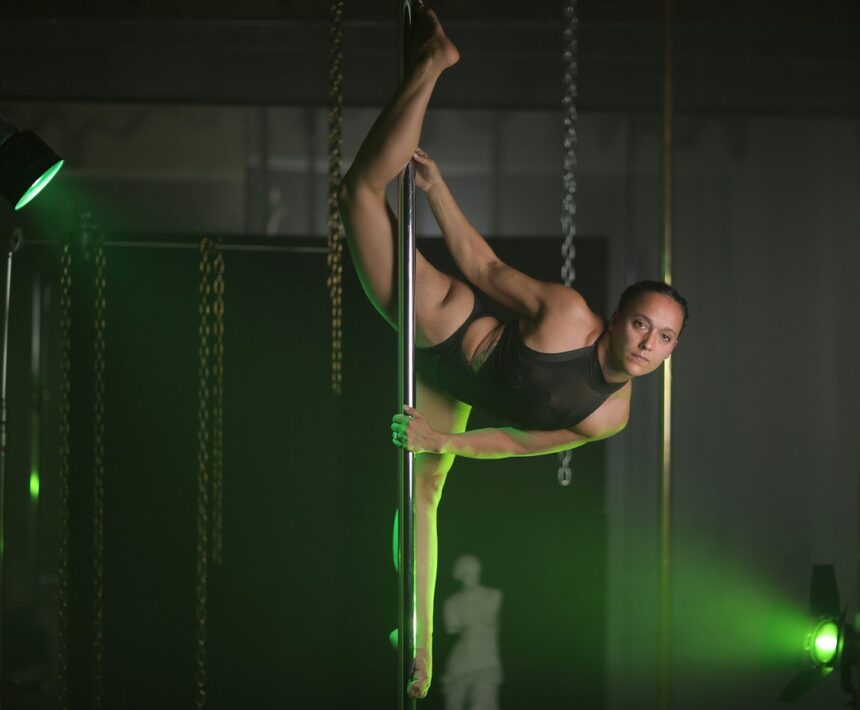
The authors describe pole dance as a performance art built on acrobatic tricks and dance manoeuvres performed around or on a vertical metal pole. Their stated reason for looking at the shoulder is blunt: surveys have shown that around 40 percent of injuries related to the sport occur at that joint.
The most commonly cited cause in those surveys, the authors write, is positions involving internal rotation of the shoulder. That framing sets up the question the study tries to answer, which is whether high-level pole dance training measurably changes how the joint rotates.
At a Glance
- Published 21 September 2026 in Scientific Reports, received 30 June 2026 and accepted 27 August 2026.
- Ten high-level pole dance practitioners compared with ten controls, tested with isokinetic dynamometry.
- Measured parameters: peak torque in newton metres, peak torque relative to body weight, time to peak torque in milliseconds, acceleration time in milliseconds, and total range of motion in degrees.
- Practitioners showed significantly increased torque production in internal rotation of the shoulder, at p below 0.05.
- No statistically significant differences appeared in external rotation torque or in total range of motion.
- Findings for acceleration time and time to peak torque were described by the authors as inconsistent.
- Main caveat: 20 participants in a cross-sectional comparison, which cannot establish that the training caused the difference.
What the Researchers Measured, and Why the Shoulder
Pole dance sits in an unusual corner of strength sport. Much of it is performed hanging, gripping and spinning on a single vertical bar, with body weight supported through the hands and forearms while the trunk and legs move around a fixed point.
That arrangement puts the shoulder under load in positions a barbell rarely reaches. The joint has to stabilise while rotating, often under something close to full body weight, and it has to do so repeatedly across a training session.
The shoulder injury statistic the authors cite is what makes the question practical rather than academic. If roughly 40 percent of pole dance injuries land at one joint, and the positions blamed involve internal rotation, then knowing what internal rotation strength looks like in experienced practitioners is a reasonable first step.
How Isokinetic Dynamometry Works
An isokinetic dynamometer holds the speed of a movement constant and measures the force the limb produces against it. Because velocity does not vary, the device records how much torque a joint can generate throughout a range rather than at a single sticking point.
The study recorded peak torque in newton metres, peak torque scaled to body weight, time to peak torque, acceleration time and total range of motion. Scaling to body weight matters in a sport where athletes move their own mass; a heavier person producing the same absolute torque is not equally strong for the task.
Time to peak torque and acceleration time are the rate-of-force variables. They describe how quickly a muscle group reaches its output, which is a different quality from how much it can eventually produce.
What Separated the Pole Dance Group From the Controls
The headline result is narrow and specific. Pole dance practitioners were found to have significantly increased torque production in internal rotation of the shoulder. Nothing else in the measured set separated the groups reliably.
External rotation torque showed no statistically significant difference. Neither did total range of motion, which is worth pausing on: a sport that looks flexible did not, on this measure, produce more rotational range than the comparison group.
The rate-of-force variables were messier. The authors describe their findings on acceleration time and time to peak torque as inconsistent, which is a more honest word than most papers use and should be read as written rather than smoothed over.
Share of injuries related to the sport that surveys place at the shoulder joint, the figure the authors give as their reason for studying pole dance rotation in the first place.
Why Internal Rotation, Specifically
Internal rotation turns the upper arm inward, so the forearm sweeps toward the midline of the body. External rotation does the opposite. Both are produced by muscles around the shoulder blade and upper arm, including the rotator cuff group, and both are trained unevenly by most activities.
Pulling and pressing patterns that dominate gym programmes tend to favour internal rotators, which is one reason shoulder-health guidance so often prescribes external rotation work as a counterweight. A pole dance training week, built on gripping and holding a vertical bar, plausibly sits at the extreme end of that same bias.
A result showing raised internal rotation torque with unchanged external rotation torque is therefore consistent with what the sport demands. The authors read it as evidence of a specific strength adaptation to high-level pole dance training.
What Ten Against Ten Can and Cannot Settle
Twenty participants is a small sample even by laboratory standards, and the design is cross-sectional. The athletes were measured once, after years of training, and compared with people who had not done the sport.
That structure cannot separate adaptation from selection. It is possible that pole dance training built the internal rotation torque difference. It is also possible that people who take to the sport and reach a high level start with shoulders suited to it, and that both effects contribute.
Small samples also make null results hard to interpret. The absence of a significant difference in external rotation torque or range of motion may mean there is no difference, or it may mean ten per group was not enough to detect one. The paper reports what it found; it does not license a claim that the sport leaves those qualities untouched.
The authors themselves close on the modest note the design supports, writing that the results warrant further research into the implications for shoulder biomechanics and injury risk.
Reading the Injury Statistic Carefully
The 40 percent figure comes from surveys cited in the paper rather than from data collected in this study. Injury surveys in niche sports are usually retrospective and self-reported, and they capture the athletes who answer rather than a defined population.
That does not make the number useless. It makes it a signal about where attention belongs rather than a precise risk estimate, and the study treats it that way.
It is also worth separating two claims. A joint that absorbs most of a sport injury total is not automatically a weak joint, and the measurement here in fact points the other way for internal rotation. Load tolerance and load exposure are different things.
What Practitioners and Coaches Can Do With This
One 20-person laboratory comparison does not change a training programme, and nothing below is individual advice. Anyone with shoulder pain or a history of shoulder injury should be assessed by a qualified clinician rather than reading a torque curve.
What the finding does is sharpen a question coaches in grip-heavy disciplines already ask. If a sport reliably loads one direction of rotation, the surrounding programme is the obvious place to look for balance.
- Treat external rotation work as programme maintenance in any hanging or gripping discipline, not as rehabilitation reserved for after an injury.
- Remember that range of motion and strength are separate qualities; this study found a difference in one and not the other.
- Expect sport-specific adaptations to be narrow. The measured difference here sat in a single direction of a single joint action.
- Treat a small cross-sectional result as a prompt to watch, not as a reason to overhaul a week that is working.
Readers following the strength-adaptation thread can compare this with our reports on how six weeks of isometric training raised strength and rapid force production and on what happened when ten men trained through a partial range of motion. Our coverage of how joint position changed quadriceps stiffness shows the same measurement problem in the lower body, and the imaging study of 13 elite weightlifters is another example of a small specialist sample read carefully.
The Fitness Living Takeaway
Ten high-level pole dance practitioners produced significantly more internal rotation torque at the shoulder than ten controls, with no significant difference in external rotation torque or total range of motion.
The pattern fits a sport that hangs and grips on a vertical bar, and the authors read it as a specific strength adaptation to high-level pole dance training. It is a cross-sectional comparison of 20 people, so it cannot prove the training produced the difference, and the rate-of-force measurements were inconsistent. Its practical value is as a reminder that specialist disciplines build specialist shoulders, and that the untrained direction is usually the one worth programming for.
Research & Sources
- Scientific Reports: The effect of pole dance training on the strength of shoulder joint rotator muscles
- Study DOI
- Scientific Reports research article listing
- Images: Louvre LA / Unsplash; Tom Audagna / Unsplash
This article summarizes peer-reviewed research for general information and is not individualized medical or exercise advice.