
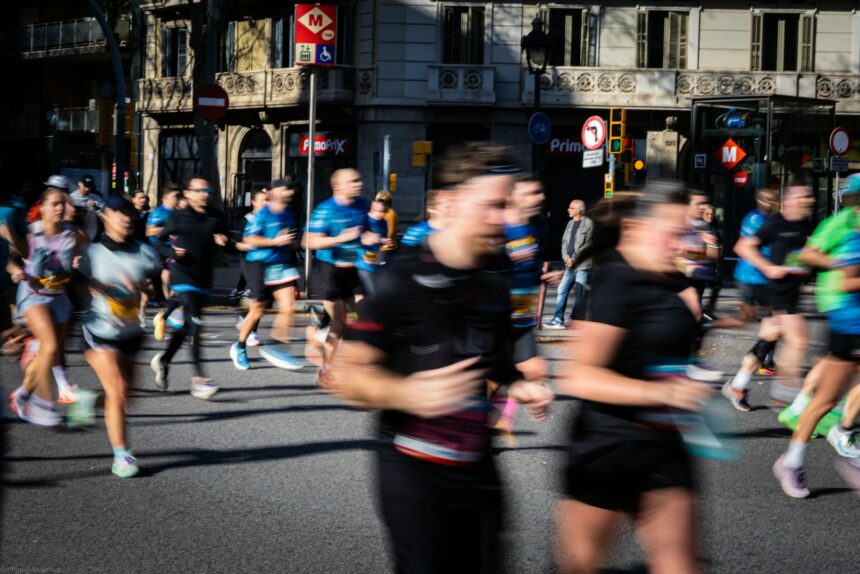
A new analysis of more than 2.7 million World Marathon Majors performances found that higher race-day nitrogen dioxide was associated with slower finishing times. The link was strongest among recreational runners, but the observational study cannot prove that pollution caused the slower performances.
Marathon air pollution may matter more to performance than many runners realize. Researchers analyzing 2,756,553 finishing times across Berlin, Boston, Chicago, London, New York City and Tokyo found a consistent association between higher race-day nitrogen dioxide, or NO₂, and slower marathon times.
The study, published August 29 in Sports Medicine – Open, examined 75 marathon-year events held between 2010 and 2024. Researchers paired official race results with modeled race-day concentrations of NO₂ and fine particulate matter, then adjusted their statistical models for heat index, wind speed and long-term time trends.
The strongest signal came from NO₂. Each 1 microgram per cubic meter increase in race-day NO₂ was associated with a 1.43-minute slower finishing time in men and a 1.56-minute slower time in women. Fine particulate matter, known as PM2.5, was not significantly associated with finishing time after the adjustments.
- The analysis included 2,756,553 marathon performances across six World Marathon Majors and 75 race-year events.
- Higher race-day NO₂ was associated with slower finishing times in both men and women.
- The estimated NO₂ association was about six times larger among recreational runners than elite runners.
- PM2.5 was not significantly associated with finishing time after weather and time-trend adjustments.
- The study was observational and used event-level pollution estimates, so it cannot establish individual exposure or causation.
What the Marathon Air Pollution Study Found
The scale of the dataset is unusual. Researchers gathered performances from the six World Marathon Majors, restricted finishing times to a plausible two-to-eight-hour window and then modeled the relationship between race-day environmental conditions and performance.
NO₂ concentrations varied considerably among race events. After adjustment, higher NO₂ tracked with slower finishing times across the field. The association was not confined to a small group of runners at the back of the pack; the researchers reported a rightward shift across the finishing-time distribution as NO₂ rose.
The performance-level analysis was especially striking. Recreational runners showed an estimated 2.12-minute slowing per 1 microgram per cubic meter higher NO₂, compared with 0.34 minutes among elite runners. Expressed relative to average finishing time, the association was 0.67% for recreational runners and 0.18% for elites.
Younger runners also showed a somewhat larger association. Among participants with age data, the estimated slowing was 2.17 minutes per 1 microgram per cubic meter higher NO₂ for runners ages 18 to 29, compared with 1.32 minutes among those 60 and older.
Why Nitrogen Dioxide Could Matter During a Marathon
NO₂ is a combustion-related air pollutant commonly associated with traffic and other urban sources. During endurance exercise, breathing rate and ventilation rise substantially. That means runners can inhale much larger volumes of air over several hours than they would at rest.
The new study did not directly measure each athlete’s lungs, blood vessels or oxygen delivery, so it cannot identify the exact mechanism behind the performance association. Previous research, however, has linked air pollution exposure with temporary respiratory and cardiovascular effects, which makes the question biologically plausible.
The U.S. Environmental Protection Agency recommends using the Air Quality Index when planning outdoor exercise because the importance of pollution depends on the level, a person’s health status, and the duration and intensity of activity. That context is especially relevant for a marathon, where exposure is prolonged and ventilation is high.
Weather has long been part of race-day strategy. This study suggests air quality belongs in the same conversation.
Fitness Living Magazine™ Editorial Analysis
Recreational Runners May Be More Exposed to the Performance Effect
The larger statistical association among recreational runners should not be interpreted as proof that less-experienced athletes are biologically six times more sensitive to NO₂. Several factors could contribute. Recreational runners spend more time on the course, may have different pacing patterns and often have less physiological reserve than elites.
Time on course is particularly important. A runner completing a marathon in four or five hours is breathing polluted outdoor air for much longer than an elite athlete finishing close to two hours. That longer exposure could help explain why the performance association appeared larger farther from the front of the field.
But this study assigned a single modeled pollution value to each race-year event. It did not track where each runner stood before the start, which side of the road they used, whether pollution varied along the course, or how much pollution each person actually inhaled. Those limitations make the recreational-versus-elite comparison intriguing rather than definitive.
What Runners Can Do With This Information
For most runners, the practical response is not to stop training outside. Regular physical activity has substantial health benefits, and air-quality guidance is designed to help people make better decisions rather than avoid movement entirely.
Before a long outdoor run or race, check the local Air Quality Index alongside temperature, humidity and wind. If air quality is poor, runners who have asthma, cardiovascular disease or unusual sensitivity to pollution may need to be more conservative. The EPA advises people to consider both the pollution level and the intensity and duration of exercise.
Training routes can also matter. When possible, choosing lower-traffic streets, parks or trails can reduce direct exposure to vehicle emissions. The goal is not to chase a perfect zero-pollution environment; it is to reduce avoidable exposure when the conditions are unfavorable.
Fitness Living Magazine has already reported on how major U.S. marathons are adjusting start times and dates as race-day heat changes. Air quality adds another environmental variable that organizers and athletes may increasingly need to consider.
Why PM2.5 Did Not Show the Same Signal
The researchers also examined PM2.5, tiny particles capable of reaching deep into the lungs. In this dataset, PM2.5 was not significantly associated with finishing time after adjustment. That does not mean particulate pollution is harmless during exercise.
It means this particular analysis did not detect a reliable relationship between race-day PM2.5 and marathon finishing time. Different pollutants vary by source, geography, weather and timing, and event-level estimates can miss the exposure that an individual runner actually experiences.
The distinction is important because health risk and performance effect are not identical questions. A pollutant can be harmful to health without producing a measurable change in marathon finish time in a specific statistical model.
The researchers compared different race-year events rather than randomly exposing runners to different pollution levels. Higher NO₂ could travel with other unmeasured features of a city or race day. The analysis adjusted for major weather variables, but residual confounding is still possible.
How to Read the Minutes-Per-Microgram Result
The headline number can sound more precise than it is. The study does not say that an individual runner will automatically lose exactly 1.4 or 1.6 minutes for every 1 microgram per cubic meter increase in NO₂. Those values are population-level model estimates across many races and years.
The useful message is directional: worse race-day NO₂ conditions were consistently associated with slower performance, and the association was larger among recreational runners. The size of the effect for any individual will depend on fitness, pace, health, course exposure, weather and many other factors.
Environmental conditions can also influence everyday activity. Our earlier report found that both hot and cold weather were associated with lower daily step counts. Together, these studies reinforce a broader point: the environment is part of the exercise dose, even when the workout plan itself does not change.
What Race Organizers May Take From the Study
Marathon organizers already monitor heat, storms and other safety hazards. The authors argue that air quality should also be considered when planning large urban endurance events, particularly because traffic restrictions and start times can influence race-day pollution.
That does not mean every elevated NO₂ reading should trigger a cancellation. Decisions require local public-health guidance, current AQI conditions and the vulnerability of participants. But adding air quality to event communication could help runners make informed choices about pacing, medication plans and whether to modify participation on unusually polluted days.
The Fitness Living Takeaway
Higher race-day NO₂ was associated with slower marathon finishing times in an analysis of more than 2.7 million World Marathon Majors performances. The statistical effect was larger among recreational runners, while PM2.5 was not significantly associated with performance after adjustment.
The study cannot prove that pollution caused slower times, and it did not measure each runner’s personal exposure. Still, it adds air quality to the list of environmental factors worth checking before a long outdoor endurance effort. Keep training; on poor-air days, use the AQI and adjust location, duration or intensity when appropriate.
Primary research: Donaldson JA, Cai S, Vande Hey J, et al. Air Pollution Impairs Marathon Performance: A Cross-Sectional Analysis of 2.7 Million Finishers Across Six World Marathon Majors. Sports Medicine – Open, published August 29, 2026. Read the open-access study.
Exercise and air quality guidance: U.S. Environmental Protection Agency. Should You Exercise Outside in Air Pollution?
Image credit: Miguel Alcântara / Unsplash.
Fitness Living Magazine™ reports on exercise and health research for general informational purposes. This article is not individualized medical advice.