A randomized laboratory study found that 30 minutes of moderate evening cycling before a night restricted to 4.5 hours of sleep was associated with better next-day declarative memory than restricted sleep without exercise. The finding is promising, but it does not mean exercise can replace adequate sleep.
Evening exercise may offer a modest cognitive buffer when sleep is cut short. In a study of 88 healthy young adults, participants who completed 30 minutes of moderate cycling before a restricted night of sleep performed better on delayed memory testing than participants who experienced the same sleep restriction without exercise.
The paper, published August 26 in the journal SLEEP, also found that the proportion of slow-wave sleep statistically mediated the association. That gives researchers a plausible pathway: exercise may have altered sleep architecture in a way that helped support memory consolidation despite a short sleep opportunity.
But the study should not be read as a workaround for chronic sleep deprivation. Participants were young and healthy, the experiment involved a single controlled night, and adults still generally need at least seven hours of sleep for health and daytime function.
- The randomized study included 88 healthy young adults; 52% were female and the average age was 24.
- Participants were assigned to 8.5 hours or 4.5 hours of sleep, with or without a 30-minute evening cycling session.
- The exercise session occurred at 7 p.m. at a moderate intensity of about 55% to 60% of maximal oxygen consumption.
- After restricted sleep, the exercise group performed significantly better on delayed face-name recall than the restricted-sleep-only group.
- Slow-wave sleep statistically mediated the memory benefit, but the experiment does not show that exercise can compensate for repeated or chronic sleep loss.
How the Evening Exercise and Sleep Study Worked
Researchers randomly assigned participants to one of four conditions: an 8.5-hour sleep opportunity, a 4.5-hour sleep opportunity, exercise before 8.5 hours of sleep, or exercise before 4.5 hours of sleep.
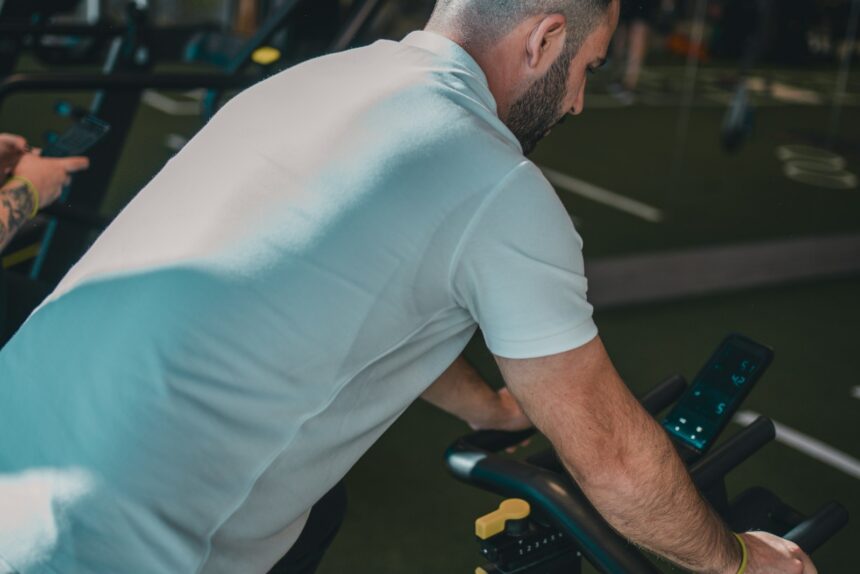
Those assigned to exercise completed 30 minutes of stationary cycling at 7 p.m. at 55% to 60% of their individual maximal oxygen consumption. That is moderate exercise rather than an all-out interval session. Participants then learned 80 face-name pairs at 10 p.m., completed an immediate memory test, slept while researchers recorded their sleep with polysomnography, and performed a delayed recall test afterward.
The study was designed to ask a precise question: if sleep is restricted, can one moderate exercise session change how well newly learned information survives the night?
What Happened to Memory After 4.5 Hours of Sleep
The restricted-sleep-only group showed the clearest memory deficit. Participants who exercised before the 4.5-hour sleep opportunity had significantly better delayed recall than those who experienced sleep restriction without exercise.
Statistically, the exercise-plus-restricted-sleep group was not different from the average-sleep groups on the delayed retrieval measure used by the researchers. That sounds dramatic, but it should be interpreted cautiously. A lack of statistical difference is not proof that four and a half hours of sleep after exercise is equivalent to a full night of sleep across cognition, mood, reaction time, metabolism or long-term health.
The experiment measured a specific form of declarative memory using face-name pairs. It did not test a full workday, driving safety, athletic performance, decision-making under pressure or the effects of repeatedly sleeping too little.
Slow-Wave Sleep May Help Explain the Result
Slow-wave sleep is a deep stage of non-rapid-eye-movement sleep that has been linked with memory consolidation. In this study, the proportion of slow-wave sleep statistically mediated the compensatory association between evening exercise, restricted sleep and long-term memory performance.
That mediation result does not prove a single biological chain of cause and effect, but it strengthens the idea that the exercise session did more than simply make participants feel alert. The researchers’ model suggests that changes in sleep architecture may have contributed to how well the brain stabilized newly learned information overnight.
A workout may soften one consequence of a short night. It does not turn insufficient sleep into sufficient sleep.
Fitness Living Magazine™ Editorial Analysis
Why This Does Not Make Sleep Optional
The most useful part of the study is also the easiest to overstate. The finding offers a possible countermeasure for an occasional short night, not permission to build a lifestyle around four or five hours of sleep.
The Centers for Disease Control and Prevention recommends seven or more hours of sleep per day for adults ages 18 to 60. A 2026 National Center for Health Statistics report found that about three in ten U.S. adults reported averaging less than seven hours in a 24-hour period, making short sleep a common real-world problem rather than a rare laboratory condition.
Chronic sleep deficiency affects more than memory. It can impair attention, reaction time, mood and broader health. The current study did not measure whether a brief exercise session could protect those systems, and it did not follow participants long enough to evaluate cumulative sleep loss.
If you have the choice between adequate sleep and a workout designed to compensate for inadequate sleep, this study does not say to sacrifice sleep. Its value is narrower: when a short night happens, moderate exercise may influence one aspect of next-day memory through changes in sleep architecture.
Does Evening Exercise Hurt Sleep?
People sometimes avoid evening workouts because they worry that exercise close to bedtime will automatically disrupt sleep. This experiment is a reminder that timing effects depend on intensity, the person and the interval before bed.
The cycling session occurred at 7 p.m., while the learning task began at 10 p.m. The exercise was moderate rather than maximal. The study therefore does not tell us whether a hard late-night interval workout immediately before bed would produce the same memory or sleep response.
For readers who already sleep well after evening training, there is no reason to interpret the study as a mandate to change workout timing. For people who notice that late exercise makes it harder to fall asleep, individual response still matters.
What Fitness Enthusiasts Can Take From the Trial
The clearest application is for occasional imperfect nights: travel, a late work deadline, a new baby or a disrupted schedule can reduce sleep even when a person understands its importance. This study suggests that maintaining moderate physical activity may be more useful than assuming a short night makes exercise pointless.
That does not mean adding a punishing workout to an already exhausted body. The protocol was 30 minutes at moderate intensity. A steady bike ride, brisk walk or comparable session is closer to what researchers tested than maximal sprint intervals or a demanding competition workout.
Fitness Living Magazine has previously reported that different forms and contexts of physical activity may relate differently to brain health. The new sleep study adds another layer: when exercise happens may interact with what the brain does during the following night.
The Difference Between a Buffer and a Replacement
A buffer reduces the size of a problem. A replacement removes the need for the original resource. The present data support the first idea far more than the second.
The participants still had a restricted sleep opportunity. Exercise was associated with better performance on one delayed memory task, but the study did not demonstrate full recovery across all cognitive systems. Nor did it test repeated nights, which is where chronic sleep restriction becomes especially important.
The distinction matters for athletes. Sleep supports recovery, learning, reaction time and training adaptation. A single moderate workout may influence slow-wave sleep, but it cannot be assumed to restore every process affected by sleep loss.
What Researchers Still Need to Test
The next questions are practical. Does the effect hold in middle-aged and older adults? Does it work in people with insomnia or sleep apnea? Would morning exercise produce the same result? How late can the session occur? And does the benefit persist after several nights of restricted sleep?
Larger trials could also compare exercise types and doses. Moderate cycling is accessible and easy to standardize in a laboratory, but resistance training, walking and interval exercise may influence sleep architecture differently.
There is also a difference between remembering face-name pairs and performing complex tasks after insufficient sleep. Future work will need to test whether the same approach improves attention, executive function, learning under stress and real-world performance.
The Fitness Living Takeaway
Thirty minutes of moderate evening exercise was associated with better next-day declarative memory after a 4.5-hour sleep opportunity in this randomized study of 88 healthy young adults. Slow-wave sleep statistically mediated the effect, offering a plausible explanation for the result.
The responsible interpretation is not that exercise replaces sleep. Most adults still need at least seven hours, and this experiment tested one short night and one memory task. If an occasional short night is unavoidable, moderate activity may be a useful supporting habit—but protecting adequate sleep remains the priority.
Primary research: Frimpong E, Mograss M, Dautet-Plourde J, et al. Slow-Wave Sleep Mediates the Compensatory Effects of Acute Moderate-Intensity Exercise on Declarative Memory Deficits in Sleep Restriction. SLEEP, published August 26, 2026. Read the study.
Sleep guidance: Centers for Disease Control and Prevention. About Sleep.
U.S. sleep data: National Center for Health Statistics, 2026. New Data on How Americans Sleep.
Image credit: Sergio Kian / Unsplash.
Fitness Living Magazine™ reports on exercise and health research for general informational purposes. This article is not individualized medical advice.