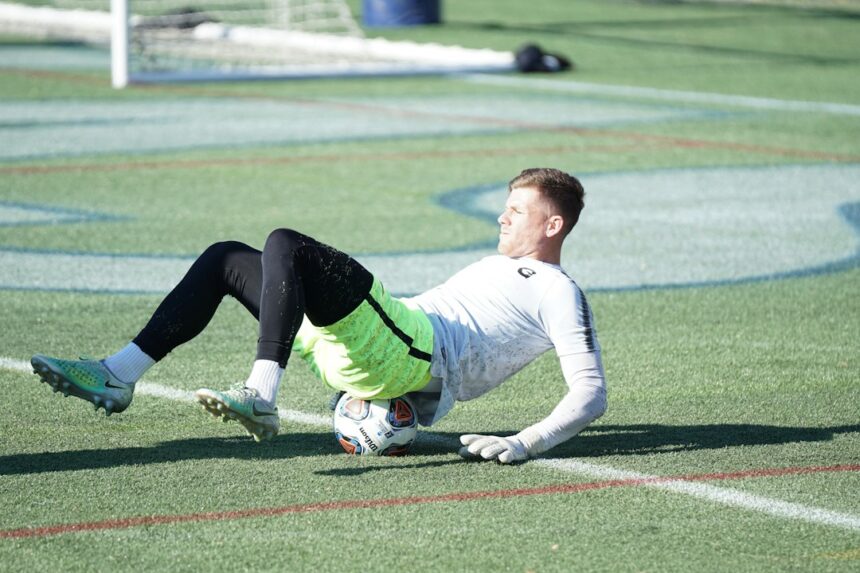
A six-week randomized comparison in 45 male football players found that a modified razor curl improved eccentric strength and posterior-chain endurance alongside the nordic hamstring exercise. The authors suggest the razor curl may work as a practical nordic hamstring alternative that allows more training volume.
Nordic Hamstring training has spent a decade as the default answer to hamstring injury prevention in football, and a trial published 5 November 2026 in BMC Sports Science, Medicine and Rehabilitation asks whether a different exercise can do the same job. Across six weeks, a modified razor curl produced gains in eccentric peak torque and trunk-hip endurance in competitive male players.
The study comes from Zait Burak Aktuğ, Büşra Çelebi, Serkan İbiş and Necdet Eray Pişkin at the Faculty of Sports Sciences, Niğde Ömer Halisdemir University, with Gönül Yavuz at Kahramanmaraş Sütçü İmam University. It was received 6 August 2026 and accepted 27 October 2026.
Forty-five licensed male football players aged 18 to 23 took part. Mean age was 19.17 plus or minus 1.28 years, mean height 177.11 plus or minus 5.05 cm and mean body weight 67.68 plus or minus 6.39 kg. Players were randomly assigned to one of three groups.
The control group continued football training only. A second group added the nordic hamstring exercise to that training. A third added the modified razor curl. Both exercise groups completed their assigned protocol three days a week for six weeks.
At a Glance
- Published 5 November 2026 in BMC Sports Science, Medicine and Rehabilitation, open access.
- 45 licensed male football players aged 18 to 23, randomized to control, nordic hamstring exercise, or modified razor curl.
- Both the nordic hamstring and razor curl protocols ran three days a week for six weeks alongside normal football training.
- Hamstring strength was measured with the H-Bord device; trunk-hip and core static endurance with the Superman test.
- Dominant-leg peak torque showed a group by time interaction of F = 21.61, p < 0.001, partial eta squared 0.50.
- Superman test performance showed F = 12.95, p < 0.001, partial eta squared 0.37.
- Bilateral strength difference showed no interaction: F = 1.11, p = 0.338, partial eta squared 0.049.
How the Nordic Hamstring Comparison Was Measured
Eccentric strength in both the nordic hamstring and razor curl groups was assessed with the H-Bord device, a field testing unit that records force during a lowering movement. Static endurance of the lower-back, hip and core muscles was measured with the Superman test. Both were taken before and after the six-week block.
The analysis used a two-way repeated-measures ANOVA, examining pre-to-post change and the group by time interaction. That interaction term is the number that matters: it tests whether the control, nordic hamstring and razor curl groups changed differently over the block, rather than whether any single group improved.
Four strength outcomes were tracked, covering peak torque and relative strength in both the dominant and non-dominant leg, plus bilateral strength difference and the Superman result. Relative strength expresses force against body weight, which matters in a sport where players carry their own mass through every sprint.
What the Modified Razor Curl Asks of a Player
The nordic hamstring exercise is a partner-assisted or anchored movement in which a kneeling athlete resists a slow forward fall, loading the hamstrings as they lengthen. It is effective and widely prescribed, but it is also demanding, and adherence in real squads has been a persistent problem.
The razor curl variation shifts hip position during the lowering phase, which changes how the load is distributed through the posterior chain. The research team’s interest was practical rather than theoretical: if a variation is easier to tolerate, players may complete more of it.
That framing explains why the comparison group was the nordic hamstring exercise rather than a generic leg curl. The question was not whether eccentric loading works, which is already well established, but whether a second movement reaches the same outcomes inside the same weekly schedule.
Why the Nordic Hamstring Exercise Became the Benchmark
Hamstring strains remain among the most common injuries in football, and they recur. The nordic hamstring exercise earned its place in warm-up programs because it loads the muscle in the lengthened position where high-speed running does the damage, and because it needs no equipment beyond a partner or an anchor.
Its weakness has always been compliance. The movement is uncomfortable, soreness after early sessions is common, and squads often drop it once the season tightens. Any trial that tests a nordic hamstring substitute is therefore testing a delivery problem as much as a physiological one.
Against that background, a comparable result from a different movement is more interesting than a marginally better one from the same movement. It gives a coach a second way to reach the same adaptation when the first option is being skipped.
Where Both Protocols Moved the Numbers
Significant group by time interactions appeared across the strength measures. Dominant-leg peak torque returned F = 21.61 with p below 0.001 and a partial eta squared of 0.50. Non-dominant-leg peak torque returned F = 20.96, p below 0.001, partial eta squared 0.49.
Relative strength moved further. The dominant leg returned F = 25.75, p below 0.001 and partial eta squared 0.54, while the non-dominant leg returned F = 24.04, p below 0.001 and partial eta squared 0.52. Superman test performance returned F = 12.95, p below 0.001 and partial eta squared 0.37.
Partial eta squared values of roughly 0.37 to 0.54 describe large shares of variance explained by the group by time interaction in this sample. The authors conclude that both the modified razor curl and nordic hamstring exercise protocols improved eccentric hamstring strength and trunk-hip extensor endurance.
The partial eta squared for the group by time interaction in dominant-leg relative strength, the largest effect reported across the four strength outcomes in this six-week trial.
The One Outcome That Refused to Move
Bilateral strength difference, the gap between a player’s two legs, showed no significant group by time interaction. The reported values were F = 1.11, p = 0.338 and partial eta squared 0.049.
That null result is worth sitting with. Side-to-side asymmetry is routinely treated as a screening target in football, yet six weeks of nordic hamstring or razor curl work did not measurably narrow it here. Both legs appear to have improved together rather than converging.
FLM has reported on how much weight that measure carries elsewhere, including a cohort in which isokinetic strength imbalance was linked to a 37.5 percent hamstring injury rate in rugby players. A protocol that builds strength without closing an imbalance leaves that question open.
Why a Nordic Hamstring Alternative Matters in Practice
The authors’ closing line is the pragmatic one: the modified razor curl may represent a practical alternative to the nordic hamstring exercise and allow a greater training volume. In squad settings, the exercise players actually finish tends to beat the one that is theoretically optimal.
That logic runs through a lot of recent applied work. Eccentric loading has a strong track record beyond injury prevention, and FLM has covered a review in which eccentric training added 2.92 cm to countermovement jump across 11 trials.
Rehabilitation research points the same way. A fourteen-trial review found that lengthening exercise cut hamstring return-to-play time by 28 days, which is the clearest evidence that how the hamstring is loaded changes outcomes that matter.
Reading This Outside a Football Squad
This was a performance trial in trained young men, not general fitness guidance. It measured strength and endurance over six weeks and recorded no injury data, so it cannot say that either exercise prevents anything. The sensible takeaways are modest and general rather than individual.
- Eccentric hamstring work appears to respond to six weeks of consistent exposure at three sessions a week.
- Variations exist; the nordic hamstring exercise is not the only route to eccentric loading.
- Strength gains and symmetry are separate outcomes, and this trial moved only the first.
- Load progression beats novelty, a theme FLM saw when velocity-based training matched traditional lifting in a 16-player football trial.
- Anyone with a current hamstring injury or a history of one should work with a qualified clinician rather than copying a research protocol.
What a coach can take from this is narrower than a headline suggests, and more useful. There is now randomized evidence that a second eccentric option produced comparable gains over six weeks, which widens the menu without discarding the nordic hamstring standard.
The Fitness Living Takeaway
Over six weeks in 45 male football players, a modified razor curl and the nordic hamstring exercise both improved eccentric hamstring strength and trunk-hip extensor endurance.
Effects on peak torque and relative strength were substantial, with partial eta squared values between 0.49 and 0.54, while bilateral strength difference did not change in any group. The authors frame the razor curl as a practical alternative that may permit greater training volume, not as a replacement proven superior. No injury outcomes were measured, and the sample was young, male and competitive, so the result is a starting point for coaches rather than a prescription.
Research & Sources
- BMC Sports Science, Medicine and Rehabilitation: modified razor curl and nordic hamstring exercises compared
- Study DOI
- Images: Jeffrey F Lin / Unsplash; Surby Subhadra / Unsplash
This article summarizes peer-reviewed research for general information and is not individualized medical or exercise advice.