
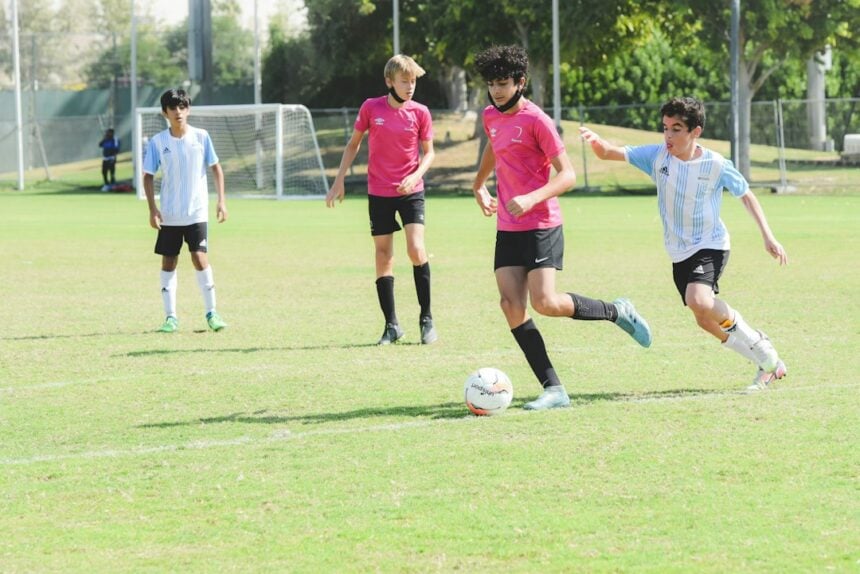
A nationally representative Slovenian project measured youth sport participation in two waves a decade apart. Organized club membership climbed sharply, yet the share of teenagers who had joined and then quit rose as well.
Youth sport participation among Slovenian adolescents rose by roughly 13 percentage points across ten years, according to an Original Research paper accepted on October 30, 2026 in Frontiers in Sports and Active Living. The analysis pooled 5,027 adolescents aged 11 to 18 and compared organized sport involvement in 2013 to 2014 against 2023 to 2024.
The work comes from the University of Ljubljana Faculty of Sport. Gregor Jurak, Nikola Todorovic, Bojan Leskosek and Gregor Starc drew on the Analysis of Children’s Development in Slovenia, known by its Slovenian acronym ACDSi, a repeated cross-sectional surveillance program that tracks youth sport participation and fitness in a nationally representative slice of the country’s school-age population.
Across the decade, organized youth sport participation moved from 50.4% of adolescents to 63.4%. The authors report that difference as statistically significant, with an odds ratio of 1.71 and a 95% confidence interval of 1.52 to 1.91. The increase appeared in both sexes and at both school levels examined.
Because the design is repeated cross-sectional rather than longitudinal, the paper describes a generational shift between two cohorts of teenagers rather than following the same children forward. That distinction matters for how the youth sport participation numbers should be read.
At a Glance
- Accepted October 30, 2026 in Frontiers in Sports and Active Living, Volume 8, as Original Research on youth sport participation.
- 5,027 adolescents aged 11 to 18, pooled across two nationally representative ACDSi waves in 2013 to 2014 and 2023 to 2024.
- Organized youth sport participation rose from 50.4% to 63.4%, odds ratio 1.71, 95% CI 1.52 to 1.91.
- Reported participation followed by discontinuation rose from 19.7% to 27.1% in the complete-case analysis.
- Adjusted weekly training volume among current participants rose from 4.26 to 4.99 hours at the lower school level, and from 4.71 to 5.30 hours at the upper level.
- Team sports remained the dominant category, with modest category shifts that were most visible among girls.
- Main caveat: participation-history data were incomplete for a substantial proportion of 2013 to 2014 non-participants, so the dropout comparison is the weakest figure in the set.
How the Slovenian Youth Sport Participation Survey Worked
ACDSi is a national monitoring effort rather than a one-off survey, which is why it can support a decade-scale comparison at all. For this paper the team used two waves and asked a simple question about each adolescent: were they currently involved in organized sport, had they been involved and stopped, or had they never taken part.
Alongside that status question, the researchers recorded weekly training volume for current participants, the sport category each adolescent belonged to, and a battery of physical fitness tests. Statistical handling used Pearson chi-square tests for differences between waves and general linear models for training volume and fitness outcomes.
Participants were grouped by ISCED 2 and ISCED 3 levels, the international classification tiers that correspond broadly to lower and upper secondary schooling. The published abstract does not spell out the Slovenian grades those tiers cover.
Youth Sport Participation Rose in Both Sexes
The headline figure is the move from 50.4% to 63.4%. An odds ratio of 1.71 means adolescents in the 2023 to 2024 wave had about 1.7 times the odds of being current participants compared with their counterparts a decade earlier, and the confidence interval of 1.52 to 1.91 does not come close to crossing 1.0.
The authors state that increases were present in both sexes and at both ISCED levels. The abstract does not break out separate percentages for girls and boys, so the size of any gap between them cannot be read from the published summary. What is clear is that the youth sport participation rise was not confined to one group.
Sport-category distribution also shifted, described by the authors as a modest change that was particularly evident among girls. Team sports stayed the largest category throughout. Fitness varied slightly across sport categories, with the clearest differences showing up in the standing long jump and the 60-meter sprint.
Youth sport participation among Slovenian adolescents in 2023 to 2024, up from 50.4% a decade earlier across a pooled sample of 5,027 young people.
Training Volume Climbed Alongside Membership
A larger share of teenagers in clubs could, in principle, mean a thinner average commitment, as casual joiners dilute the group. That is not what the adjusted figures show. Among current participants, weekly training volume rose from 4.26 to 4.99 hours at ISCED 2 and from 4.71 to 5.30 hours at ISCED 3.
Both school levels gained in the region of three quarters of an hour of weekly youth sport participation. The direction is what makes them interesting: more adolescents were taking part, and those taking part were training more, not less. Youth sport participation widened and deepened at the same time in this sample.
More Teenagers Had Already Quit a Club
The less comfortable result sits in the same dataset. In the complete-case analysis, adolescents who reported previous participation followed by discontinuation made up 27.1% of the 2023 to 2024 wave against 19.7% a decade earlier. More teenagers had been through a club and left it. That number is the mirror image of the youth sport participation headline, and it comes from the same survey question.
Mechanically, a rise in dropout and a rise in current membership can coexist: if more children enter organized sport in the first place, more will also have exited by any given age. The paper does not claim to separate those pathways, and the authors flag this specific comparison as the one to treat with caution.
Why Youth Sport Participation Prevalence Is Not the Whole Story
The practical argument the authors make is about measurement rather than about any single intervention. Their conclusion is that surveillance and policy should evaluate participation as a pathway, weighing retention, training exposure, sport-category composition and social inequalities alongside headline prevalence.
That framing is a useful corrective for anyone who reads a single percentage and calls it progress or decline. Two systems can report identical youth sport participation rates while one keeps most of its young athletes for years and the other churns through them. The pathway view asks how long youth sport participation lasts, not only whether it exists on the day of the survey.
It also reframes the dropout figure. If more adolescents are entering organized sport, retention becomes the harder and more useful target. A program that recruits well and holds nobody is not obviously better than one that recruits less and keeps more.
What Youth Sport Participation Data Means for Parents and Coaches
This is population surveillance from one country, not a trial of any particular coaching approach, so it cannot tell a family what to do on Tuesday evening. It does offer fair, general reference points for thinking about youth sport participation in a household or a club.
- Roughly five hours a week of club training was typical for participating Slovenian adolescents in the recent wave, which is a useful benchmark rather than a target.
- Leaving a sport is common and not a failure; more than a quarter of teenagers in the newer wave reported having stopped.
- Team sports remain the most common entry point, and category choice showed only modest differences in fitness measures.
- A child trying several sports before settling is consistent with the category shifts the authors describe.
For context from earlier FLM coverage, a separate analysis found that physical fitness was linked to better arithmetic fluency in 1,166 adolescents, while a Stockholm cluster trial reported that 3,751 children showed no activity gain from a six-month preschool activity policy. Both illustrate how far apart surveillance findings and intervention results can sit.
On the selection side, sports medicine researchers have argued that early talent selection may miss future elite athletes, which bears directly on retention. And a large Chinese survey found that exercise participation was linked to a better relative health position in 76,827 adults, a reminder of why adolescent habits draw this much attention.
The Fitness Living Takeaway
Organized youth sport participation in Slovenia rose from 50.4% to 63.4% across a decade, with weekly training volume among participants rising too.
The same dataset shows a larger share of teenagers who had joined and quit, and the authors warn that this dropout comparison rests on incomplete participation-history data. Because the design compares two cohorts rather than following individuals, it documents a generational shift without explaining its causes. The more durable lesson is the authors’ own: treat participation as a pathway with retention and training exposure attached, not as a single annual percentage.
Research & Sources
- Frontiers in Sports and Active Living: Generational Change in Slovenian Youth Sport Participation
- Study DOI
- Images: Alliance Football Club / Unsplash; Philippa Rose-Tite / Unsplash
This article summarizes peer-reviewed research for general information and is not individualized medical or exercise advice.