Two groups of trained lifters did the same eight weeks of squats and jumps, with only the training sequence reversed between them. Almost everything improved, and almost nothing separated the two orders.
Training sequence is one of the oldest arguments in strength coaching, and a randomised trial published 29 October 2026 in Frontiers in Physiology put it to a direct test: squats before jumps, or jumps before squats, across eight supervised weeks in resistance-trained men.
The work was carried out by Tingting Fu of the Faculty of Sports and Leisure at Guangdong Ocean University in Guangzhou, Ziang Zhang of the China College of Basketball at Beijing Sport University, and Jinchen Zhao and Faquan Li of the Department of Orthopedics at Wenzhou Central Hospital in Zhejiang. It appears in the Exercise Physiology section of the journal as Original Research.
Twenty-four resistance-trained men took part, with a mean age of 22 ± 2.1 years, height of 179.8 ± 3.5 cm and body mass of 70.4 ± 5.5 kg. All had at least three years of resistance-training experience. They were randomly assigned to one of two groups of twelve: a resistance-to-plyometric group, labelled RT–PT, and a plyometric-to-resistance group, labelled PT–RT.
Every outcome the researchers measured improved over the eight weeks. Only one measure showed any sign of being affected by training sequence, and that signal did not hold up once the analysis was adjusted for baseline differences.
At a Glance
- Published 29 October 2026 in Frontiers in Physiology, Exercise Physiology section, Volume 17; accepted 30 September 2026.
- Randomised controlled design, 24 resistance-trained men split into two groups of twelve, each with at least three years of lifting experience.
- 16 supervised sessions over eight weeks, two per week, with at least 72 hours between sessions; training sequence was the only difference between groups.
- Back-squat one-rep max rose by 10.2 kg (95% CI 7.5 to 13.0 kg) in RT–PT and 13.1 kg (95% CI 12.1 to 14.1 kg) in PT–RT.
- Vertical jump height improved 2.4 cm (95% CI 0.5 to 4.4 cm) in RT–PT and 2.7 cm (95% CI 1.8 to 3.6 cm) in PT–RT.
- No significant group-by-time interactions for jump height, relative peak power, standing long jump, 20-metre sprint time or T-test time.
- Main caveat: the single interaction that did reach significance for squat strength was not corroborated by the baseline-adjusted analysis.
How the Two Orders Were Built
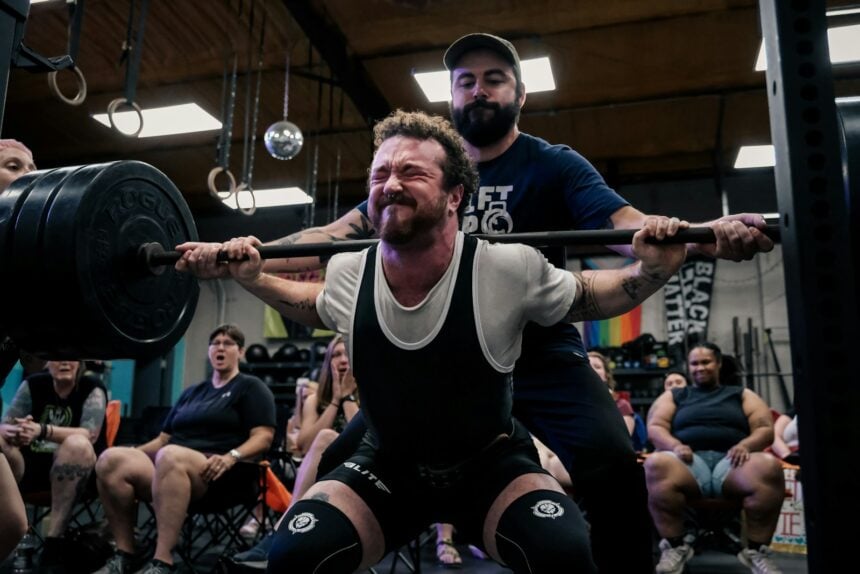
The protocol was deliberately spare. Participants completed 16 supervised training sessions over an eight-week period, with two sessions each week and at least 72 hours between them. The RT–PT group performed three back-squat repetitions at 85% of one-rep max, then three minutes of passive recovery, then four maximal countermovement jumps. The PT–RT group did the same work in the opposite training sequence.
Each session ran three rounds of back squats and countermovement jumps, with a four-minute passive recovery period between rounds. Training volume, relative intensity and recovery intervals were matched between groups, with exercise order representing the only difference. That matching is what makes the comparison a clean test of training sequence rather than a test of workload.
Where the Training Sequence Showed Up
One result separated the groups. A significant group-by-time interaction was observed for back-squat one-rep max, reported as F(1, 22) = 4.83, p = 0.039, with a partial eta squared of 0.180. The between-group effect was Hedges g = 0.87, with a 95% confidence interval of 0.01 to 1.73, favouring the group that jumped before it squatted.
Taken alone that looks like a verdict on training sequence. The authors did not treat it as one, and neither should readers, because of what happened when the same data were analysed a second way.
The Interaction That Did Not Survive Scrutiny
The effect was not corroborated by the baseline-adjusted ANCOVA, which returned p = 0.072. The Bonferroni-adjusted interaction value was p = 0.232. In plain terms: once the analysis accounted for the fact that the two groups did not start from the same place, and once it corrected for multiple comparisons, the training sequence advantage stopped being distinguishable from noise.
The raw change figures tell the same story. A 10.2 kg gain against a 13.1 kg gain sounds like a meaningful gap until you notice that the confidence interval on the Hedges g effect runs from 0.01 to 1.73, which is nearly the full range from nothing to large.
Supervised sessions each lifter completed across eight weeks, two a week with at least 72 hours of recovery between them.
Jump, Sprint and Agility Moved Together
Outside squat strength, the two orders were close to indistinguishable. Vertical jump height changes were 2.4 cm (95% CI 0.5 to 4.4 cm) in RT–PT and 2.7 cm (95% CI 1.8 to 3.6 cm) in PT–RT. Twenty-metre sprint time changed by −0.06 s (95% CI −0.08 to −0.05 s) and −0.07 s (95% CI −0.08 to −0.06 s) respectively.
Change-of-direction performance followed the pattern, with T-test times falling by 0.14 s in RT–PT and 0.16 s in PT–RT. No significant group-by-time interactions were found for jump height, relative peak power, standing long jump, 20-metre sprint or T-test time. Whatever training sequence does inside a session, it did not register in any of these outcomes over eight weeks.
Why Training Sequence Keeps Getting Tested
Acute studies have repeatedly found that a heavy set can temporarily raise jump output, which is why priming protocols are popular. FLM has reported on one such trial examining how velocity loss during a resistance priming set affected later jump performance. The acute effect is well documented; the open question has always been whether it compounds.
This trial suggests it may not. Eight weeks of putting the heavy set first produced no advantage over eight weeks of putting the jumps first, and in the unadjusted analysis the jumps-first order actually looked slightly better for squat strength. A within-session potentiation effect and a chronic training sequence effect are different claims, and the second one did not follow from the first here.
Readers who track jump testing will recognise the measurement problem underneath all of this, which FLM covered in a scoping review of countermovement jump protocols used to monitor fatigue. Jump height is a noisy outcome, and small trials have limited room to detect modest differences in it.
What 24 Trained Men Can and Cannot Settle
The design has real strengths: randomisation, supervision of every session, and matched volume, intensity and recovery so that training sequence was genuinely the only variable. What it does not have is scale, duration, or breadth of population, and the authors say so plainly rather than leaving readers to infer it.
There is also a definitional wrinkle worth noting. The authors acknowledge that the countermovement jump may not meet all definitions of a plyometric exercise, because it lacks a preceding flight phase. A trial using drop jumps or depth jumps might load the stretch-shortening cycle differently and produce a different answer on training sequence.
What Lifters Can Take From This
The authors own practical reading is unambiguous: both RT–PT and PT–RT can be used as practical training strategies to improve lower-body strength, and exercise sequence appears to be a secondary programming consideration. That is general guidance drawn from one small trial in trained young men, not individualised advice, and anyone with a current injury or medical condition should work with a qualified professional.
A few points follow reasonably from the results:
- If a session already includes heavy squats and maximal jumps, the training sequence between them is unlikely to be what decides your eight-week outcome.
- Volume, relative intensity and recovery were matched here for a reason; those variables are the ones with the stronger evidence behind them.
- Three minutes between the squat set and the jumps, and four minutes between rounds, is a lot of rest by general gym standards, and it was built in deliberately.
- Order may still matter for what you want to execute well in a given session, which is a skill and quality argument rather than an adaptation argument.
For context on how much jump and sprint improvement other modalities deliver over similar timeframes, FLM has covered a meta-analysis of eccentric training for explosive power and jumping and a trial of suspension training for jump and sprint outcomes in adolescents. Against those comparisons, a training sequence decision looks like a small lever.
The Fitness Living Takeaway
Reversing the training sequence of heavy squats and maximal jumps across eight weeks produced no clear advantage for either order in 24 resistance-trained men.
One interaction favoured the jumps-first group for squat strength, but it did not survive baseline adjustment (p = 0.072) or correction for multiple comparisons (p = 0.232), and the effect interval stretched from essentially zero to large. With twelve men per group and a single eight-week configuration, this trial narrows the training sequence question rather than closing it, and it points attention back toward volume, intensity and recovery.
Research & Sources
- Frontiers in Physiology: Effects of an 8-week resistance-to-CMJ training sequence on lower-body strength and countermovement-jump performance in resistance-trained men
- Study DOI
- Frontiers in Physiology: recently published articles
- Images: Aiden Craver / Unsplash; Luke Aguaita / Unsplash
This article summarizes peer-reviewed research for general information and is not individualized medical or exercise advice.