
A systematic review pooled 30 training studies to ask how much resistance training actually moves the reactive strength index, the standard gauge of fast, springy force production. The answer was a small but consistent gain, and no single style of training owned the reactive strength index outright.
Reactive Strength Index improvements from resistance training are real but modest, according to a systematic review and meta-analysis published on November 16, 2026 in Sports, an open access journal from MDPI.
The review was led by Luke W. Garganis with Charlie J. Davids, Scott W. Talpey, Minh Huynh and Lachlan P. James. Garganis, Davids, Talpey and James work at the Centre for Sport and Human Performance Research at La Trobe University in Melbourne; Huynh is in the Department of Econometrics and Business Statistics at Monash University.
Their search of Web of Science, SPORTDiscus and PubMed, run in January 2026, returned 30 eligible studies supplying 48 separate intervention arms. Every study tested healthy adults in structured resistance training lasting at least four weeks and reported the reactive strength index derived from a bilateral drop jump under fast stretch-shortening cycle conditions.
Across those 48 arms, the pooled change was g = 0.42, with a 95% confidence interval of 0.26 to 0.58 and p less than 0.001. That is a small-to-moderate improvement by conventional standards, and it is the headline number the review contributes.
At a Glance
- Published November 16, 2026 in Sports, volume 14, issue 11, article 524, under DOI 10.3390/sports14110524.
- Systematic review and meta-analysis of 30 studies providing 48 resistance training intervention arms in healthy adults.
- Interventions ran at least four weeks and reported bilateral drop jump measures of the reactive strength index.
- Pooled change was g = 0.42, 95% confidence interval 0.26 to 0.58, p less than 0.001.
- By modality: plyometric 0.59, combined 0.52, ballistic 0.41, strength 0.31, with no evidence of a difference between them at p = 0.583.
- Databases searched were Web of Science, SPORTDiscus and PubMed, in January 2026.
- Main caveat: funnel asymmetry suggested small-study effects, and a trim-and-fill adjustment pulled the pooled reactive strength index estimate down to g = 0.27.
What the Reactive Strength Index Measures
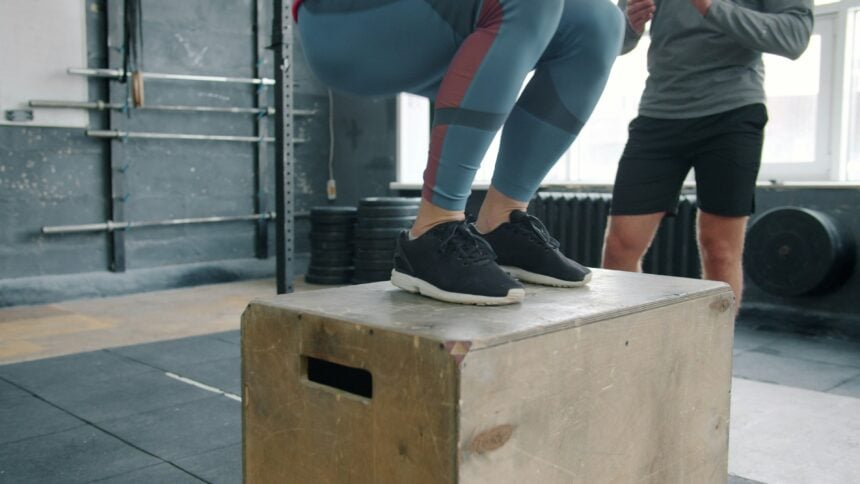
The reactive strength index describes how rapidly an athlete produces force during fast stretch-shortening cycle actions, and it is most often calculated from a drop jump. The athlete steps off a box, lands, and rebounds as quickly and as high as possible.
That single movement captures something a maximum squat does not. It rewards short ground contact and a stiff, well-timed rebound rather than raw force output, which is why sprinting, cutting and jumping sports lean on it as a monitoring tool.
Because the test is specific, the review restricted itself to bilateral drop jumps performed under fast conditions. Keeping the measurement consistent is what makes pooling 48 arms defensible, though it also narrows the question to one version of the reactive strength index.
How the Review Was Assembled
Studies qualified if they put healthy adults through structured resistance training for four weeks or more and reported drop jump outcomes. The authors then sorted each intervention arm into one of four categories: plyometric, ballistic, strength, or combined.
That classification used a threshold rather than a judgment call. An arm was labelled with a modality only when at least 60 percent of its exercises fitted that category, which keeps the grouping transparent but can still misfile a genuinely mixed program.
Pooling 48 arms rather than 30 studies matters too. Several trials ran more than one training group, and counting each arm separately lets the review compare modalities directly inside the same analysis instead of across studies with different athletes, seasons and testing equipment.
The pooled change in reactive strength index across 48 intervention arms, with a 95% confidence interval of 0.26 to 0.58.
No Training Modality Clearly Led
The modality comparison is the part coaches will look at first, and it is less decisive than expected. Plyometric arms posted the largest pooled change at 0.59, followed by combined at 0.52, ballistic at 0.41 and strength at 0.31.
Those figures line up with intuition. But the formal test for a difference between modalities returned p = 0.583, meaning the review found no evidence that one approach outperforms another for the reactive strength index once the usual statistical uncertainty is accounted for.
The authors offer a reading rather than a ranking: the largest changes may reflect training that closely matches the mechanical and temporal demands of the test itself. Plyometric work looks like a drop jump, so it is unsurprising that it scores well on one.

Why the Pooled Estimate Shrank Under Scrutiny
Meta-analyses routinely test whether small studies with flattering results are over-represented in the literature. Here the funnel plot was asymmetric, which the authors read as evidence of small-study effects.
Applying a trim-and-fill correction pulled the pooled estimate from g = 0.42 down to g = 0.27. That is a meaningful haircut: it moves the finding from small-to-moderate toward small, and it is the number a cautious reader should keep in mind.
Small-study effects are an ordinary hazard in training research, where a study of fourteen athletes is normal and a null result is harder to publish than a positive one. The correction does not prove any individual study was wrong; it estimates what the pooled picture would look like if the missing null findings were present.
For a practitioner the implication is simple enough. Expect the smaller figure, plan for the smaller figure, and treat any reactive strength index gain beyond it as a pleasant surprise rather than the baseline promise of the method.
What the Spread Means for Reactive Strength Index Gains
Total heterogeneity came in at 48.9 percent, which is moderate. More telling is the 95 percent prediction interval, which ran from -0.27 to 1.11. That interval describes where the result of a new, similar study would be expected to land.
Its lower end is below zero. In plain terms, the review expects the average program to improve the reactive strength index, while accepting that some programs in some settings will produce no gain at all, or a small decline.
This is the familiar gap between an average effect and an individual outcome. It argues for measuring rather than assuming, which is exactly what the reactive strength index was built to do.
Where It Sits Alongside Other Jump Research
The picture is consistent with neighbouring work. A separate meta-analysis published on November 3, 2026 in Frontiers in Physiology pooled 12 studies of 326 volleyball athletes and found standalone plyometric training improved countermovement jump height by g = 0.55, about 2.4 centimetres, with a 95% confidence interval of 1.6 to 3.3 centimetres.
Fitness Living Magazine has covered the same territory from other angles, including evidence on eccentric training and explosive jump power and on plyometric training and match running in young soccer players. Both suggest modest, real gains rather than transformations.
Measurement matters as much as method. Work on countermovement jump testing under fatigue shows how easily a jump score moves for reasons unrelated to training, and research on resistance priming and jump performance shows how sensitive these outputs are to what happened in the preceding hours.
How Coaches Might Read This
Nothing in this review tells an individual athlete what to do, and a pooled average cannot replace a training decision. It does narrow the argument usefully: if no modality is statistically ahead, the choice can rest on cost, skill level, injury history and what an athlete will actually complete.
- Pick the modality the athlete can perform well. The review gives no statistical reason to prefer one over another for the reactive strength index.
- Hold the programme to at least four weeks, since that was the minimum duration for inclusion.
- Test the way you train. The drop jump is a specific skill, and gains partly reflect familiarity with the test.
- Treat the trim-and-fill figure of g = 0.27 as the conservative expectation rather than the headline g = 0.42.
Landing-intensive work carries real load. Athletes returning from lower-limb injury, and anyone new to jump training, should build exposure gradually and under qualified supervision. This article is general information and not individualized medical or training advice.
The Fitness Living Takeaway
Across 30 studies and 48 intervention arms, resistance training produced a small pooled improvement in the reactive strength index of g = 0.42, and no modality was statistically ahead of the rest.
The honest version is more cautious still: correcting for small-study effects pulls the estimate to g = 0.27, and the prediction interval allows for no benefit at all in some settings. Plyometric work led the ordering without winning the statistical comparison, which makes athlete suitability a better basis for choosing than the league table.
Research & Sources
- Sports: Resistance Training and Drop Jump Derived Reactive Strength Index, a systematic review and meta-analysis of training modality effects
- Study DOI: 10.3390/sports14110524, published November 16, 2026 in Sports, volume 14, issue 11, article 524.
- Frontiers in Physiology: standalone plyometric training and countermovement jump and sprint performance in volleyball athletes
- Images: Vitaly Gariev / Unsplash; Eduardo Cano Photo Co. / Unsplash
This article summarizes peer-reviewed research for general information and is not individualized medical or exercise advice.