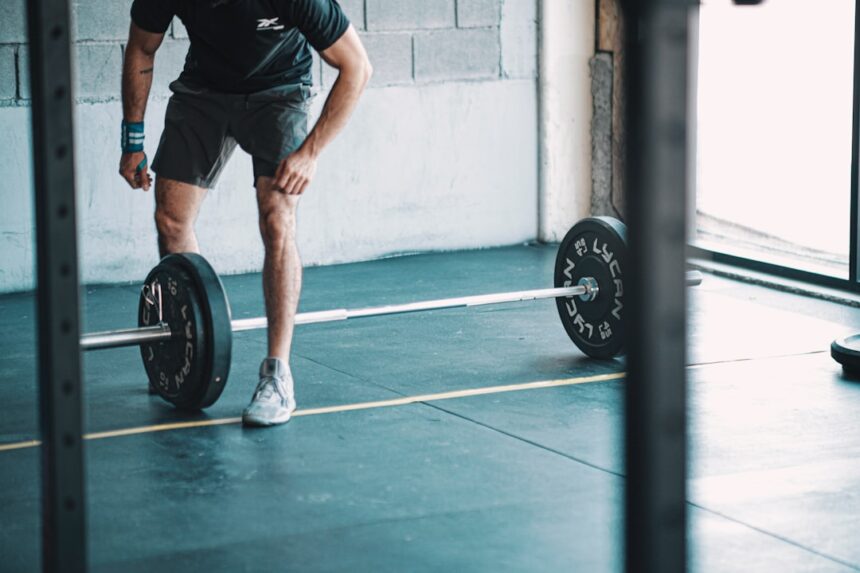
A new study in resistance-trained athletes found that a single generalized bar-speed threshold estimated deadlift one-repetition maximum with relatively low error in both men and women, offering a practical option for velocity-based strength testing.
Deadlift 1RM velocity methods aim to estimate maximal strength without requiring a lifter to repeatedly attempt a true one-repetition maximum. Research published September 10 in BMC Sports Science, Medicine and Rehabilitation tested four minimal-velocity-threshold approaches in 70 resistance-trained athletes.
The sample included 35 men and 35 women. Each athlete completed two identical sessions separated by 72 hours, working through submaximal loads at 40%, 60%, 80% and 90% of estimated 1RM before directly testing the deadlift maximum.
The most practical finding was a generalized optimal minimal velocity threshold of 0.36 meters per second. That threshold was the same in men and women and produced low absolute prediction errors without significant systematic bias.
At a Glance
- The study was published September 10, 2026.
- Seventy resistance-trained athletes participated: 35 men and 35 women.
- Each athlete completed two deadlift-testing sessions separated by 72 hours.
- A generalized optimal minimal velocity threshold of 0.36 m/s estimated 1RM with median absolute errors of about 3.2% to 3.7%.
- An individualized optimal threshold reduced median error to 1.8%, but its reliability was less consistent, particularly in women.
- The study was short-term and did not test whether the threshold remains stable across a full training cycle.
What a Minimal Velocity Threshold Means
As a barbell gets heavier during a maximal-effort lift, concentric velocity generally slows. Velocity-based training systems use that relationship to estimate how close a lifter is to maximum strength.
A minimal velocity threshold is the bar speed associated with a true 1RM attempt. If that threshold is reliable, a coach can build a load-velocity profile from submaximal lifts and estimate 1RM without requiring a maximal lift every time.
The challenge is that the threshold can vary between lifters, exercises and testing sessions. The new study directly compared individualized and generalized approaches to see which offered the best balance of accuracy and practicality.
was the generalized optimal minimal velocity threshold identified for the free-weight deadlift in both sexes. Using it produced low absolute error without a detectable sex effect on prediction accuracy.
The General Threshold Was Not the Most Precise — but It Was Practical
The individualized optimal minimal velocity threshold produced the lowest median absolute error at 1.8%. However, it requires prior maximal testing to establish each lifter’s own threshold, which reduces its appeal if the goal is to avoid frequent 1RM testing.
The generalized 0.36 m/s threshold produced median absolute errors of roughly 3.2% to 3.7% and showed no significant systematic bias. The researchers also found no significant sex effect on prediction accuracy.
By contrast, the actual minimal-velocity-threshold models significantly overestimated 1RM. That distinction matters because not every velocity-based shortcut performed equally well.
Fitness Living recently reported that six weeks of isometric resistance training increased maximal and rapid force in a small study. The new deadlift research addresses a different problem: how to measure strength efficiently without turning every assessment into a maximal test.
Why the Individualized Method Still Deserves Caution
The individualized optimal threshold was more accurate on average, but reliability was not equally strong across the sample. It met the study’s prespecified between-session reliability criteria only in men, and the researchers found heteroscedasticity in women.
That means prediction error was not perfectly uniform across female participants. It is one reason the generalized threshold may be preferable when consistency and simplicity matter more than squeezing out the smallest possible error.
The 95% limits of agreement for the individualized method were still wide enough to matter for strong lifters: approximately -11.0 to 13.0 kg in men and -9.4 to 8.7 kg in women. An estimate can be useful without being interchangeable with a direct maximal test.
Velocity-based estimates depend on reliable bar-speed measurement, standardized technique and maximal intent during submaximal lifts. Consumer devices and inconsistent setup can introduce additional error that was not the main focus of this laboratory-style protocol.
What the Study Cannot Tell Us Yet
The design covered only two testing sessions separated by 72 hours. It does not establish that the same threshold remains accurate after months of training, fatigue, peaking, detraining or major changes in technique.
The participants were resistance-trained athletes, so the findings should not automatically be extended to novice lifters, older adults, rehabilitation settings or lifters using substantially different deadlift styles and equipment.
The authors specifically called for longitudinal work to examine how optimal minimal velocity thresholds change across a training cycle.
What Lifters Can Take From It
For coaches and lifters who already use a reliable linear transducer or velocity sensor, the study supports 0.36 m/s as a reasonable generalized reference point for estimating free-weight deadlift 1RM in trained adults.
It should be treated as an estimate, not a replacement for judgment. If programming decisions hinge on a few kilograms, a direct test or individualized profile may still be warranted.
Fitness Living has also covered how resistance training produced especially large protein changes in type II muscle fibers. Together, the research reinforces a broader point: strength training can be measured and programmed with increasing precision, but the tools are only as useful as the assumptions behind them.
The Fitness Living Takeaway
In 70 resistance-trained athletes, a generalized 0.36 m/s bar-speed threshold estimated deadlift 1RM with low error in both men and women.
The method was practical and unbiased on average, but it is still an estimate. Individualized thresholds were slightly more accurate yet less consistently reliable, and the study did not test whether either approach stays stable over a long training cycle.
Research & Sources
- BMC Sports Science, Medicine and Rehabilitation: Minimal velocity threshold and deadlift 1RM estimation
- Study DOI
- Image: Eduardo Cano Photo Co. / Unsplash
This article summarizes peer-reviewed research for general information and is not individualized strength-testing or training advice.